
A glass lamp shade supplier plays a critical role in ensuring that lighting products meet both functional and visual requirements across residential and commercial applications. Beyond appearance, glass lamp shades directly influence light diffusion, thermal behavior, and long-term durability.
Within modern lighting supply chains, a glass lamp shade supplier acts as the link between design intent and manufacturable components. Their ability to coordinate with a glass lamp shade manufacturer determines whether a design can be consistently reproduced at scale. This makes supplier capability a defining factor in project success rather than a simple sourcing decision.
Glass Lamp Shade Supplier and Glass Lamp Shade Manufacturer Coordination
A professional glass lamp shade supplier does not operate independently of production. Instead, effective suppliers maintain structured coordination with a glass lamp shade manufacturer to align specifications, tolerances, and production methods.
This coordination is essential because lighting-grade glass requires tighter control than decorative glass alone. Wall thickness, edge finishing, and dimensional consistency all affect installation safety and light output.
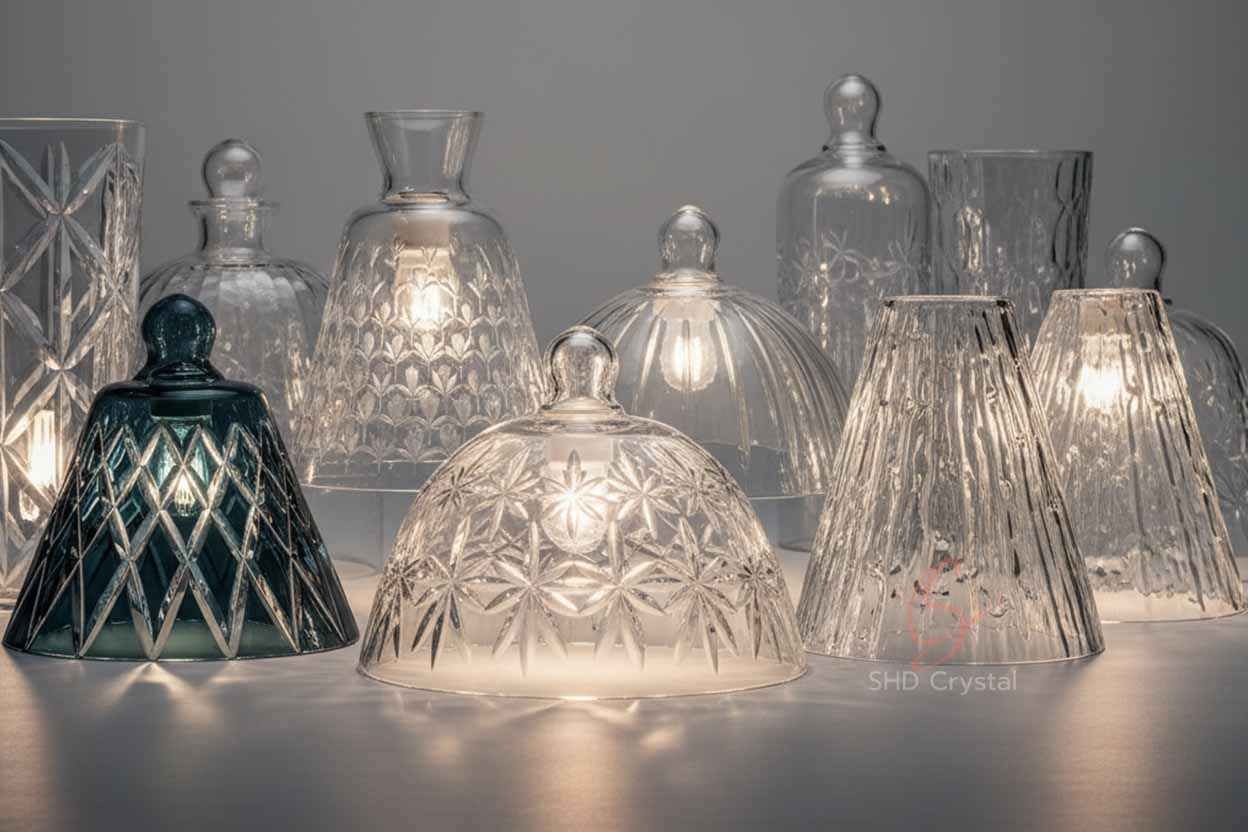
For projects involving custom glass lamp shades, this relationship becomes even more critical. Suppliers often manage communication between design teams and manufacturing units, ensuring that prototypes, revisions, and final production remain aligned. This reduces the risk of deviation between approved samples and delivered batches.
What A Glass Lamp Shade Supplier Provides Beyond Products
A capable glass lamp shade supplier contributes practical knowledge that extends beyond supplying components.
In hospitality and commercial lighting environments, glass lamp shades must withstand frequent use, cleaning, and environmental variation. Suppliers familiar with these conditions can recommend appropriate material thickness, surface treatments, and forming methods based on real application scenarios.
For custom glass lamp shades, suppliers also structure the development process. This includes mold planning, sample validation, and batch consistency tracking. Rather than treating customization as a one-off task, experienced suppliers build repeatable workflows that support long-term product programs.
This operational support often determines whether a design remains viable after initial sampling.
Common Misunderstandings When Selecting Suppliers
One frequent misconception is that any supplier offering glass products can support lighting applications. In reality, a qualified glass lamp shade supplier must understand both glass behavior and lighting requirements.
Working with a supplier connected to an experienced glass lamp shade manufacturer ensures that factors such as heat resistance, structural integrity, and optical performance are addressed during production.
Another misunderstanding relates to lead time. While custom glass lamp shades involve additional steps, suppliers with established manufacturing coordination can streamline development through existing tooling experience and standardized processes.
This reduces unnecessary delays without compromising quality.
Practical Evaluation Criteria for Lighting Projects
Selecting a reliable glass lamp shade supplier requires evaluating consistency, not just initial samples.
Reviewing multiple batches reveals how well a supplier and their partnered glass lamp shade manufacturer maintain dimensional accuracy and finish quality over time. This is especially important for projects requiring uniform installations.
Packaging capability is another critical factor. Glass lamp shades must be protected according to their geometry and fragility. Suppliers experienced in export logistics typically design packaging systems that reduce breakage risk during transit.
Clear technical communication is equally important. A supplier capable of providing drawings, tolerances, and structured feedback helps reduce production errors—particularly for custom glass lamp shades with non-standard forms.
Conclusion
Choosing the right glass lamp shade supplier involves more than comparing cost. It requires assessing coordination with a glass lamp shade manufacturer, understanding of lighting-grade requirements, and the ability to support projects throughout development and production.
Suppliers with stable manufacturing integration contribute to consistent quality, predictable timelines, and reduced project risk.
For businesses developing new lighting collections, working with an experienced glass lamp shade supplier helps align design intent with manufacturing feasibility. Early collaboration improves decision-making when creating custom glass lamp shades intended for long-term application and consistent production.
SHD Crystal Glass Lamp Shade OEM Manufacturing Capability
In lighting projects where consistency and customization are critical, SHD Crystal operates as a specialized OEM partner supporting both suppliers and brands. As a manufacturer experienced in producing custom glass lamp shades, we work closely with project stakeholders to ensure that design requirements translate into stable production outcomes.
Our capability covers forming process selection, thickness control, and finishing consistency—factors that directly influence light diffusion and structural performance. By maintaining controlled coordination similar to a professional glass lamp shade supplier working with a reliable glass lamp shade manufacturer, we ensure alignment between prototypes and mass production.
From hospitality lighting programs to decorative residential fixtures, SHD Crystal supports scalable manufacturing with strict quality control, enabling clients to deliver lighting products that balance visual refinement with functional reliability.