
Blogpost keywords: glass lamp shade manufacturer, custom glass lamp shades, glass lamp shade supplier
As a glass lamp shade manufacturer, we have learned that a lamp shade is never just a cover for light. It is the point where light becomes visible, where structure meets atmosphere.
At SHD Crystal, we do not begin with dimensions—we begin with how light should feel. Soft, diffused, directional, dramatic. Every custom glass lamp shade we produce is shaped around this intention. The form is not applied afterward. It is inherent to the process of making.
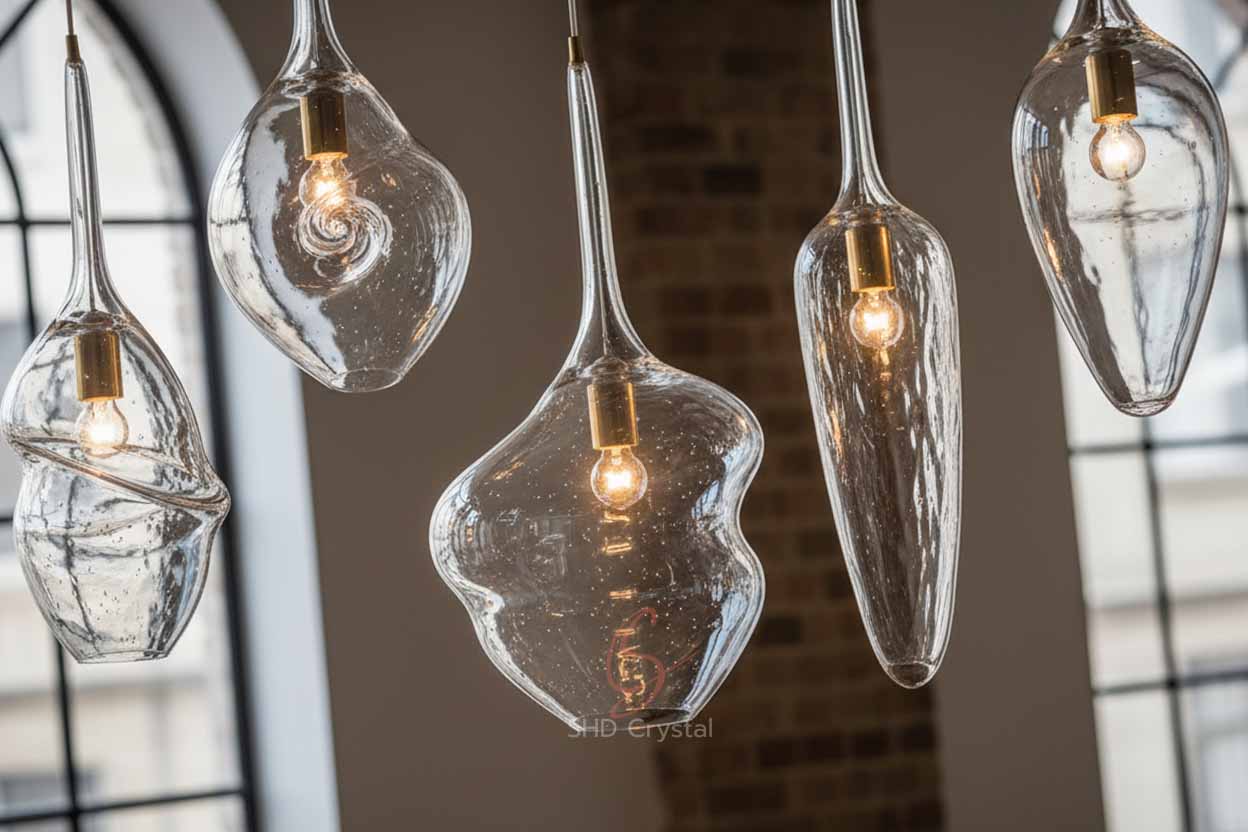
Blown glass, in particular, allows this relationship between light and form to emerge naturally. It carries subtle variations, controlled asymmetry, and a sense of movement that rigid forming methods cannot replicate.
A Glass Lamp Shade Manufacturer Working with Molten Form
When we shape glass, we are not forcing it into geometry. We are working with a material that is temporarily fluid.
In hand-blown production, the glass expands under air pressure, gravity, and rotation. This creates forms that are slightly alive—never perfectly mechanical, but never uncontrolled either.
This is where many misunderstand a glass lamp shade manufacturer. Precision does not mean uniformity. It means knowing how far variation can go before it disrupts function.
A well-made custom glass lamp shade holds this balance. Its thickness remains stable, its opening aligns precisely with fixtures, yet its surface and silhouette retain a sense of hand-shaped identity.
Why Blown Glass Creates More Expressive Lighting Forms
Molded glass can deliver consistency. Blown glass delivers character.
For lighting, this distinction matters. A blown shade allows light to travel through subtle variations in thickness, creating gradients rather than flat illumination. Edges may glow slightly more, curves may soften the beam, and internal reflections add depth to the light itself.
This is why many designers choose a glass lamp shade manufacturer capable of blown techniques when developing signature collections. The goal is not just to produce light—but to give it presence.
From Shape to Language: Designing Custom Glass Lamp Shades
Every project begins with a question: what role should the lamp shade play in the space?
Some designs require restraint—clean forms that disappear into architecture. Others demand expression—sculptural silhouettes that become focal points.
As a glass lamp shade supplier, we translate these intentions into manufacturable forms. This involves adjusting proportions, refining curvature, and controlling how the glass transitions from neck to body.
In larger projects, consistency becomes part of the design language. Multiple units must align visually, even when each piece carries slight variation from the blowing process. This is where production discipline supports artistic intent.
Key Factors That Define High-Quality Lamp Shade Production
- Wall thickness consistency without visual heaviness
- Precision at mounting edges and openings
- Controlled light diffusion through material and form
- Surface refinement, including subtle texture or clarity
- Repeatability across batches without losing character
These factors determine whether a glass lamp shade manufacturer delivers lighting components or design elements.
Common Misconceptions About Glass Lamp Shades
One common assumption is that all glass shades behave the same if dimensions match. In reality, small differences in thickness or curvature can significantly affect light distribution.
Another misconception is that handmade glass cannot be consistent. In practice, experienced manufacturers control variation within a defined range, ensuring both individuality and reliability.
There is also a tendency to separate design from production. When these are disconnected, forms may look appealing in concept but become difficult to produce or install.
Practical Considerations from a Manufacturer‘s Perspective
From our experience as a glass lamp shade supplier, early alignment between design and production is critical.
Details such as mounting tolerance, fixture compatibility, and packaging are often overlooked during initial design stages. However, they directly affect installation efficiency and product durability.
We also advise reviewing multiple samples rather than a single prototype. This reveals how custom glass lamp shades behave across production, not just in isolated cases.
Conclusion
Being a glass lamp shade manufacturer is not only about producing components. It is about shaping how light interacts with form.
Through custom glass lamp shades developed with blown glass techniques, lighting becomes more than illumination. It becomes part of the spatial experience—subtle, expressive, and continuously responsive to its environment.
Where Craft Meets Scalable Lighting Production
At SHD Crystal, we approach glass lamp shade manufacturing as a balance between craftsmanship and production control.
We specialize in custom glass lamp shades formed through blown glass processes that preserve sculptural qualities while ensuring structural stability. As a glass lamp shade supplier, we support projects that require both artistic expression and repeatable production.
From concept development to batch delivery, our goal is to ensure that each piece carries the intended form, light behavior, and material clarity—without losing the character that defines handmade glass.