
Blogpost keywords: custom glass artwork, handcrafted glass art, bespoke glass design
Custom glass artwork changes how a space is experienced by introducing light interaction, material depth, and visual movement into the environment. Unlike standardized decorative products, custom glass artwork is developed in response to a specific interior context, allowing the piece to interact with architecture, circulation, and atmosphere rather than existing as an isolated object. In contemporary interiors, handcrafted glass art is increasingly used not only for decoration, but for shaping how a space feels and functions.
Custom Glass Artwork and the Formation of Spatial Identity
In modern interiors, materials are often selected not only for appearance, but for the atmosphere they create. Custom glass artwork contributes to this by responding dynamically to light and perspective.
As natural or artificial light changes throughout the day, reflections and transparency shift across the surface of the glass. This movement gives handcrafted glass art a sense of presence that static materials cannot easily achieve.
Because of this, bespoke glass design is frequently used in spaces where identity and atmosphere are closely connected, including hospitality environments, galleries, and private residences designed around visual experience.
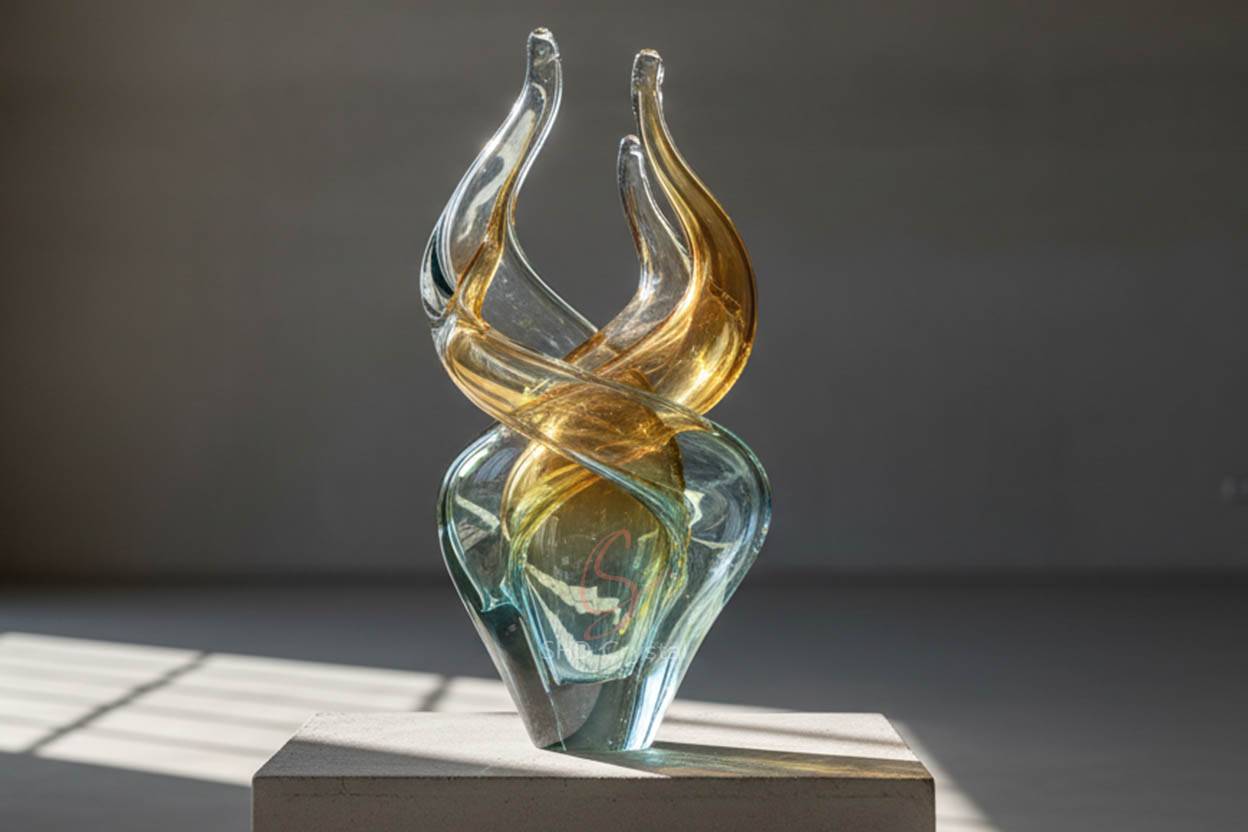
Handcrafted Glass Art as a Material With Movement
One of the defining characteristics of handcrafted glass art is its ability to appear visually different depending on viewing angle and lighting condition. Transparency, color density, and surface texture influence how the material behaves within a space.
Some installations diffuse light softly, while others create concentrated reflections or layered shadows. In custom glass artwork, these effects are often more important than decorative pattern alone.
This quality allows bespoke glass design to function as an active visual element rather than a passive decorative accessory.
Bespoke Glass Design and Architectural Integration
Unlike mass-produced décor, bespoke glass design is often developed alongside architectural planning. Scale, proportion, and placement are adjusted according to the dimensions and circulation of the environment.
Large sculptural pieces may define an entry sequence, while suspended glass installations can draw attention upward and reshape spatial perception. Wall-mounted custom glass artwork may also interact with surrounding materials such as stone, wood, or metal to create contrast and visual balance.
Because handcrafted glass art responds strongly to lighting, placement decisions become part of the design process itself.
Why Material Authenticity Matters
A common misconception is that visual impact comes primarily from complexity or ornamentation. In reality, the effect of custom glass artwork often depends on restraint and material authenticity.
Subtle curvature, layered transparency, and controlled color transitions can create stronger spatial presence than excessive decoration. Handcrafted glass art achieves this through variation in thickness, texture, and forming behavior rather than through surface graphics alone.
This is one reason bespoke glass design remains relevant in contemporary interiors where natural materials and tactile qualities are increasingly valued.
Long Term Relevance Beyond Trends
Unlike decorative objects tied to short-term styles, custom glass artwork is often designed as a long-term spatial feature. Its visual effect changes with environment and lighting, allowing the piece to remain engaging over time.
Handcrafted glass art also supports durability when properly annealed and finished. In many projects, bespoke glass design becomes part of the architectural identity of the space itself rather than an interchangeable accessory.
For this reason, designers frequently integrate custom glass artwork early in the planning process instead of treating it as a final decorative addition.
Conclusion
Custom glass artwork transforms interiors by combining material depth, light interaction, and spatial presence. Through handcrafted glass art and carefully developed bespoke glass design, glass becomes more than decoration—it becomes part of how a space communicates atmosphere, identity, and experience.
Glass Artwork Developed for Spatial Experience
At SHD Crystal, we create custom glass artwork for interiors, hospitality projects, and architectural environments where material presence and visual atmosphere play a defining role. Our approach to handcrafted glass art focuses on how light, transparency, and form interact within real spaces rather than on decoration alone.
Through bespoke glass design, we support custom development in scale, texture, color layering, and sculptural form, allowing each piece to respond naturally to its surrounding environment while remaining suitable for long-term installation and use.