
Blogpost keywords: glass wash basins factory, furnace cycle management, yield rate optimization
Glass wash basins factory production with furnace cycle management and yield rate optimization for large-scale supply and consistent product quality.
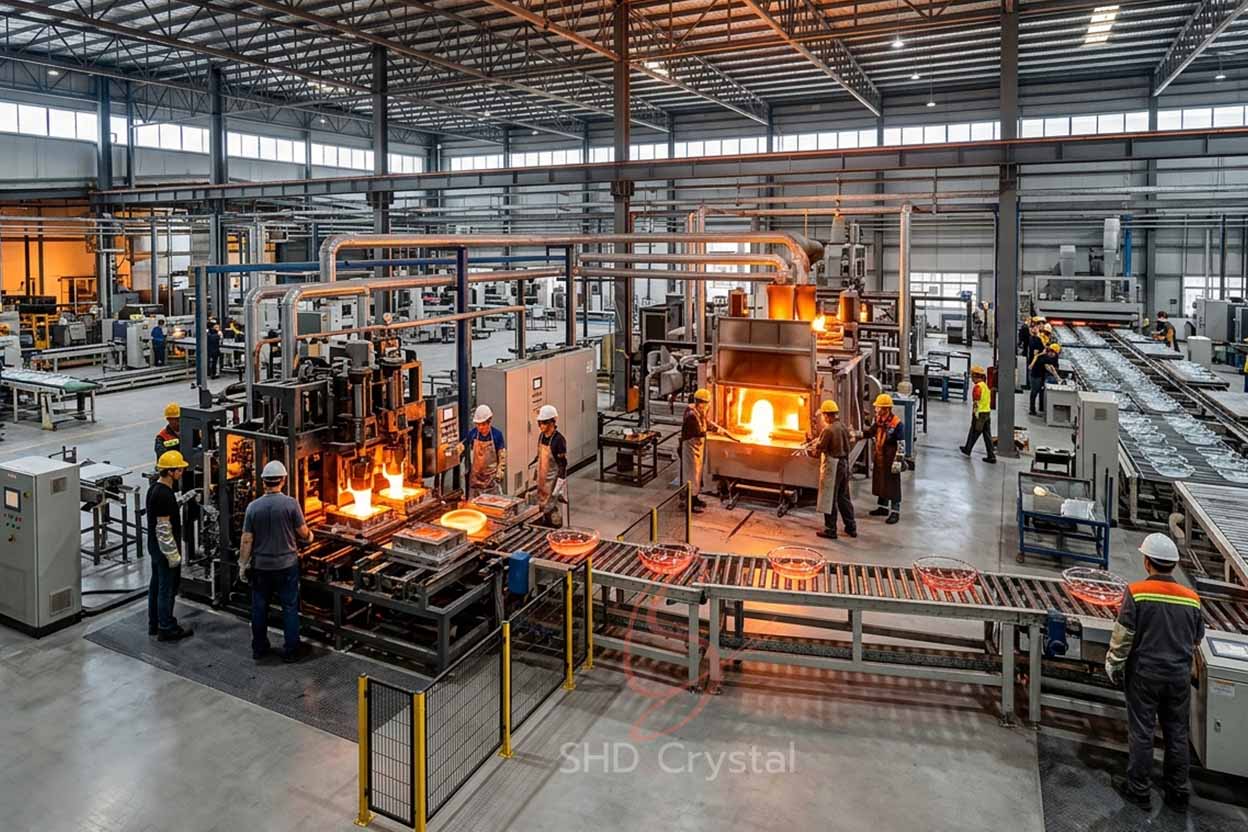
Industrial Logic Behind a Glass Wash Basins Factory
A glass wash basins factory operates on process stability rather than isolated craftsmanship. Unlike small workshops, factory-scale production depends on synchronized systems where temperature, timing, and material flow must remain consistent across continuous output.
For buyers and project developers, selecting a glass wash basins factory means evaluating not only design capability but also production reliability. Facilities that prioritize furnace cycle management and systematic yield rate optimization are better positioned to deliver consistent quality at scale.
This industrial structure ensures that every basin meets the same performance and dimensional standards.
Continuous Production and Thermal Rhythm
At the core of any glass wash basins factory is the furnace system. Glass forming relies heavily on controlled heating and cooling, which must follow a precise rhythm to maintain material stability.
Through furnace cycle management, manufacturers regulate temperature fluctuations, melting consistency, and forming intervals. This reduces internal stress within the material and ensures that each basin achieves uniform structural properties.
Disruptions in the furnace cycle can lead to defects such as distortion or uneven thickness. Maintaining a stable thermal process is therefore essential for both quality and efficiency.
At the same time, controlled cycles support smoother transitions between production stages, improving overall workflow.
Optimizing Output Without Compromising Quality
Large-scale production introduces the challenge of balancing quantity with consistency. A professional glass wash basins factory must ensure that increasing output does not lead to higher defect rates.
This is where yield rate optimization becomes critical. By analyzing production data and identifying inefficiencies, manufacturers can reduce waste and improve overall productivity.
For example, refining forming parameters or improving cooling consistency can significantly increase the number of usable units per production cycle.
In practical terms, this means clients receive products that meet specifications without delays caused by rework or rejection.
Process Coordination Across Production Stages
A glass wash basins factory is not defined by a single process but by the coordination of multiple stages. These include raw material preparation, forming, annealing, finishing, and inspection.
Each stage must align with the others to maintain consistency. Through furnace cycle management, the forming and cooling stages remain synchronized, preventing structural inconsistencies.
At the same time, yield rate optimization ensures that each stage contributes efficiently to the overall process, minimizing bottlenecks.
This integrated approach allows factories to maintain stable output even under high production demands.
Quality Control as a System, Not a Step
In factory environments, quality control is embedded throughout the production process rather than applied only at the end.
A reliable glass wash basins factory implements inspection checkpoints at multiple stages, including dimensional verification, surface evaluation, and structural testing.
Through yield rate optimization, manufacturers track defect patterns and adjust processes accordingly. This proactive approach reduces recurring issues and improves long-term consistency.
Meanwhile, stable furnace cycle management ensures that material properties remain uniform, supporting reliable product performance.
Together, these systems create a feedback loop that continuously improves production quality.
Common Manufacturing Challenges
Even in advanced facilities, certain challenges can affect production efficiency. One common issue in a glass wash basins factory is variation in material behavior due to inconsistent temperature control.
Without proper furnace cycle management, these variations can lead to defects that reduce usable output.
Another challenge is maintaining efficiency across large batches. Ineffective yield rate optimization can result in increased waste and higher production costs.
Addressing these challenges requires both technical expertise and continuous process monitoring.
Applications in Large-Scale Supply
Products from a glass wash basins factory are widely used in projects that require both customization and volume consistency.
In hospitality developments, large quantities of basins must match in both appearance and performance.
Residential projects also rely on factory production to ensure that multiple units maintain the same design standards.
Through effective yield rate optimization, manufacturers can meet these demands while maintaining efficiency.
At the same time, stable furnace cycle management ensures that each unit performs reliably in real-world conditions.
Conclusion
A glass wash basins factory represents a system-driven approach to production, where consistency, efficiency, and quality are achieved through controlled processes. By implementing precise furnace cycle management and continuous yield rate optimization, manufacturers can deliver reliable products at scale. This structured approach supports both large projects and long-term supply partnerships.
Selecting the Right Glass Wash Basins Factory
When choosing a glass wash basins factory, it is important to evaluate both technical capability and process stability. Manufacturers with strong expertise in furnace cycle management and yield rate optimization can support sampling, production planning, and large-scale delivery. This ensures that the final products meet both design expectations and operational requirements.