
Blogpost keywords: antique trifle bowl OEM, vintage pedestal serveware, dessert presentation glassware
An antique trifle bowl OEM project is rarely about reproducing a single historical object exactly. Most modern buyers are looking for something more flexible: a serving piece that carries vintage influence while still fitting contemporary retail, hospitality, and gifting environments. This is why pedestal dessert bowls inspired by pressed-glass traditions continue to remain commercially relevant across multiple markets.
In today’s tabletop industry, buyers often want products that feel expressive without becoming difficult to merchandise. A trifle bowl with molded floral relief, ribbed surfaces, or a sculptural pedestal base can immediately create stronger shelf presence than a plain serving bowl while still remaining functional for desserts, fruit, pastries, or decorative presentation.
Why Antique Trifle Bowl OEM Relies on Shape Balance More Than Decoration Alone
Many low-cost vintage-style products focus only on surface ornament. However, successful antique trifle bowl OEM development depends just as heavily on silhouette, bowl depth, pedestal proportion, and wall thickness.
Older pressed-glass serveware traditionally carried a certain visual weight. The bowls often appeared deeper, the stems more pronounced, and the molded patterns more integrated into the structure itself. When these proportions become too thin or too lightweight in modern production, the object can quickly lose the historical character buyers expect.
For this reason, experienced manufacturers usually begin with profile development before finalizing decorative details. A well-balanced footed structure helps the bowl feel stable and visually grounded even before embossing or texture is introduced.
Molded Relief Must Remain Sharp After Polishing
Pressed patterns play a major role in vintage pedestal serveware, especially in designs influenced by Victorian, Depression glass, or early Art Deco references. However, these details are surprisingly easy to soften during production.
Excessive fire polishing may blur floral textures and ribbed geometry, while insufficient polishing can leave the surface visually dry or overly industrial. Maintaining clear molded relief therefore requires controlled finishing rather than aggressive smoothing.
This becomes especially important under warm restaurant lighting or natural daylight where shallow embossing may disappear visually. A successful piece of dessert presentation glassware should retain enough pattern definition to create depth even when viewed from a distance.
Heavy-Looking Glass Often Performs Better Visually
A common misconception is that thinner glass automatically feels more premium. In antique-inspired serveware, slightly heavier visual construction often creates a stronger impression.
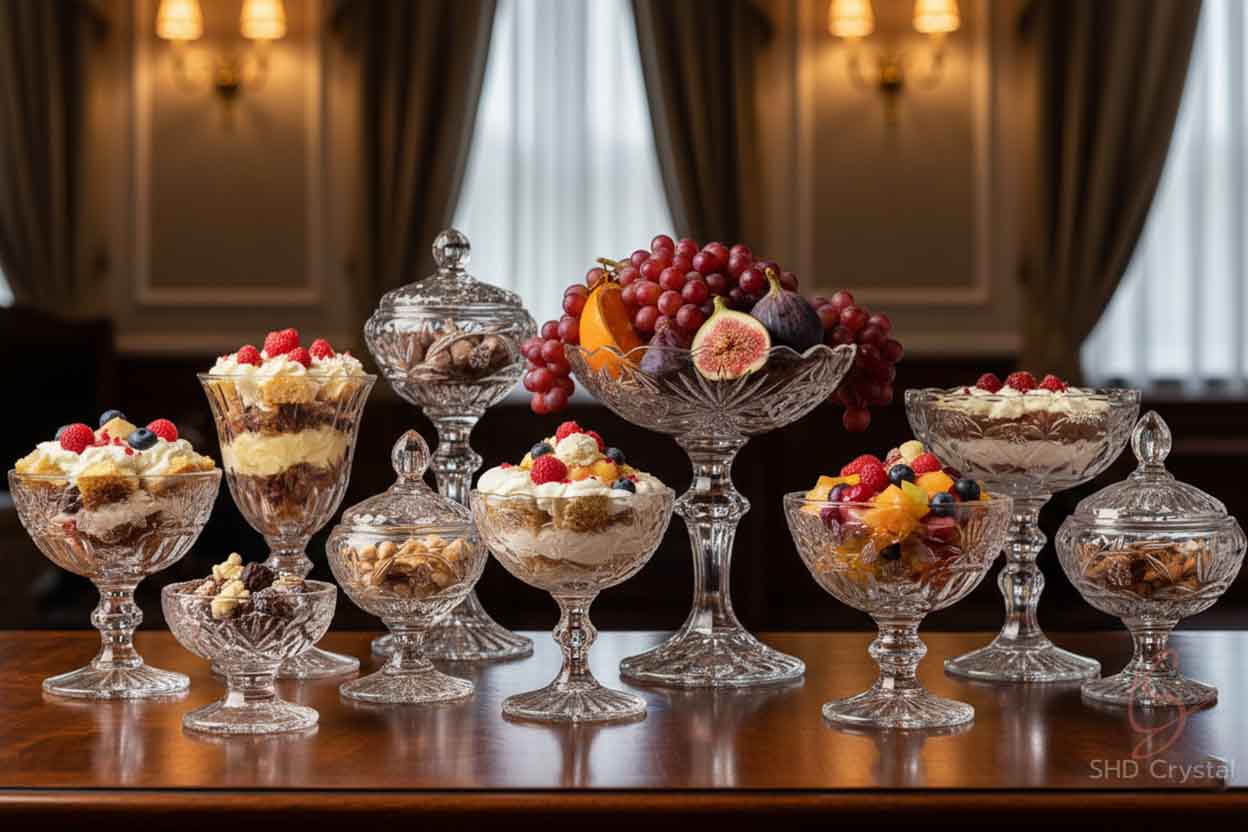
This does not necessarily mean excessive weight. Instead, it refers to controlled wall thickness, deeper pedestal transitions, and fuller rim structure that reinforce the historical appearance of the piece. Buyers reviewing samples should therefore evaluate how the bowl feels visually from multiple angles, not only from the front view.
In many antique trifle bowl OEM projects, the side profile determines whether the product feels authentic or commercially generic.
Collection Planning Adds More Commercial Value
One reason vintage pedestal serveware remains commercially useful is its ability to expand into coordinated collections. A successful trifle bowl design can often evolve into compotes, candy dishes, cake stands, footed fruit bowls, or smaller dessert cups without losing visual consistency.
For retailers and private-label brands, this creates stronger merchandising opportunities than isolated tabletop products. Coordinated dessert presentation glassware collections also help hospitality buyers maintain a more unified presentation language across buffet service, event styling, and decorative dining environments.
This flexibility is one of the main reasons vintage-inspired glassware continues to perform well despite changing tabletop trends.
What Buyers Should Review Before Final Approval
Before approving production, buyers should carefully review molded clarity, pedestal alignment, rim smoothness, packing protection, and overall proportion consistency between samples.
Transparent pressed glass reveals asymmetry very quickly. Even minor variation in pedestal centering or mold alignment can affect how the bowl reflects light across the table. It is also useful to evaluate how desserts, fruit, or decorative contents visually sit inside the bowl because depth perception changes once the product is actually in use.
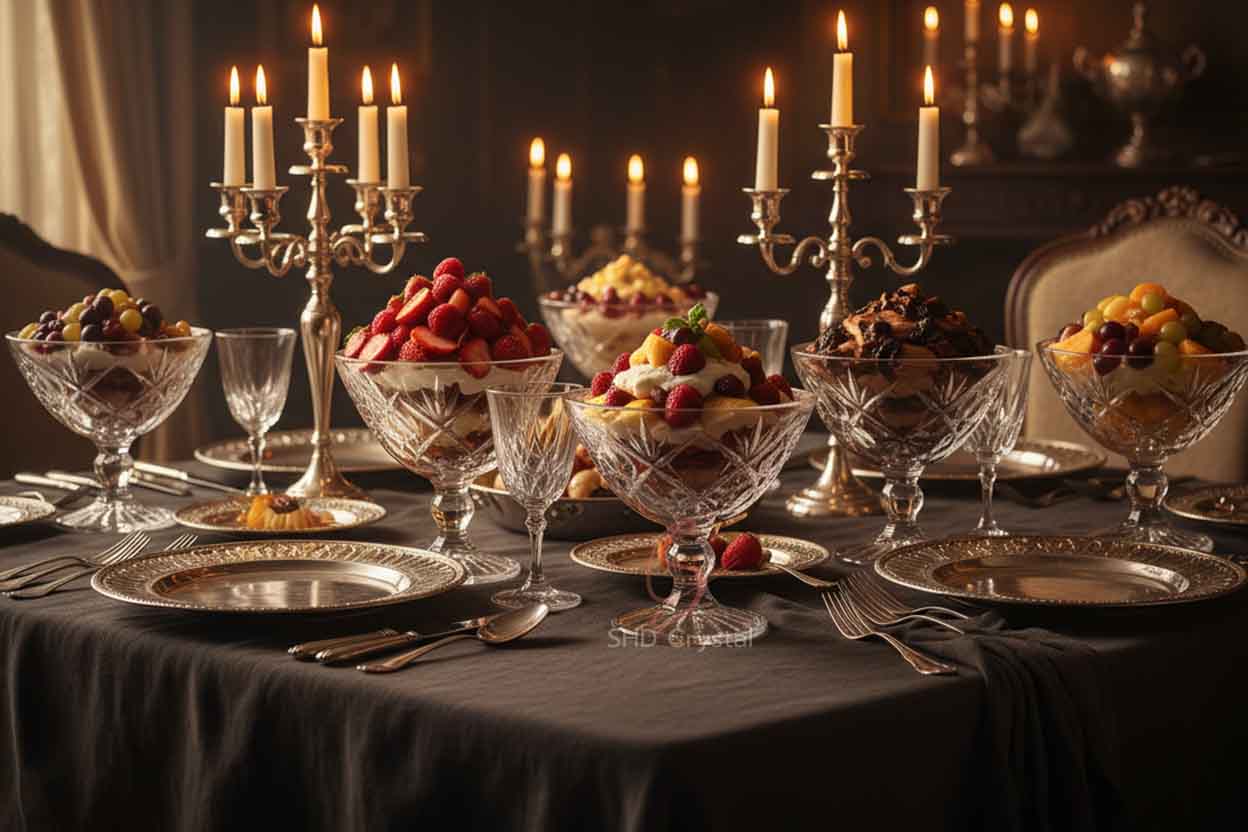
For larger hospitality programs, stackability, cleaning access, and replacement consistency should also be reviewed early during sampling.
Conclusion
An effective antique trifle bowl OEM program combines historical visual language with practical modern production. Through balanced proportions, controlled molded detail, stable pressing quality, and thoughtful collection planning, vintage-inspired serveware can become both commercially adaptable and visually memorable across tabletop, gifting, and hospitality applications.
Developing Vintage-Inspired Glass Serveware Collections
At SHD Crystal, we support OEM production for pressed and decorative tabletop glassware through custom mold development, embossed pattern control, pedestal structure refinement, polishing adjustment, and export-oriented packaging solutions. For brands developing vintage pedestal serveware and coordinated dessert presentation glassware collections, our team helps balance historical styling with stable large-scale production and modern retail presentation requirements.