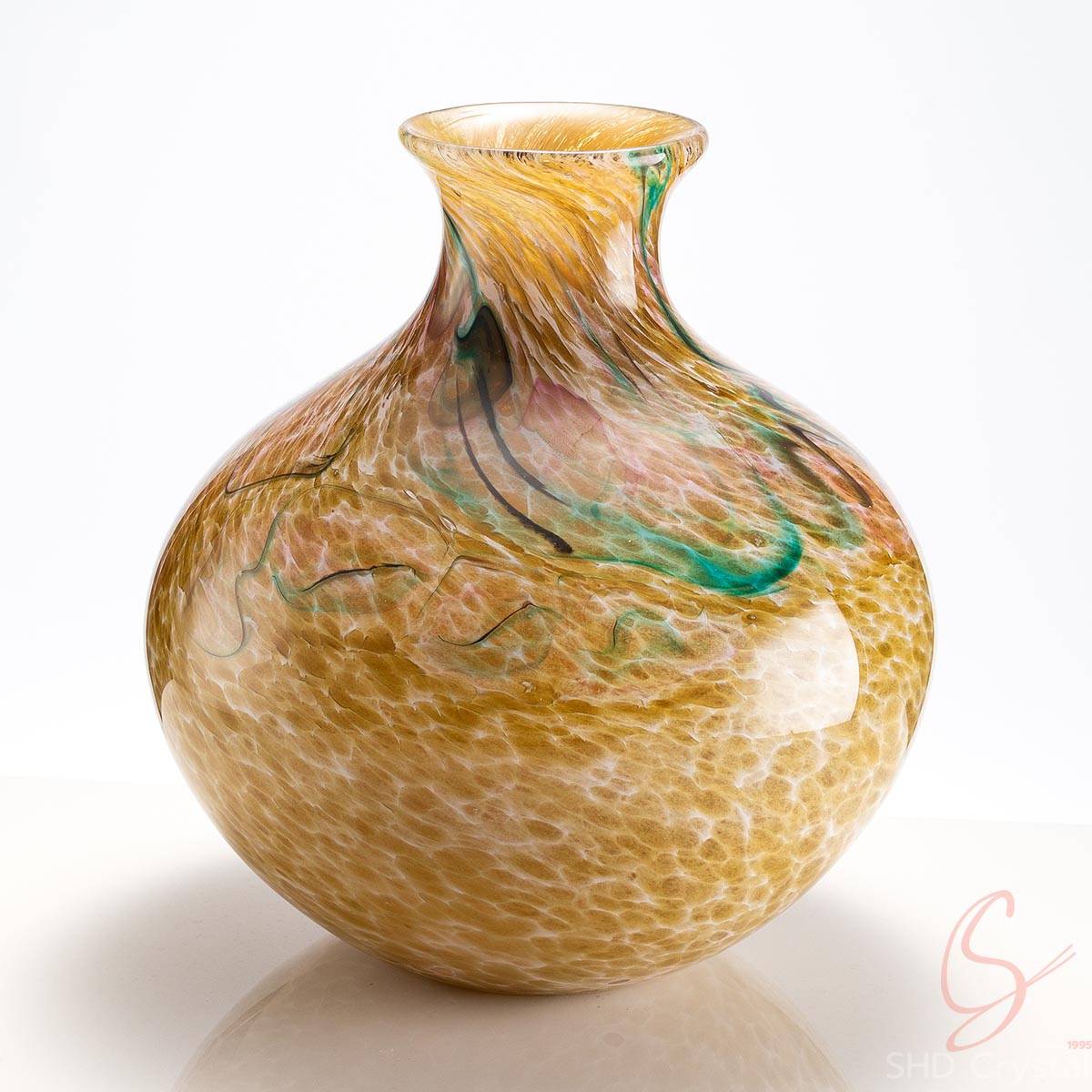
Blogpost keywords: cloud texture glass vase OEM, optical diffusion glass, sculptural blown glass
A successful cloud texture glass vase OEM program depends less on external ornament and more on how color behaves inside the glass body itself. Unlike painted or sprayed decorative glass, cloud-textured art glass develops depth through layered color diffusion suspended within transparent material. Once illuminated, the vase begins to shift visually as light travels through embedded texture, curved wall thickness, and flowing internal color transitions.
This is one reason cloud-textured blue glass continues to appear in artistic interiors, decorative hospitality environments, and sculptural tabletop collections. The object feels visually active even when standing still because the internal pattern changes continuously with viewing angle and surrounding light.
Optical Diffusion Glass Creates Depth Without Heavy Surface Texture
Many decorative glass products rely on carved surfaces or applied decoration to create visual complexity. In high-quality optical diffusion glass, the depth is generated internally during hot-form production instead.
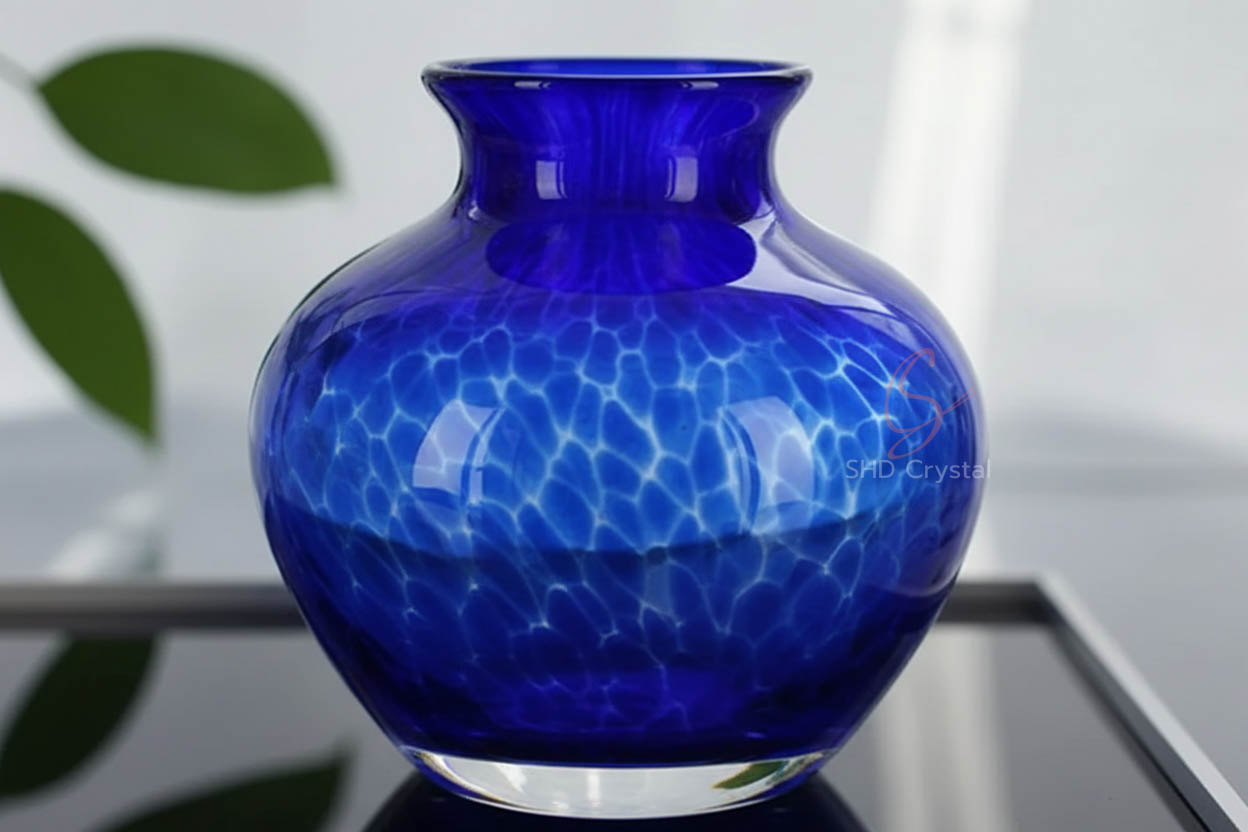
The blue cloud pattern develops as colored glass particles and transparent crystal layers fuse together at high temperature. During blowing, the internal color stretches and disperses naturally through the expanding glass body, creating fluid transitions that resemble water movement, smoke diffusion, or layered cloud formations.
Because the texture exists inside the material rather than on the surface, the vase maintains smooth reflective clarity while still carrying strong visual depth.
Wall Thickness Influences How the Blue Pattern Expands
One of the defining characteristics of a cloud texture glass vase OEM design is the relationship between wall thickness and optical movement. Thicker lower areas often appear deeper and more saturated because more color layers overlap inside the glass mass. Thinner shoulder transitions allow light to pass more freely, creating brighter blue diffusion and softer transparency near the upper body.
This changing density gives the vase a more atmospheric appearance than flat-colored glass. However, it also makes production more difficult because uneven gathering or unstable blowing rhythm can distort the internal diffusion pattern unpredictably.
For this reason, experienced art glass workshops carefully control furnace temperature, glass gathering consistency, and expansion timing throughout production.
Sculptural Blown Glass Depends on Organic Expansion Control
The reference shape itself also plays a major role in the final visual effect. Rounded sculptural forms allow the internal pattern to stretch smoothly across curved surfaces, helping the optical diffusion remain fluid rather than fragmented. Abrupt shoulder transitions or overly rigid geometry tend to interrupt the cloud movement visually.
This is why many pieces categorized as sculptural blown glass rely on softened contour transitions, expanded body curves, and gradual neck shaping. The glass needs enough internal space for the optical pattern to breathe naturally throughout the form.
In hand-blown production, even slight variation in inflation pressure can dramatically change how the internal texture distributes across the vase body.
Hot-Worked Rim Forming Adds More Artistic Character
The slightly flared opening visible in many cloud-texture vases is usually shaped while the glass remains hot rather than added afterward through cutting alone.
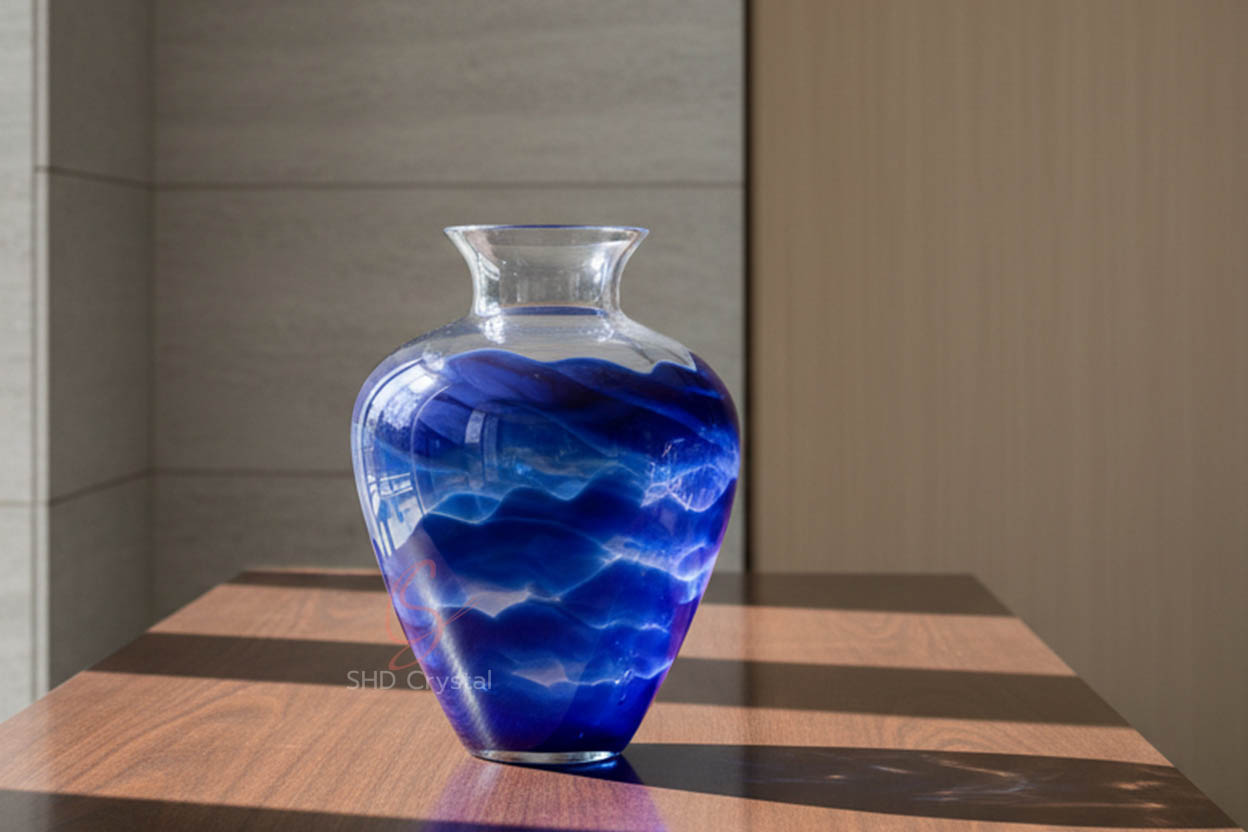
This hot-worked expansion creates softer transitions around the mouth and helps the upper edge feel more fluid and organic. In some pieces, the color density also shifts toward the rim because the glass stretches during the opening process.
These subtle changes contribute significantly to the artistic identity of a cloud texture glass vase OEM collection. Mechanically perfect symmetry often feels less convincing in studio-style art glass because slight movement and variation create a more natural handcrafted appearance.
Lighting Conditions Determine the Final Visual Experience
Cloud-textured blue glass behaves very differently depending on lighting conditions. Under daylight, the vase may appear cooler and more transparent. Warm interior lighting often intensifies the layered blue depth and reveals stronger internal diffusion movement. Directional side lighting can also dramatically increase reflection contrast within the cloud texture itself.
Because of this, professional sample review should always include multiple lighting environments. A vase that appears understated in photography may develop far richer optical behavior once placed inside real interior settings.
Conclusion
A refined cloud texture glass vase OEM program combines layered internal color movement, controlled wall thickness, hot-worked contour shaping, and carefully balanced optical diffusion glass behavior to create decorative objects with stronger sculptural presence. Through disciplined sculptural blown glass production, cloud-textured blue vases achieve depth and atmosphere without relying on heavy external ornamentation.
Supporting Artistic Cloud Texture Glass Vase Production
At SHD Crystal, artistic glass vase production combines hand-blown forming, layered color fusion, optical diffusion control, hot-worked rim shaping, and precision polishing refinement for decorative art glass collections. For brands developing premium cloud texture glass vase OEM programs, our team supports custom sculptural glass development with stable internal diffusion patterns, controlled transparency transitions, and handcrafted artistic character across production batches.