
Blogpost keywords: glass sink OEM, thermal stress calibration, dimensional repeatability
A glass sink may appear visually finished long before it is structurally stable. Smooth polishing, transparent surfaces, and accurate color do not necessarily indicate reliable production quality. In architectural and hospitality projects, the more important question is whether the sink can maintain dimensional stability, edge integrity, and installation accuracy after repeated use and environmental temperature variation.
This is where professional glass sink OEM manufacturing differs from decorative glass production. The process is not centered only around appearance. It depends heavily on thermal control, forming discipline, cooling balance, and repeatable engineering tolerances across large production runs.
Thermal Stress Calibration Determines Long-Term Structural Reliability
Glass reacts continuously to temperature change during production. As the material cools, different sections of the sink contract at different speeds depending on wall thickness, curve depth, drainage structure, and edge geometry.
Without stable thermal stress calibration, internal tension may remain trapped inside the sink body even after polishing is complete. These stress points are often invisible during initial inspection but can later contribute to cracking around drainage openings, countertop contact zones, or unsupported edge sections.
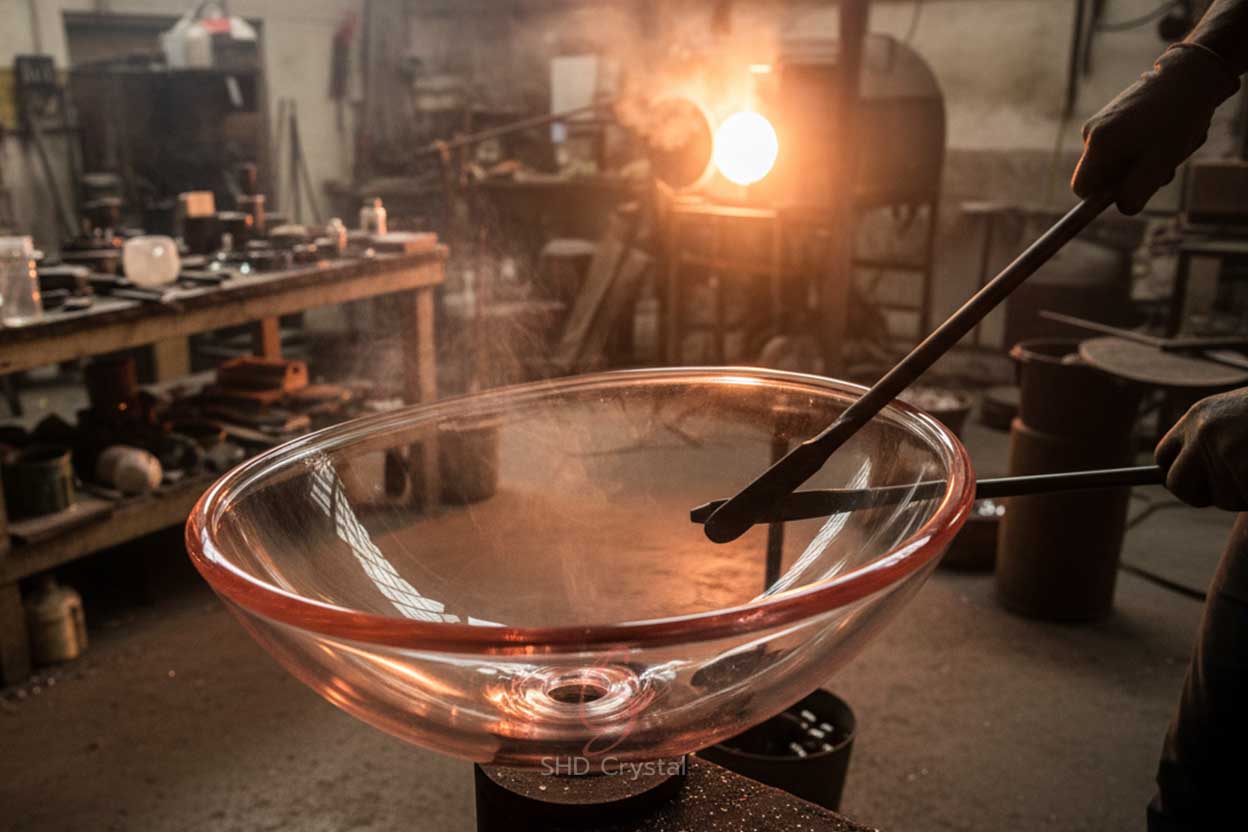
This becomes especially important in bathroom environments where sinks experience repeated hot and cold water exposure over long periods.
Complex Sink Geometry Creates Uneven Cooling Risk
Unlike flat decorative glass, sink structures contain multiple directional transitions. The drainage area is usually thicker. Edge sections cool faster. Bowl curves distribute heat unevenly during forming. If cooling rhythm is not carefully managed, these zones may stabilize at different rates and create internal imbalance. Experienced glass sink OEM manufacturers therefore monitor cooling transitions throughout both forming and annealing stages rather than relying only on final inspection.
For oversized vessel sinks or sculptural countertop designs, the challenge becomes even greater because larger glass surfaces amplify thermal movement across the structure.
Dimensional Repeatability Affects Real Installation Performance
One of the most underestimated issues in sink production is dimensional variation between units.
A sink may look visually correct while still creating installation problems if drainage alignment shifts slightly or countertop contact surfaces vary between production batches. In architectural projects, even small differences can disrupt faucet positioning, sealing accuracy, or cabinet integration. Reliable dimensional repeatability therefore becomes essential not only for appearance, but also for construction compatibility. Professional manufacturers usually control this through calibrated forming systems, staged measurement inspection, and carefully stabilized mold conditions during production.
Edge Processing Influences Both Safety and Load Stability
The edge structure of a glass sink performs multiple functions simultaneously. It contributes to visual definition, supports structural load transfer, and determines how the sink interacts with countertop materials. Aggressive polishing may soften edges visually, while insufficient refinement can leave stress-sensitive sharp transitions near mounting areas.
In premium glass sink OEM production, edge finishing must balance optical clarity with mechanical stability. This is especially important for transparent or lightly tinted glass where polished transitions remain highly visible under bathroom lighting.
Dimensional Repeatability Becomes Critical in Hospitality Projects
Single-unit approval is relatively straightforward. Maintaining consistency across dozens or hundreds of sinks is much harder.
Hotels, residential developments, and branded bathroom collections often require identical installation conditions throughout multiple spaces. Variations in bowl depth, overflow positioning, wall thickness, or drainage geometry become immediately noticeable once units are installed side by side. This is one reason large-scale projects increasingly evaluate dimensional repeatability during sampling rather than focusing only on aesthetic approval. The engineering discipline behind the sink often matters more than decorative styling alone.
Common OEM Production Risks Buyers Often Miss
Several manufacturing risks are frequently overlooked during sourcing. Some factories separate forming and polishing between different subcontractors, increasing dimensional inconsistency. Others prioritize rapid cooling cycles to improve production speed, unintentionally increasing internal stress sensitivity. Packaging also becomes critical. Glass sinks carry concentrated weight around edge and drainage zones, making poor packaging support especially dangerous during export transit. These problems rarely appear in catalog photography but become highly visible during real project installation.
Conclusion
Reliable glass sink OEM manufacturing depends on far more than surface clarity or decorative appearance. Stable thermal stress calibration, controlled forming transitions, accurate edge processing, and repeatable dimensional repeatability all play essential roles in determining whether a sink performs successfully within architectural and hospitality environments.
Supporting Architectural Glass Sink Manufacturing
At SHD Crystal, architectural glass sink production combines controlled furnace forming, stress-managed annealing systems, precision edge processing, structural polishing refinement, and export-oriented packaging engineering for hospitality and residential bathroom projects. For brands developing custom glass sink OEM programs, maintaining stable dimensional accuracy and long-term structural reliability remains central to scalable production.