
Blogpost Keywords: crystal glass sink oem, thermal stress calibration, dimensional repeatability
Why Industrial Manufacturing Beats Handcrafted at Scale
A single handcrafted crystal glass sink can be beautiful. A thousand identical sinks require something different. They need process engineering. Glass sink OEM production is not about artistry. It is about stability. Every unit must match the one before it. Every edge must align. Every drain hole must fit.
For bathroom brands and large-scale developers, a crystal glass sink OEM partner delivers two things above all else. First, thermal stress calibration ensures the glass survives temperature changes without cracking. Second, dimensional repeatability guarantees every sink fits the same countertop cutout. These are not optional. They are the foundation of reliable production.
Unlike small-batch studios, OEM manufacturing eliminates variability through systems. The same mold. The same temperature curve. The same cooling rate. The result is a sink that performs the same way whether it is unit 1 or unit 1000.
Why Thermal Stress Calibration Defines Crystal Glass Sink Quality
Glass has a memory. Heat it unevenly. Cool it too fast. It will remember. And it will crack. Thermal stress calibration is the process of controlling temperature across every stage of production. During forming, the glass must be uniformly heated. During annealing, it must cool at a precise rate.
Without proper calibration, internal stress builds inside the glass. You cannot see it. But it is there. Weeks or months after installation, a crack appears. The sink fails. The brand takes the blame. A professional crystal glass sink OEM environment applies thermal stress calibration during both forming and annealing stages. The result is a temperature-resistant sink that handles daily use and sudden hot water exposure.
Bathroom environments are harsh. A sink goes from cold to hot in seconds. Ice water to steaming water. Poorly calibrated glass will not survive. Properly calibrated glass will last decades.
Achieving Dimensional Repeatability Across Thousands of Units
Installers have a nightmare scenario. Fifty countertops cut to the same template. Fifty sinks that are supposed to fit. Five of them are off by two millimeters. The installers curse. The project delays. The brand loses money. Dimensional repeatability prevents this nightmare.
A crystal glass sink OEM supplier controls key parameters with precision. Width. Depth. Wall thickness. Drainage position. Drain hole diameter. Every measurement is verified during production. Calibrated molds and continuous measurement systems ensure that unit 500 matches unit 1.
Accurate dimensions are not just about installation. They are about appearance. A row of sinks in a hotel bathroom must look identical. Any variation becomes obvious. Dimensional repeatability guarantees that one-of-a-kind design intent survives mass production.
Forming Methods and Structural Stability
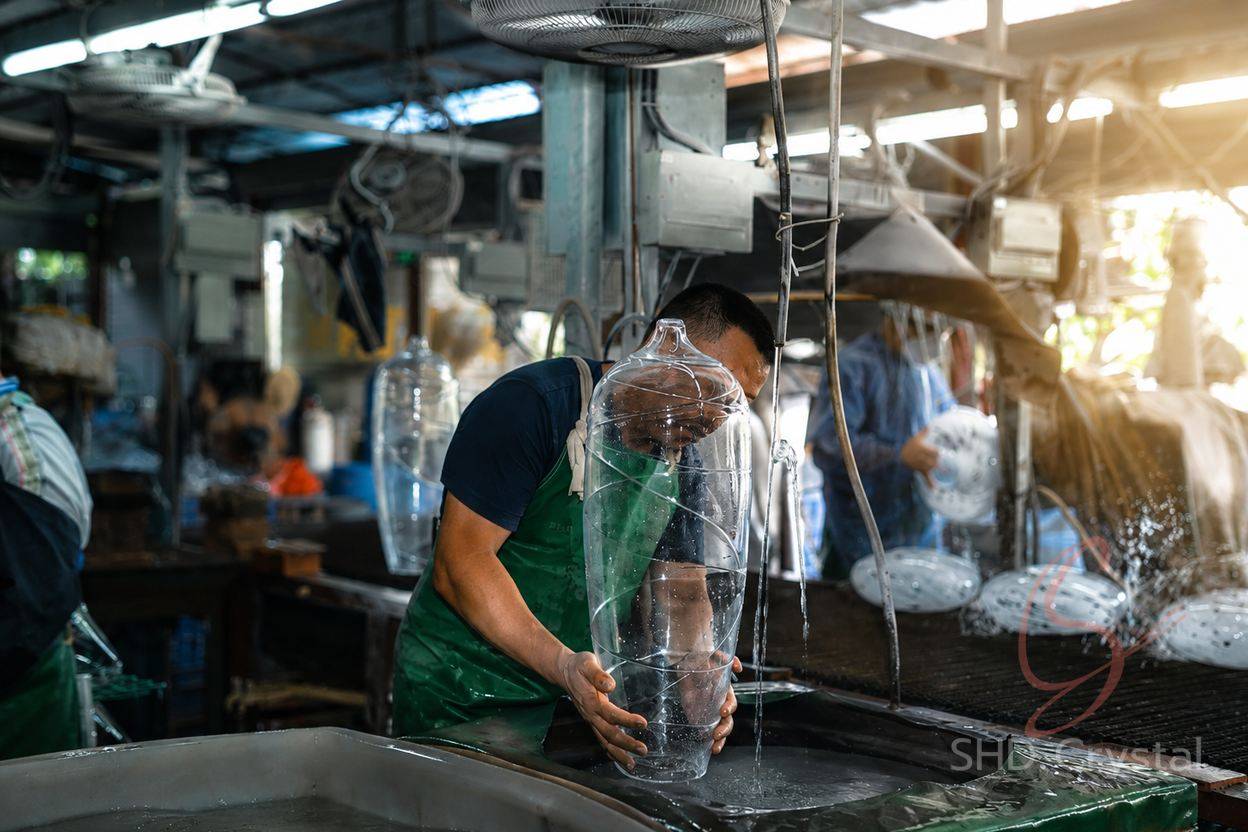
The forming stage defines the sink’s geometry. In crystal glass sink OEM production, shaping uses controlled heating and precise molds. The glass must flow evenly into every corner of the mold. No thin spots. No thick ridges.
During this stage, thermal stress calibration and dimensional repeatability must be monitored together. A change in temperature affects the shape. A change in pressure affects stress distribution. The two are linked.
Uniform thickness is critical. Uneven material creates weak points. It also creates visual distortion. A sink that looks wavy is not flawless. A glass sink OEM process maintains thickness within tight tolerances. The result is a sink that is both robust and visually gorgeous.
Quality Control in OEM Production
Quality control goes beyond a visual check. Each sink must be evaluated for structural integrity, dimensional accuracy, and surface finish. Thermal stress calibration is verified through controlled testing. Dimensional repeatability is confirmed with measurement tools.
Surface finishing matters too. Edges must be smooth. Rims must be polished. Drain holes must be clean. A crystal glass sink OEM process includes these finishing steps as part of the production line, not as an afterthought.
The final result is a sink that is exquisite in appearance and temperature-resistant in performance. It is heirloom-quality in durability but produced at commercial scale.
Common OEM Risks and Mitigation
Several risks appear when process control is insufficient. Inadequate thermal stress calibration leads to delayed cracking. The sink looks fine at delivery. It fails months later. Loss of dimensional repeatability creates installation nightmares. Sinks do not fit. Tolerances drift over time.
Design complexity also increases risk. Sharp corners. Deep bowls. Thin walls. These features look beautiful but are harder to manufacture. A skilled glass sink OEM partner helps simplify geometric features without compromising the design. This collaboration between design and production teams is essential.
Applications in Large-Scale Projects
Glass sink OEM solutions are used in hospitality, residential developments, and commercial buildings. Hotels need every guest room to have the same sink quality. Residential towers require hundreds of identical units. Commercial projects demand reliable installation.
In each case, thermal stress calibration ensures long-term durability. Dimensional repeatability guarantees consistent fit and appearance. The result is a versatile product that works across different project types.
The Takeaway
Glass sink OEM manufacturing depends on precise control of material behavior and production parameters. Through thermal stress calibration and dimensional repeatability, manufacturers deliver sinks that meet both design expectations and functional requirements. This structured approach ensures consistent quality across large-scale projects.
For Buyers Sourcing Crystal Glass Sink OEM
When developing a glass sink OEM project, select a manufacturer with strong process control capabilities. Suppliers experienced in thermal stress calibration and dimensional repeatability can support design validation, sampling, and production scaling. Early collaboration ensures your final product integrates smoothly into the intended application.