
Blogpost Keywords: cyan glass vessel OEM, balanced light glass decor, commercial glass sourcing
Cyan glass vessel OEM programs occupy a specific niche in commercial interior design. The color cyan — positioned between blue and green on the visible spectrum — produces a light transmission profile that neither cool blue nor warm green can replicate. For B2B buyers specifying decorative glass across hospitality, wellness, and retail environments, this distinction matters. A product from a cyan glass vessel OEM line does not simply fill a shelf. It modulates ambient color temperature, softens harsh illumination, and creates a calibrated visual anchor in spaces where lighting design directly influences customer behavior.
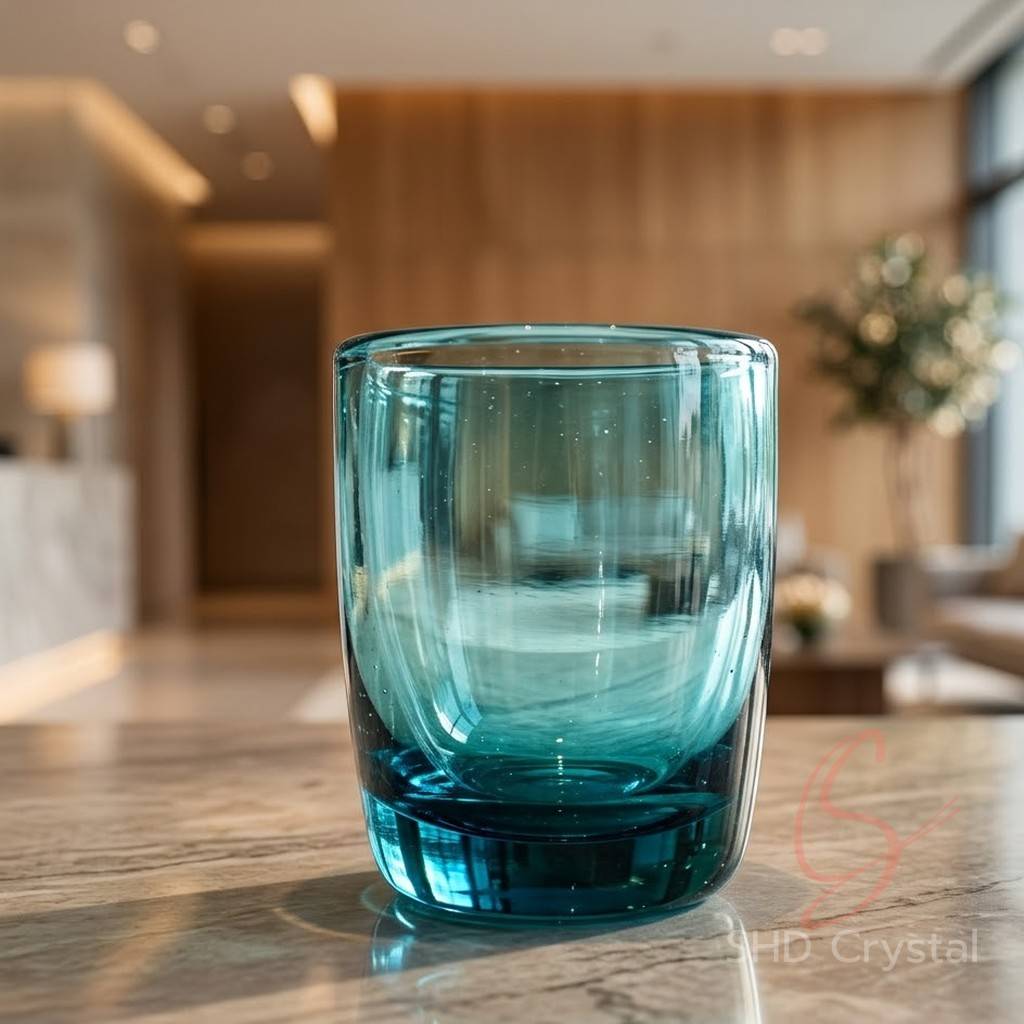
Unlike lighter colors that recede, cyan advances visually without dominating. It holds attention while maintaining a sense of calm. This quality makes it particularly valuable in commercial spaces where the goal is to engage visitors without overwhelming them.
Colorant Chemistry and the Cyan Transmission Window
The challenge of manufacturing cyan glass lies in the precision of colorant ratios. Cobalt oxide produces blue. Chromium or iron oxide produces green. Achieving true cyan requires a controlled blend where neither ion dominates the absorption spectrum. In a cyan glass vessel OEM production run, this means the batch recipe must account for furnace atmosphere, melt temperature, and the base silica composition — each of which shifts the final hue.
Even a two percent variance in cobalt concentration can push the result toward teal or sky blue, neither of which delivers the intended spatial effect. Skilled manufacturers address this by maintaining strict colorant tolerances, typically within plus or minus zero point five percent, and by producing pre-production sample tiles for spectral verification before committing to a full melt.
The thickness of the glass wall further influences color perception. Thicker sections absorb more light, deepening the cyan tone. Thinner sections transmit more, creating a lighter, more translucent appearance. A well-crafted design for balanced light glass decor specifies wall thickness as a design parameter, not merely a structural one, ensuring the delivered color matches the designer intent across the entire form.
Spatial Light Modulation Through Cyan Glass
Cyan glass interacts with ambient light in ways that affect how a space feels. Natural daylight, rich in the full visible spectrum, passes through the material and emerges with the warmer wavelengths slightly attenuated. The result is a softened, cooler cast that reduces visual intensity without making the space feel cold.
Under artificial warm-white lighting, the effect reverses. The glass absorbs some of the yellow-orange output and transmits a neutralized tone that prevents color buildup. This bidirectional behavior — cooling warm light, warming cool light — makes a cyan glass vessel OEM piece particularly useful in environments where lighting conditions change throughout the day. Restaurants, hotel lobbies, and spa reception areas benefit from this automatic color correction without requiring any adjustment to the lighting plan.
Placement also determines impact. Positioned near a window, the glass filters incoming daylight. Placed near a warm light source, it absorbs excess warmth. Set against a neutral wall, it becomes a focal point. Designers who understand these interactions treat balanced light glass decor as a specification category with the same intentionality they apply to fixture selection or material palette.
Manufacturing Tolerances and Quality Control
Producing cyan glass at commercial scale introduces several quality control checkpoints. The first is raw material consistency. Cobalt and chromium sources vary in purity between suppliers, and a manufacturer that switches colorant vendors without recalibrating the batch recipe will see visible hue shifts.
The second checkpoint is forming method. Mouth-blown cyan glass develops subtle thickness variations that create natural color gradients. These are generally considered desirable, as they add depth and character. Mold-pressed or machine-blown alternatives achieve more uniform color but can appear flat if the mold geometry does not introduce sufficient optical variation.
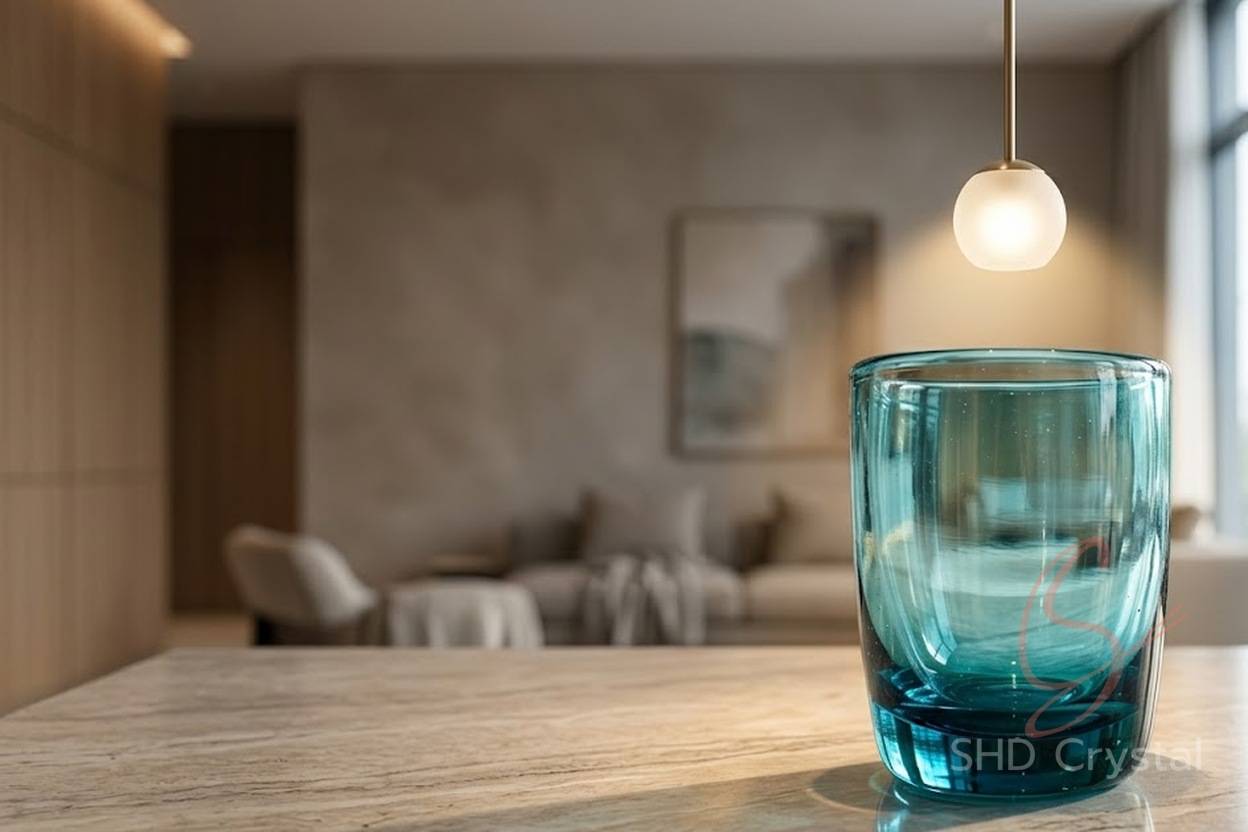
The third checkpoint is annealing. Glass cooled too quickly develops internal stress, which manifests as birefringence — a rainbow-like interference pattern visible under polarized light. While this effect is invisible under normal viewing conditions, it indicates structural weakness that increases breakage risk during shipping. A reliable supplier documents annealing curves and performs polariscopic inspection as part of standard quality assurance.
Batch color matching is the final control. Manufacturers should provide spectrophotometer readings for each production lot, measuring the dominant wavelength and chromaticity coordinates against an approved standard. Acceptable tolerance for commercial glass sourcing is typically within two Delta E units of the reference sample.
Procurement Criteria for Cyan Glass Products
Buyers evaluating a cyan glass vessel OEM partner should assess four factors. First, colorant formulation control — whether the manufacturer maintains documented recipes and pre-production sample approval processes. Second, forming capability — whether the supplier can produce the required shapes through blowing, pressing, or a combination, and whether the chosen method aligns with the intended aesthetic.
Third, quality assurance documentation — including annealing records, spectrophotometric batch reports, and visual inspection criteria. Fourth, packaging and logistics — decorative glass requires individual wrapping, corner protection, and drop-tested carton design to survive international freight.
A commercial glass sourcing engagement succeeds when the supplier treats color as an engineered specification rather than an artistic accident. This means providing measurable tolerances, reproducible processes, and transparent quality data — the same standards applied to any functional component in a commercial build-out. Buyers who approach commercial glass sourcing with these criteria in place reduce the risk of receiving visually inconsistent or structurally compromised inventory.
The Takeaway
A cyan glass vessel OEM product balances cool color with intelligent engineering. Through precise colorant chemistry and controlled manufacturing, manufacturers produce decorative glass that commands attention while maintaining a sense of calm — balanced light glass decor that performs as well in function as it does in appearance.
For Buyers Sourcing Cyan Glass Vessel OEM Products
When specifying a cyan glass vessel OEM product, work with a manufacturer experienced in color control and light transmission design. Request pre-production samples under your intended lighting conditions. Require spectrophotometric batch verification and Delta E tolerance limits in your purchase agreement. A manufacturer experienced in balanced light glass decor and commercial glass sourcing can support sampling, validation, and production at scale — delivering glass that is balanced in performance as it is in appearance.