
Blogpost Keywords: crystal champagne glass manufacturers, champagne flute glasses, custom champagne glasses
The difference between ordinary and captivating champagne presentation lives in the behavior of bubbles — their size, velocity, and the rhythm at which they reach the surface. Crystal champagne glass manufacturers understand that the vessel is not a passive container but an active participant in the effervescence choreography. The geometry, surface treatment, and crystal composition of champagne flute glasses determine whether a pour produces a delicate persistent stream or a rapid dissolving fizz.
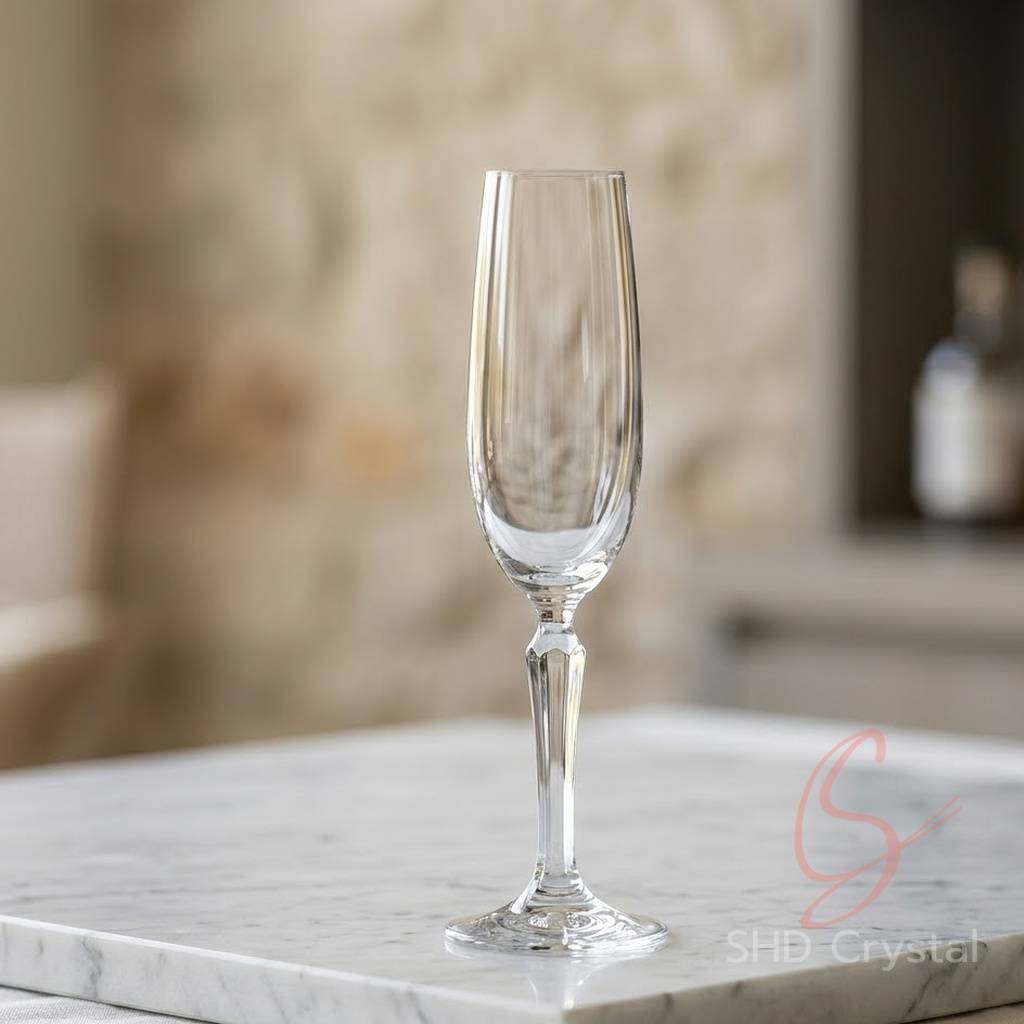
Custom champagne glasses designed with intentional nucleation engineering transform each pour into a controlled performance. This article examines how the most sophisticated crystal champagne glass manufacturers approach bubble dynamics as a core design parameter rather than an afterthought.
Nucleation Point Engineering Laser-Etched Nucleation Arrays
The finest champagne flute glasses feature laser-etched nucleation points — microscopic imperfections deliberately introduced at the bowl’s base to serve as controlled CO2 release sites. Crystal champagne glass manufacturers that specify nucleation arrays with between twenty and forty points per square centimeter create a consistent bubble stream that persists throughout the drinking experience.
A custom champagne glasses program without nucleation engineering relies on random surface imperfections, producing irregular bubble bursts that exhaust within minutes. The laser-etched approach ensures that bubble generation continues at a steady rate from first pour to last sip, maintaining the visual and aromatic performance that defines premium champagne service.
The positioning of nucleation points matters as much as their density. Crystal champagne glass manufacturers that cluster points in a central column create a single dramatic bubble stream, while distributed patterns produce multiple smaller streams with a gentler visual effect. Each approach serves a different aesthetic intention.
Surface Roughness and Spontaneous Nucleation
Even without laser etching, the microscopic surface roughness of crystal champagne glass manufacturers’ production influences spontaneous nucleation. A polished interior surface with Ra values below 0.05 micrometers minimizes uncontrolled bubble formation, while a slightly textured surface with Ra values between 0.1 and 0.3 micrometers encourages distributed nucleation across the entire bowl area.
Custom champagne glasses intended for ultra-premium positioning typically combine both approaches: a smooth bowl surface for controlled appearance paired with a laser-etched nucleation zone at the base for reliable bubble generation. This dual-surface strategy gives the bartender predictable performance regardless of the champagne’s carbonation level.
Bubble Size and Rise Velocity Control Bowl Taper Angle and Bubble Growth Rate
As bubbles rise through champagne, they grow by absorbing dissolved CO2 from the surrounding liquid. The bowl taper angle of champagne flute glasses directly affects the rate of this growth — a narrower bowl confines the liquid column, increasing pressure and slowing bubble expansion, while a wider bowl allows faster growth and larger bubbles at the surface.
Crystal champagne glass manufacturers that specify a taper angle between four and six degrees produce bubbles that reach the surface at diameters between 0.4 and 0.6 millimeters — the range that sensory studies identify as most visually pleasing and aromatically effective. Custom champagne glasses with steeper tapers produce larger, faster bubbles that dissipate more quickly.
Mousse Formation and Surface Dynamics
The mousse — the foam ring that forms at the champagne surface — is the visible endpoint of bubble dynamics. Crystal champagne glass manufacturers that design for optimal mousse production balance bubble size, rise velocity, and surface tension to create a ring that persists for three to five minutes, releasing aromatic compounds throughout its lifetime.
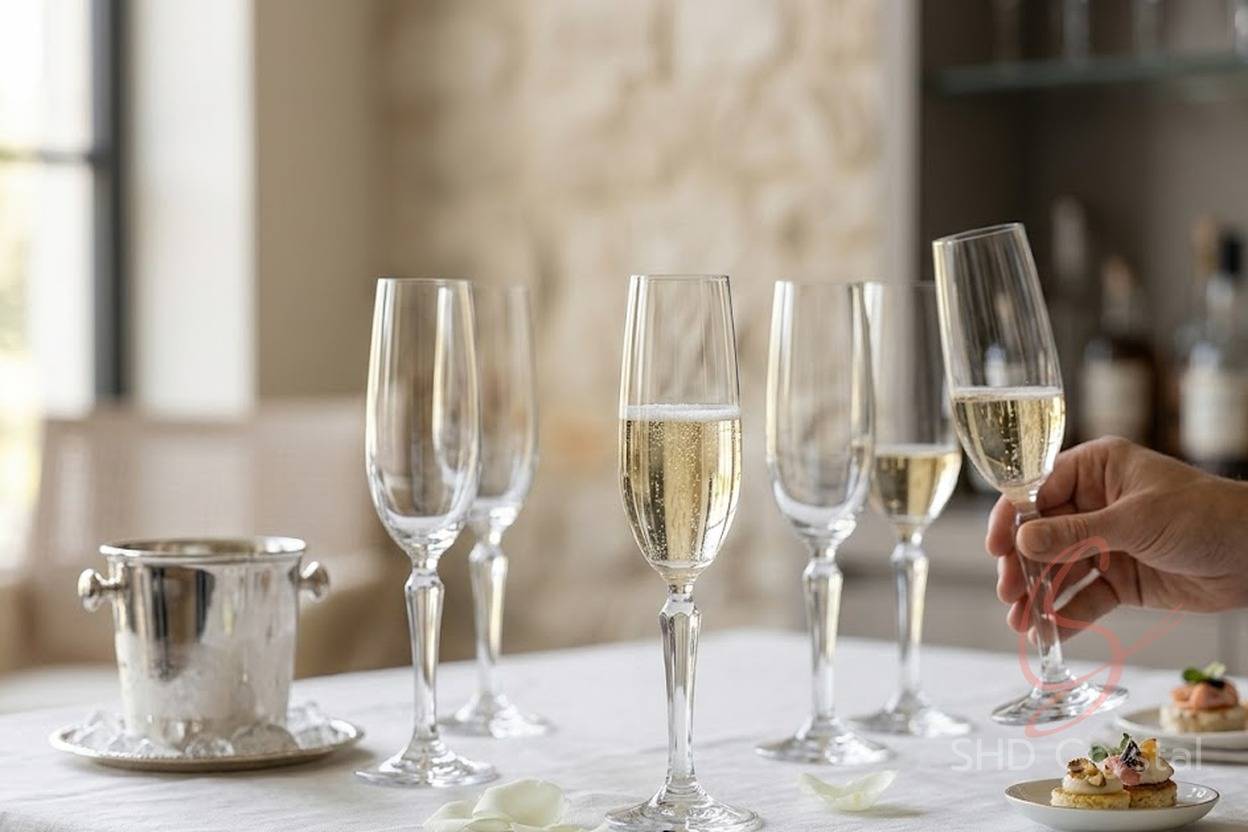
Champagne flute glasses with a subtle inward curve at the rim concentrate the mousse into a tighter ring, increasing aromatic intensity at the drinking position. Custom champagne glasses designed for aromatic-focused champagnes incorporate this rim geometry as a standard feature.
Crystal Composition and Bubble Behavior Lead-Free Crystal and CO2 Solubility
The crystal composition itself influences how champagne behaves within the glass. Lead-free crystal formulations with titanium or potassium-based stabilizers have different surface energy properties than traditional leaded crystal, affecting how CO2 molecules adhere to the glass surface and nucleate into bubbles.
Crystal champagne glass manufacturers that formulate their crystal specifically for champagne service optimize the surface energy to encourage consistent nucleation without excessive adhesion. The result is champagne flute glasses where bubbles release cleanly from nucleation points rather than clustering on the glass wall, producing a clearer visual presentation.
Custom champagne glasses manufactured from high-barium crystal achieve a higher refractive index that makes individual bubbles more visible under ambient lighting — a subtle but measurable enhancement of the visual champagne experience that guests perceive as increased quality.
Bubble engineering represents one of the most scientifically sophisticated areas of crystal champagne glass manufacturing. When nucleation patterns, rise velocity, and mousse formation are designed rather than left to chance, the resulting champagne flute glasses transform each pour into a controlled sensory experience.
The most accomplished crystal champagne glass manufacturers treat bubble dynamics as a quantifiable design parameter — measuring bubble diameter, rise speed, and mousse persistence with the same rigor that other industries measure electrical or mechanical specifications. Custom champagne glasses built to these standards deliver consistent performance that justifies their positioning at the premium end of the market.