
A glass packaging sourcing guide becomes valuable long before a purchase order is issued. Decisions made during packaging selection influence tooling investment, filling efficiency, transportation safety, inventory planning, and future product expansion. Many packaging projects encounter avoidable delays because sourcing begins with appearance instead of manufacturing feasibility. An attractive bottle or jar may still require unexpected engineering changes if it cannot support the filling process, closure system, production line, or logistics requirements. Packaging performs best when design objectives and manufacturing realities are evaluated together rather than separately.
Why A Glass Packaging Sourcing Guide Begins With Product Requirements
Every successful packaging project starts with understanding how the container will actually be used instead of selecting a shape from a catalog.
A perfume bottle, food jar, spirits bottle, candle vessel, beverage bottle, and cosmetic container all introduce different engineering considerations. Product viscosity, filling temperature, carbonation, alcohol content, UV sensitivity, sterilization requirements, and closure type all influence the final packaging solution. These factors determine whether standard production methods are suitable or whether additional engineering work will be required.
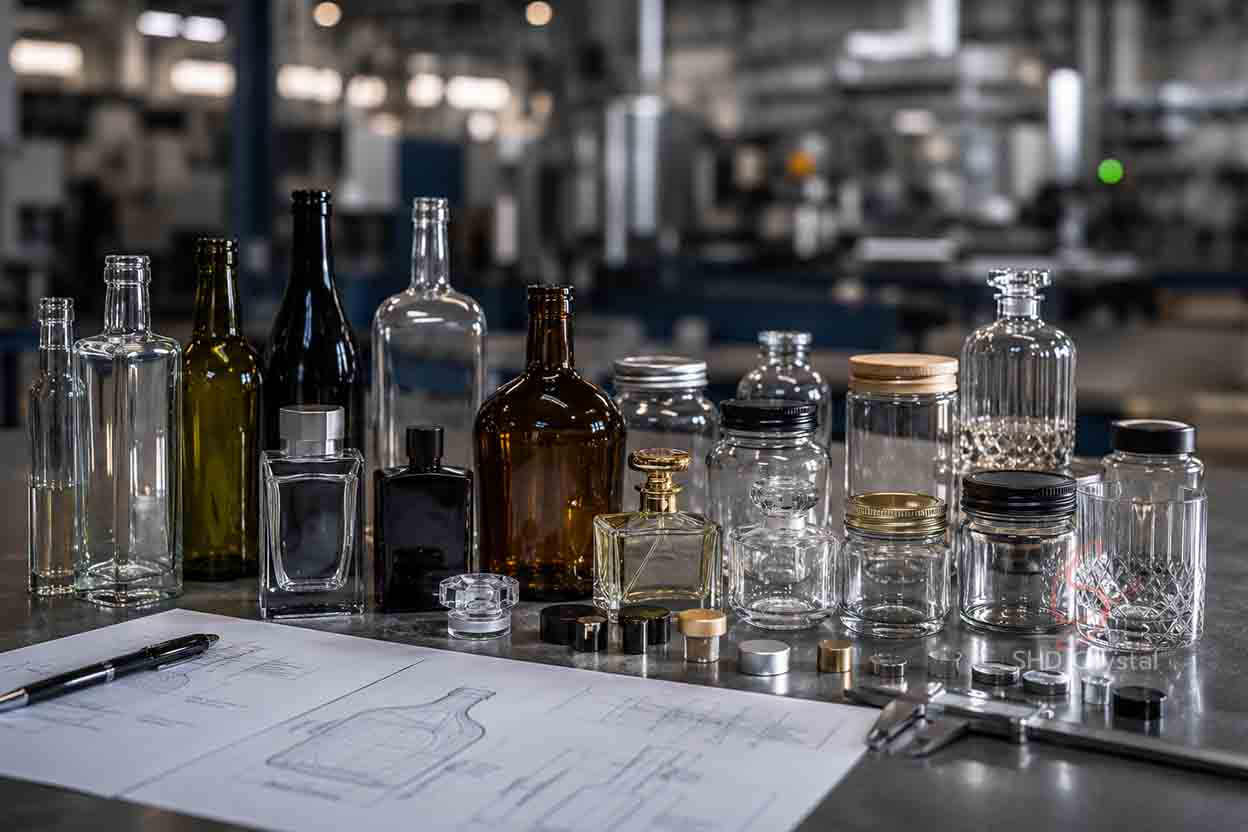
Providing this information during the initial discussion allows glass bottle suppliers to recommend practical manufacturing solutions rather than estimating from reference images alone. Early technical communication often eliminates multiple rounds of redesign before tooling begins.
Stock Packaging And Custom Development Solve Different Business Goals
One of the earliest sourcing decisions is whether an existing bottle should be adopted or whether custom glass packaging should be developed from scratch.
Stock packaging generally works well for market validation, promotional launches, seasonal products, or businesses that need to reduce initial investment. Existing molds shorten development cycles and allow production to begin quickly.
Custom development serves a different objective. Brands seeking long-term product differentiation often require exclusive bottle shapes, proprietary proportions, customized decoration areas, or packaging systems that competitors cannot easily replicate. Although new tooling increases the initial investment, the packaging becomes part of the brand identity over multiple product generations.
A common misconception is that companies can simply switch from stock packaging to custom designs after sales increase. In practice, changing bottle dimensions frequently requires new labels, revised cartons, updated filling settings, modified pallet configurations, and additional transportation validation. Planning these factors early usually reduces total project cost over the product lifecycle.
Price Comparisons Only Work When Project Scope Is Identical
Requesting quotations before defining technical specifications often produces misleading comparisons between suppliers. Two glass bottle suppliers may appear to offer significantly different pricing while quoting completely different manufacturing assumptions. Glass weight, mold cavity quantity, decoration process, inspection standards, export packaging, carton construction, pallet configuration, and quality acceptance levels all influence the final quotation.
For example, one quotation may include only undecorated bottles packed in standard export cartons, while another includes silk-screen decoration, protective dividers, stricter dimensional inspection, and reinforced packaging for international shipment. Comparing these quotations without understanding the scope rarely reflects the actual project cost.
Before requesting final pricing, buyers should confirm container capacity, finish dimensions, decoration requirements, packaging specifications, annual demand, sampling expectations, and quality criteria. A clear project definition usually produces more meaningful quotations than negotiating unit price alone.
Manufacturing Variables That Influence Production Stability
Appearance represents only one part of packaging quality. Long-term production consistency depends on manufacturing variables that are often overlooked during sourcing discussions. Among the key factors include mold tolerances, wall thickness transitions, the machining precision of the bottle neck, annealing performance, and decoration processes.
Supplier Evaluation Should Go Beyond Product Photos
Product photography is useful for evaluating aesthetics, but it reveals very little about a supplier’s ability to manufacture consistently over time. Experienced glass bottle suppliers should be able to explain how a design will move through mold development, sampling, production, inspection, decoration, and export packaging. Their willingness to discuss technical limitations is often a stronger indicator than a polished product catalog.
During OEM development, engineering teams sometimes recommend increasing a bottle radius, adjusting the push-up depth, or simplifying a decorative feature before tooling begins. These recommendations are rarely made to reduce visual quality. Instead, they improve mold release, reduce stress concentration, stabilize dimensional tolerance, or increase decoration consistency across thousands of units.
For buyers, one practical question is often more valuable than asking for the lowest quotation:
“What changes would you recommend before opening the mold?”
The answer usually reveals whether the supplier is focused only on manufacturing what was requested or on helping the project succeed in mass production.
Planning For Reorders And Future Product Expansion
Packaging decisions should support more than the first production run. Many brands launch with a single SKU but later expand into multiple fragrances, beverage flavors, capacities, or seasonal editions. If future development is considered during the initial design stage, a unified packaging architecture can reduce both engineering effort and operating costs.
For example, different bottle capacities may share the same neck finish, closure specification, decoration process, or carton dimensions. Standardizing these elements simplifies purchasing, reduces inventory complexity, and shortens production preparation for future launches.
This is one of the long-term advantages of custom glass packaging. The investment is not limited to creating a distinctive appearance. It also establishes a scalable packaging platform that supports product growth without requiring every new item to start from the beginning.
Another factor frequently overlooked is mold maintenance. Well-managed tooling programs include periodic inspection, refurbishment, and dimensional verification so that future production batches remain consistent with approved samples. Buyers planning long product life cycles should discuss mold ownership, maintenance responsibility, and replacement planning before production starts rather than after quality variations appear.
Balancing Design Ambition With Manufacturing Reality
Distinctive packaging often attracts attention on the shelf, but highly complex designs also introduce engineering trade-offs.
Deep embossing, sharp corners, dramatic wall thickness changes, and unusual bottle geometries may improve visual impact while increasing mold complexity, production cycle time, decoration difficulty, or transportation risk. Likewise, reducing glass weight lowers shipping costs but may also decrease impact resistance if structural design is not optimized.
Successful packaging projects rarely pursue appearance at any cost. They balance brand identity, manufacturing efficiency, logistics performance, and long-term production stability.
For procurement teams, understanding these trade-offs before tooling approval usually prevents expensive design revisions after sampling has already begun.
Conclusion
A glass packaging sourcing guide is most effective when it treats packaging as a manufacturing project rather than simply a purchasing task. The strongest sourcing decisions consider production feasibility, dimensional control, inspection standards, logistics requirements, and future product development alongside appearance. Evaluating suppliers through engineering capability instead of catalog images helps brands reduce development risk and build a packaging program that remains reliable throughout the product lifecycle.
Supporting Smarter OEM Packaging Decisions
Whether you are selecting an existing bottle or developing custom glass packaging, early engineering discussions often eliminate unnecessary tooling revisions and shorten development time. Our OEM team supports feasibility evaluation, mold planning, sampling, decoration selection, quality verification, and production coordination, helping product brands transform packaging concepts into reliable, scalable manufacturing solutions.
Exclusive Release by SHD Crystal
Custom Crystal Glass OEM Manufacturer

This article is originally published by SHD Crystal. Original Link: https://shdcrystal.com/blogs/glass-packaging-sourcing-guide/