
The first oil sprayer bottle OEM inquiry we received came with a single reference photo and one sentence: “We want this, but for olive oil.” We made the bottle. It looked perfect. The pump, sourced from a catalog we trusted, failed within a week of actual kitchen use. That project taught us something no specification sheet had mentioned: a cooking oil sprayer lives in a completely different environment than a cosmetic mister, and the testing logic has to start from that difference.
Most oil sprayer bottle OEM conversations still begin with bottle shape, color, and decoration. We understand why. Shelf appeal matters. But over the years, the projects that moved smoothly from sample to repeat order were the ones where the buyer let us challenge the bottle around what the pump actually needed. This shift in sequence changes everything.
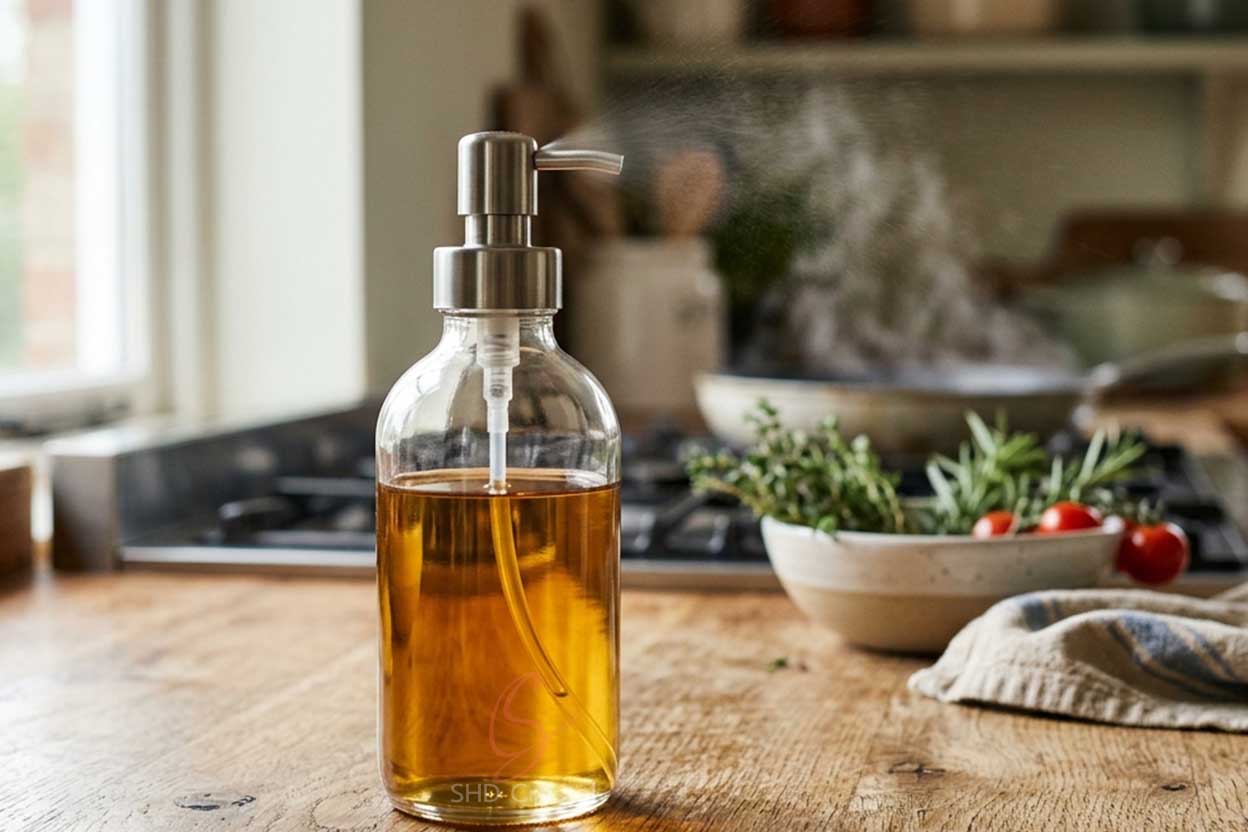
Rethinking the Testing Order for Oil Sprayer Bottle OEM
Standard protocol in many factories goes roughly like this: mold the bottle, find a pump that fits the neck, fill with water, check for leaks. For a cosmetic sprayer, that sequence works often enough. For a kitchen oil dispenser, it misses the variable that determines whether the product stays in a kitchen or gets returned: oil behavior.
Water sprays differently. Olive oil at room temperature has a different surface tension and flow curve than avocado oil or blended cooking oils. A mist spray nozzle that produces a fine, even fan pattern with water can sputter, stream, or drip with oil. We learned to flip the testing order. We now ask for the target oil first, not last. If the buyer cannot provide it, we test across three common viscosities and report the differences before tooling begins. This single change in an oil sprayer bottle OEM workflow eliminated most of the early-stage pump mismatches we used to catch only during pre-shipment inspection.
Bottle geometry also shifts once oil enters the equation. A tall, narrow profile looks elegant but can feel top-heavy when a user presses the pump with one hand while holding a pan with the other. We have made prototypes that passed every dimensional check but tilted on a wet countertop. That kind of failure does not appear on a caliper report. It only shows up when someone actually cooks.
What a Mist Spray Nozzle Reveals About the Glass
There is a detail we pay close attention to now that we ignored early on: the way a mist spray nozzle sits on the bottle shoulder. A pump that threads on smoothly but sits at a subtle angle tells us something about neck roundness or thread start consistency. The naked eye rarely catches a 0.3 mm deviation, but the pump amplifies it visually.
We also began measuring spray angle stability over multiple presses, not just the first three. A good mist spray nozzle should maintain pattern consistency through at least twenty full strokes. If the angle shifts or droplets grow larger after five or six presses, it usually indicates that the dip tube or ball check is reacting to viscosity buildup—common with oils—or that air re-entry is uneven. Neither issue appears on a water test.
For a kitchen oil dispenser, this matters because real cooking involves intermittent short bursts, not one continuous spray. A user might press five times over thirty seconds while sautéing, then leave the bottle untouched for ten minutes before returning. The pump needs to pick up where it left off without priming or dribbling. We now simulate this stop-start rhythm in our testing room using actual cooking oils, not substitutes.
The Glass Part Nobody Talks About
After hundreds of oil sprayer bottle OEM runs, one observation keeps repeating: the most underrated variable is the internal base contour. Oil pools differently than water. A flat internal base with a slight central dip helps the dip tube reach the last portion of liquid. A sharply curved or uneven base traps oil in a ring, leaving a layer the user cannot spray. That wasted oil, often only 5–8 ml, irritates home cooks far more than we expected.
We also found that a kitchen oil dispenser with a heavily textured exterior, while attractive on a showroom shelf, collects cooking residue in the recesses. After two weeks near a stove, the surface becomes sticky. Smooth profiles with a gentle taper clean faster and look better over time. We started recommending this to buyers who sell through retail channels where returns and reviews directly impact repeat orders.
A Project That Changed How We Think About Sealing
Last year, a European kitchenware brand approached us for a glass dressing bottle—similar neck geometry to a kitchen oil dispenser, but intended for emulsified vinaigrettes. The brief looked straightforward: 200 ml capacity, standard 24/410 neck, push-pull cap. Water testing passed on the first round. The buyer approved.
Three weeks after the first shipment landed, we received an email with photos of leaking bottles. Not during transit—on kitchen counters, after opening and reclosing. The emulsion had a lower surface tension than water and was wetting the orifice surface, creeping down the threads overnight. Our cap had passed water immersion tests. It failed with real vinaigrette because water testing only checks static sealing, not how a low-surface-tension liquid wets and climbs through micro-gaps.
We pulled a production sample, filled it with the buyer’s exact emulsion formula, and ran a horizontal storage test at three fill levels over seven days. The weep pattern matched their photos exactly. The fix came from a combination of a revised orifice geometry and a liner material change. Neither adjustment appeared in the original specification. Both became part of our internal checklist for any closure paired with emulsified liquids.
The brand still works with us today. That project taught us something we now apply to every oil sprayer bottle OEM inquiry: the liquid defines the seal, not the other way around. A cap tested with water tells you almost nothing about how it will behave with oil, dressing, or anything with viscosity.
Conclusion
Our experience with oil sprayer bottle OEM projects points to one clear pattern: the projects that succeed are those where spray testing, glass geometry, and real kitchen conditions are connected from the start. The bottle, the pump, and the oil are not separate components to be assembled. They are a system that either works together or exposes every shortcut taken during sourcing.
Send Us Your Oil, Not Just Your Drawing
If you are planning an oil sprayer bottle OEM project and already have a mist spray nozzle in mind, we still recommend testing it with your liquid. Share your target oil type, bottle capacity, and any reference images, and we will prepare a feasibility review that includes spray pattern testing with matched oil viscosities. This approach has helped our buyers get a kitchen oil dispenser into production with fewer revisions and a shorter timeline.
Exclusive Release by SHD Crystal
Custom Crystal Glass OEM Manufacturer
This article is originally published by SHD Crystal. Original Link: https://shdcrystal.com/blogs/oil-sprayer-bottle-oem/