
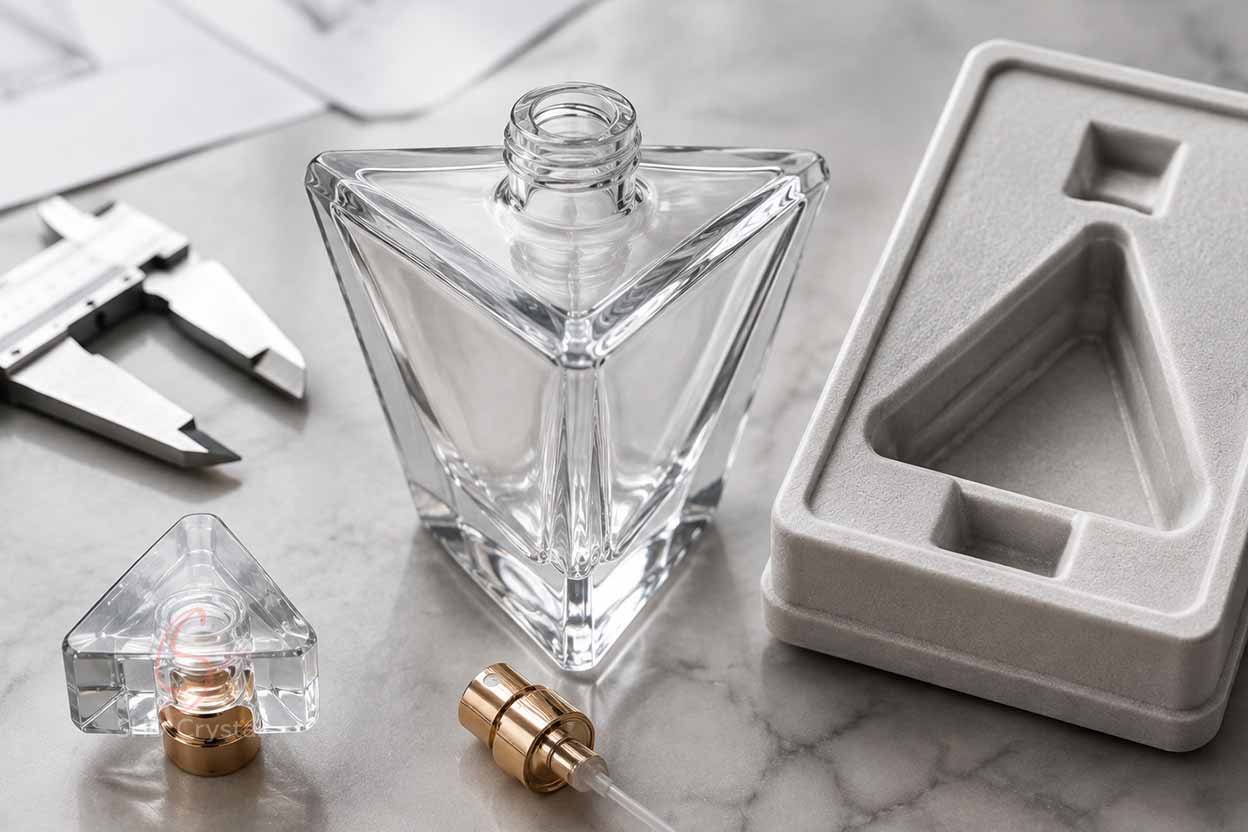
At SHD Crystal, a triangular perfume bottle manufacturer project usually begins with a strong visual concept, but our first review is not about making the corners as sharp as possible. We look at whether the geometry can be formed consistently, whether the neck remains visually centered, whether one face can support decoration, and how exposed corners will be protected during packing. A triangular silhouette can create immediate shelf recognition, but it only works commercially when the shape remains practical through molding, filling, assembly, and repeat production.
What a Triangular Perfume Bottle Manufacturer Reviews Before Tooling
The first question we often discuss with buyers is whether the bottle needs physically sharp corners or simply needs to look sharp.
These are not the same thing.
A controlled corner radius can preserve the visual character of a triangle while making glass distribution, handling, and packaging more manageable. Extremely acute transitions may look impressive in a rendering, but they can make geometric bottle design harder to reproduce consistently once molten glass enters the mold.
For this reason, we usually review the relationship between the three main faces, the corner transitions, shoulder geometry, and base before confirming the tooling direction. Strong geometry should remain recognizable without forcing the glass into unnecessarily difficult transitions.
Neck Alignment Matters More Than Perfect Symmetry
Triangular bottles create a strong visual centerline, so even a small neck or cap misalignment can become easier to notice than on a round bottle.
During development, we pay close attention to the relationship between the neck, shoulders, and base. A bottle can have three attractive faces but still feel visually unbalanced if the sprayer does not sit cleanly above the body. The base also needs enough stability for filling, packing, and display. If too much glass weight is concentrated around the corners or one part of the base, the bottle may feel less balanced even when the exterior dimensions appear correct. This is where glass molding precision becomes more important than simply matching every decorative dimension on the drawing. Neck finish, base stability, and major facet alignment are often more critical than minor variation in a purely visual edge.
Glass Flow Has to Support the Geometry
A triangular body creates a different glass-distribution challenge from a simple cylindrical bottle. Flat panels, corner zones, shoulder transitions, and a heavy perfume-bottle base may cool and form differently.
At SHD Crystal, we review wall thickness transition, mold condition, glass distribution, and annealing behavior together rather than treating them as separate issues. If one corner becomes unnecessarily heavy while an adjacent face becomes too thin, the bottle may show visual imbalance or less stable batch consistency.
This does not mean that every triangular concept requires heavy glass. In fact, excessive weight can create its own problems through higher freight cost and greater pressure on protective inserts. The practical trade-off is clear: stronger mass and thicker corners can reinforce a jewel-like appearance, while more controlled glass weight can improve handling and logistics. The appropriate direction depends on the fragrance positioning and the intended order program.
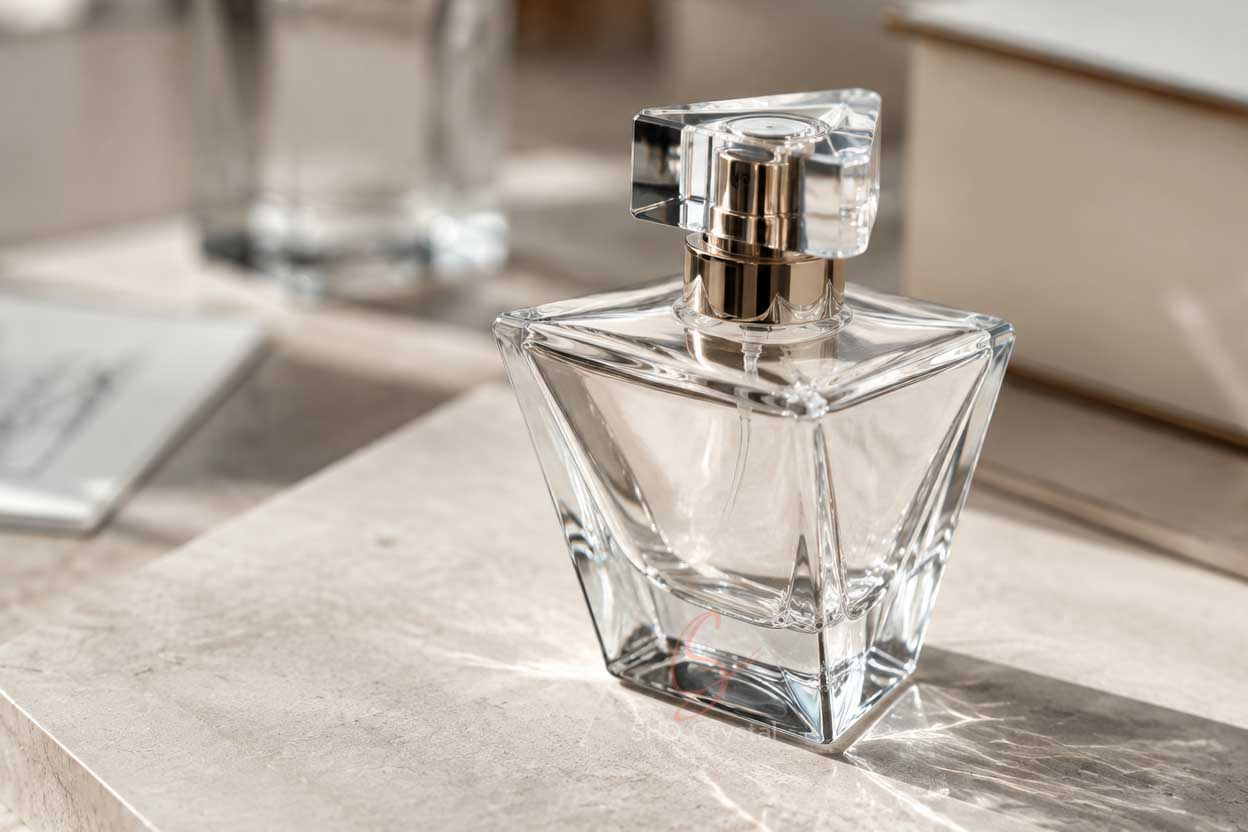
Decoration Should Be Planned Around the Three Faces
A good geometric bottle design should decide early which surfaces are decorative and which surfaces are functional.
One face may remain relatively clean for screen printing, hot stamping, labeling, or product information. The other two can carry stronger angular expression. Trying to apply one graphic continuously across several angled planes often makes alignment more difficult.
Frosting and color spraying also change how the triangular structure is perceived. A clear bottle emphasizes reflections and internal depth, while a matte or dark finish can make the silhouette itself more dominant. We therefore recommend approving decoration on an actual bottle sample rather than relying only on flat artwork or digital renderings.
Stable glass molding precision also supports decoration. If facet positions or panel dimensions vary too much, the print or coating boundary may appear inconsistent even when the decoration process itself is controlled.
Packaging Has to Protect the Corners
Triangular bottles often create three concentrated contact zones rather than one continuous rounded surface. This changes how the bottle should sit inside an inner tray or carton.
A generic divider may press directly against a prominent corner, while excessive free space can allow the bottle to move during transport. We normally review inner trays, carton dividers, cap protection, and orientation using the actual bottle geometry.
This is one reason packing should be discussed before the final sample is approved. A bottle that looks excellent on a studio table can still become difficult or expensive to ship if its corner protection was never considered during development.
What Buyers Should Confirm Before Sampling
Before a triangular perfume bottle manufacturer project moves into tooling or detailed sampling, we recommend confirming:
- Target capacity
- Approximate glass weight
- Neck finish and pump direction
- Cap dimensions
- Preferred decoration face
- Surface finish
- Order range
- Packaging concept
These details help us judge whether the proposed structure needs adjustment before mold development. They also make quotation and sample evaluation more meaningful.
Conclusion
A triangular perfume bottle manufacturer should not treat the project as a simple exercise in creating sharper corners. The real value comes from balancing geometry, glass molding precision, neck alignment, decoration access, and packaging protection. When these factors are planned together, a triangular bottle can keep its strong visual identity without becoming unnecessarily difficult to produce or ship.
Turning Angular Concepts Into Practical Fragrance Packaging
For brands developing a triangular bottle, SHD Crystal can review drawings, reference models, mold feasibility, neck and cap matching, geometric bottle design, decoration direction, and export packing before production begins. Early discussion with a triangular perfume bottle manufacturer helps preserve the design language while reducing avoidable revisions during sampling and mass production.
Read the original article on custom crystal glass manufacturing: https://shdcrystal.com/blogs/triangular-perfume-bottle-manufacturer/