
At SHD Crystal, glass kettle OEM development starts with how the kettle will actually be used rather than how elegant it looks when empty. A transparent body, curved handle, refined spout, and fitted lid may create the right visual direction, but real performance depends on heating conditions, working capacity, pouring balance, component clearance, and protective packaging. Unlike ordinary drinkware, a kettle has to behave predictably when it is full, hot, moving, and repeatedly handled.
What a Glass Kettle OEM Project Should Confirm Before Sampling
The first question is the intended heating method. A borosilicate glass kettle designed for serving freshly boiled water should not automatically be treated as equivalent to a kettle intended for direct stovetop or electrically heated use. Those applications may involve different structural, component, and validation requirements.
For this reason, buyers should clarify whether the kettle will be used mainly for brewing, serving, direct heating, or as part of a tea set before structural development begins. Material choice is important, but it does not replace product-specific testing.
Pouring Performance Is More Than Spout Shape
A narrow spout can create a refined silhouette, while a broader outlet may support faster pouring. Neither approach guarantees good flow on its own. During glass kettle OEM sampling, pouring should be evaluated with the intended working volume. Spout angle, outlet geometry, the connection between the spout and body, fill level, and how air enters through the lid system can all influence the stream. A kettle that pours smoothly when half full may behave differently when filled close to its normal service level.
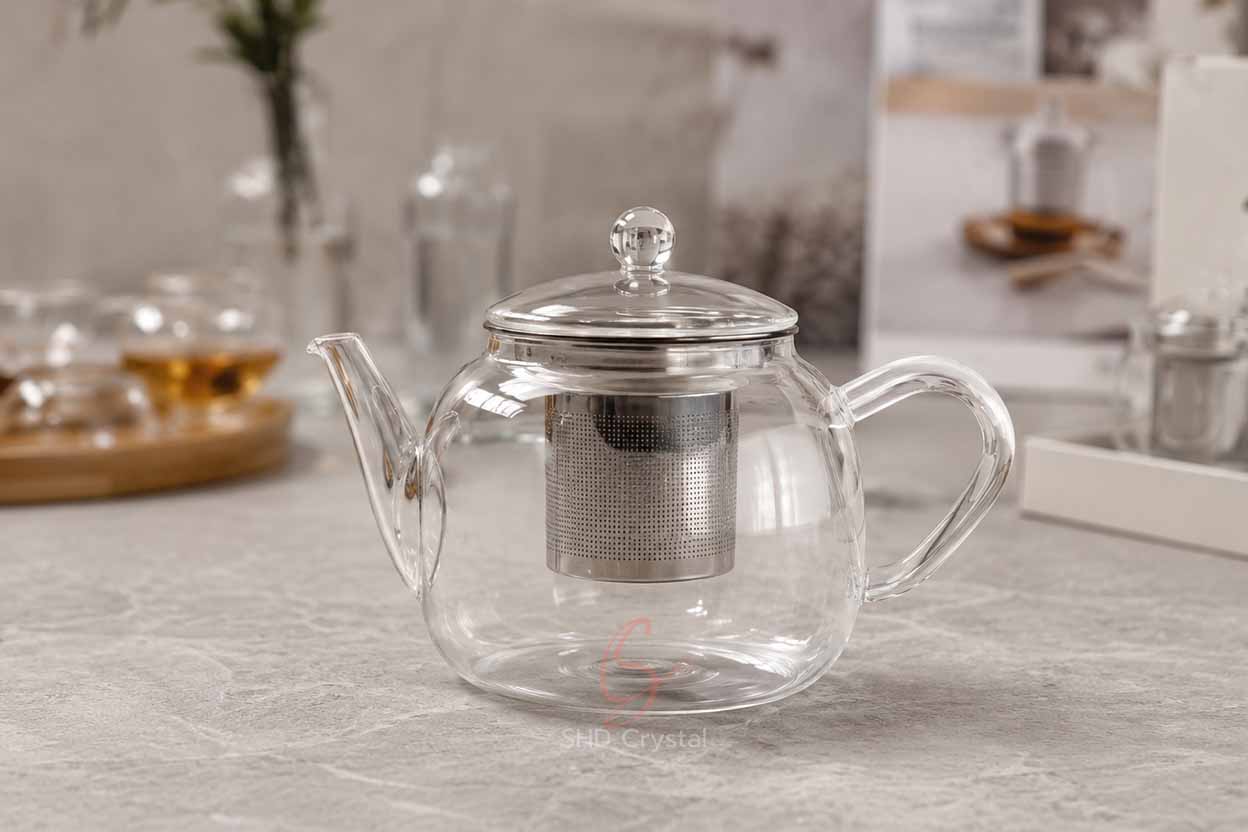
Dripping is also not purely a cosmetic issue. Poor flow control can affect table service and user confidence, especially in hotel, restaurant, or premium retail applications.
The Handle Must Feel Right When the Kettle Is Full
An empty kettle can be misleadingly comfortable. Once water is added, the center of gravity shifts and the load on the handle increases. A handle positioned too close to the body may look compact but leave limited hand clearance. A handle placed too far outward may improve grip space while making the product feel less balanced.
This creates a practical trade-off. Larger capacity improves serving efficiency, but it also increases total weight during pouring. For a borosilicate glass kettle, body proportion, handle position, and intended fill volume should therefore be evaluated together rather than as separate design decisions.
During sampling, the kettle should be lifted and poured at its expected working volume, not only inspected on a table.
Lid and Infuser Fit Need Real Assembly Testing
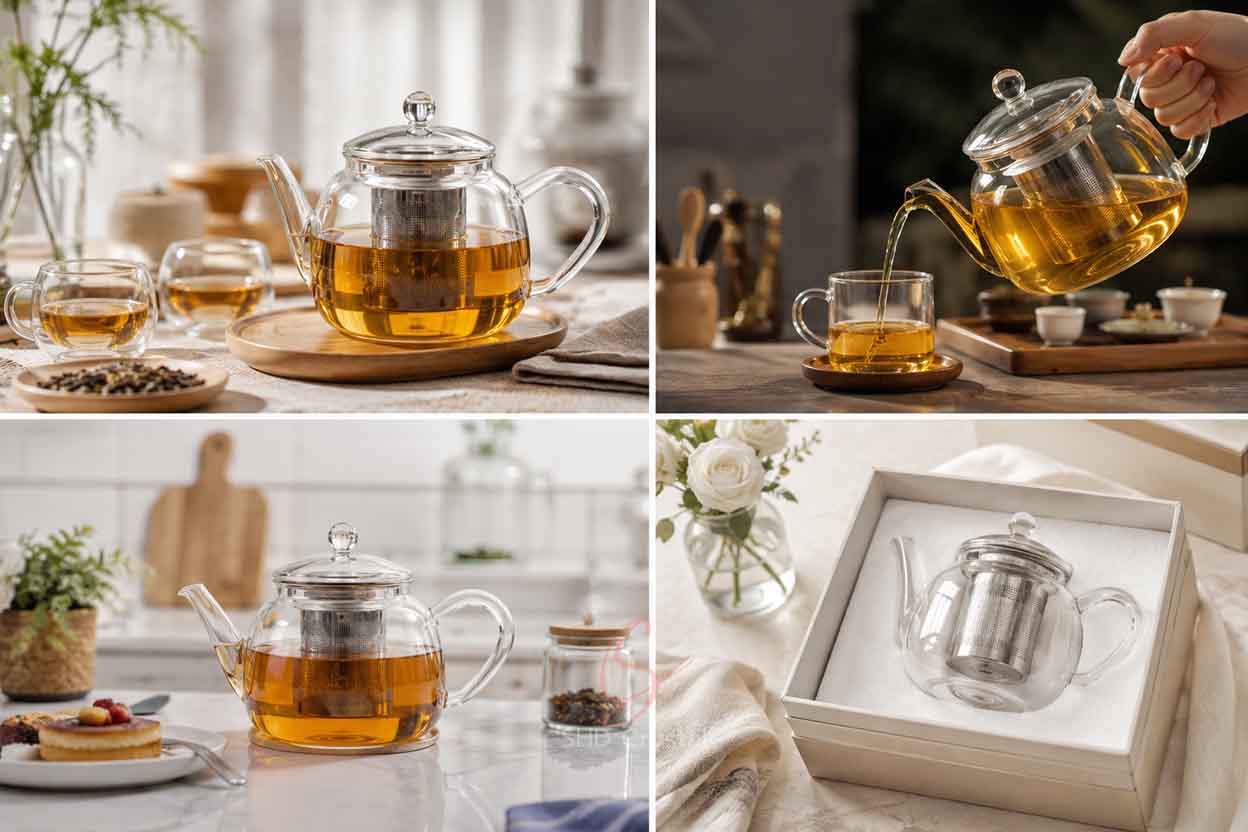
The lid and tea infuser assembly introduce another set of dimensional relationships. A stainless steel infuser needs enough depth to hold tea leaves effectively without touching the base unnecessarily. It should remain stable during pouring but still have enough clearance to be removed without scraping the glass rim or interfering with the lid.
The lid itself must sit securely without becoming difficult to remove. If the assembly relies on several materials such as glass, stainless steel, silicone, bamboo, or plastic, their manufacturing tolerances should be considered together.
This is why approving each component individually can create problems later. At SHD Crystal, glass kettle OEM development is more reliable when the body, lid, filter, and related components are reviewed as a complete assembly.
Wall Distribution Still Matters
Borosilicate glass offers useful thermal properties for hot-beverage products, but a borosilicate glass kettle still depends on sound structural design and production control.
Wall thickness transition is one manufacturing variable that deserves attention. The body, base, spout, and handle connection may cool and form differently, particularly where geometry changes quickly. Glass distribution, forming conditions, annealing behavior, and manual finishing can all influence consistency.
More glass is not automatically better. A heavy structure can feel substantial but increases product weight and transport cost. A lighter kettle is easier to handle, yet excessive weight reduction may leave less margin for handling impacts. The goal is balanced glass distribution rather than maximum thickness.
Decoration Should Stay Compatible With Use
Kettle decoration should support the product rather than interfere with cleaning and handling. Small printed logos, subtle markings, or controlled surface details may provide enough brand identity without covering large areas of the transparent body.
Coatings or decorative finishes should be reviewed according to their location and intended use. High-contact areas, handle zones, and frequently washed surfaces may need a different approach from purely decorative sections. For private-label programs, keeping one clear and repeatable decoration area also makes future production easier to compare.
Packaging Should Support the Body, Not the Fragile Parts
A glass kettle contains several exposed features: the spout, handle, lid, and sometimes a removable tea infuser assembly. Packaging should prevent these components from carrying unnecessary load during transportation.
The main body should receive stable support from the insert, while the spout and handle need adequate clearance from carton walls and adjacent components. A tightly packed gift box can look efficient but create pressure at exactly the wrong points.
Inner trays, molded pulp, foam structures, and dividers should therefore be tested with the finished kettle and accessories. Packaging is not the last cosmetic step in a glass kettle OEM project; it is part of the engineering plan.
What Buyers Should Confirm Before Sampling
A useful development brief should include:
-Intended heating and serving method
-Target working and overflow capacity
-Body dimensions and approximate weight
-Handle direction and grip requirement
-Spout preference and pouring expectation
-Lid material and structure
-Tea infuser dimensions and removal method
-Decoration requirements
-Packaging and gift-set configuration
-Expected order quantity and reorder plan
Providing these details early gives the development team a much clearer basis for evaluating feasibility than a reference image alone.
Conclusion
Glass kettle OEM works best when the kettle is evaluated as a heated-use, moving, multi-component product rather than simply a transparent vessel. Material selection, filled balance, spout behavior, wall distribution, lid fit, tea infuser assembly, and packaging protection all contribute to real performance. A successful kettle should look refined, but it also needs to pour comfortably, assemble consistently, and survive the journey from production to daily use.
Refining a Kettle Concept Before Sampling
For brands developing glass kettle OEM projects, SHD Crystal can support body-shape review, borosilicate glass kettle development, spout and handle evaluation, tea infuser assembly matching, finishing, sampling, and export packaging planning. Sharing the intended heating method, working capacity, component structure, and packaging requirements before sampling creates a more practical starting point for development.
Read the original article on custom crystal glass manufacturing: