
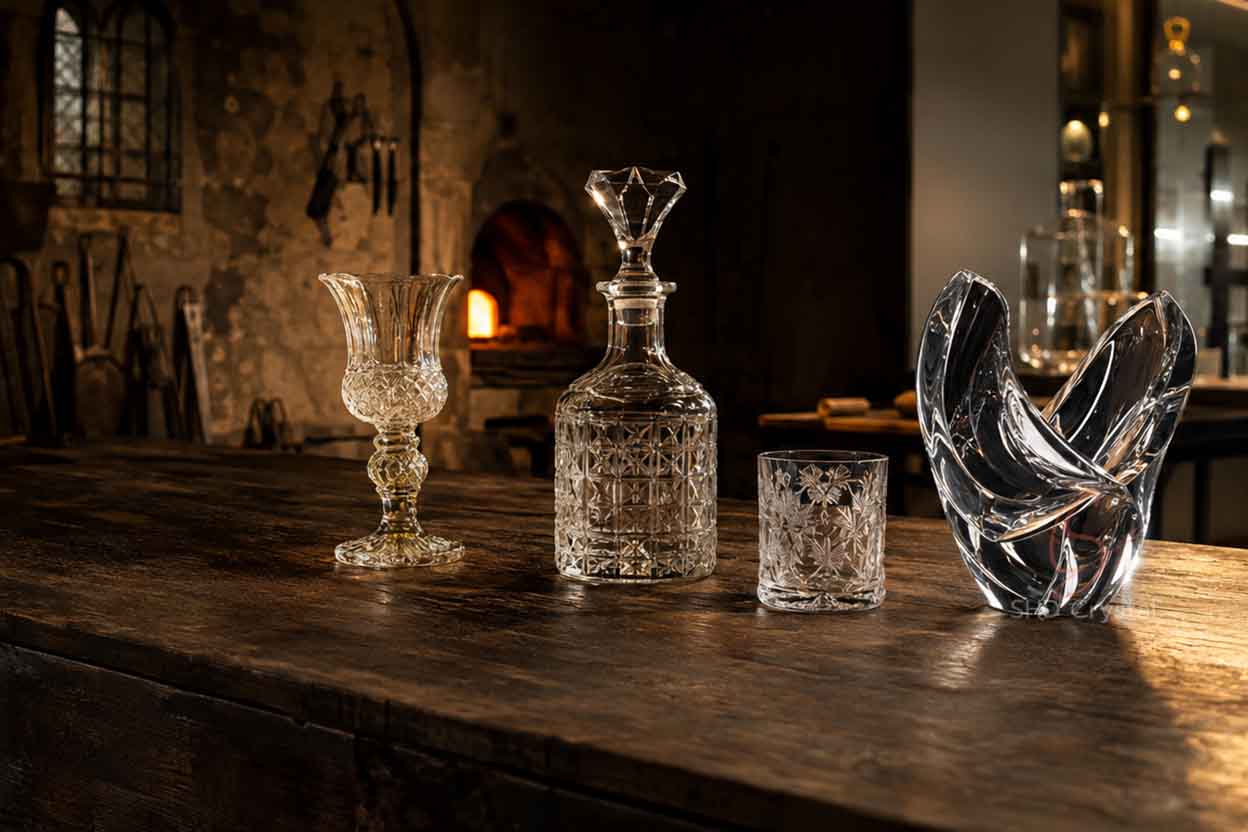
History of crystal glass begins with an ambition: to make man-made glass resemble natural rock crystal. Long before factories, European glassmakers pursued clarity, brilliance, and workability. That search moved through Venetian furnaces, English lead-glass experiments, Bohemian cutting workshops, and eventually modern quality standards. For today’s buyers, the story explains why composition, forming control, annealing, cutting, finishing, and packaging decide whether a crystal product is attractive or commercially reliable.
History of Crystal Glass Began With A Search For Clarity
The word “crystal” did not originally describe one fixed formula. In Venice, cristallo was used from the 14th century for glass intended to resemble colorless rock crystal. It was a claim about appearance before it became a regulated material category.
Picture a furnace worker watching molten glass turn at the end of a blowpipe. There was no digital viscosity reading. The maker judged readiness through color, movement, and experience. Impure raw materials could tint the glass. An unstable batch could later develop surface damage. Even a well-formed piece still had to survive cooling. This early chapter of crystal glassware history established a principle that remains valid: clarity is produced, not simply promised. Raw material quality, furnace condition, forming rhythm, and cooling all leave evidence in the finished object.
Venetian cristallo was not identical to the brilliant leaded material later associated with crystal. The development was not one invention in one workshop. It was a sequence of regional solutions to the same question: how could glass become clearer, more workable, and more expressive?
Lead Glass Changed What Cutters Could Achieve
A major turning point came in 17th-century England. George Ravenscroft received a patent in 1674 for a crystalline glass resembling rock crystal. His early production was not flawless. Some pieces suffered from crizzling, a chemical instability that produces fine surface cracking. The composition was later improved with more lead oxide.
The revised material became known as flint glass or lead crystal glass. It was heavier and more refractive than ordinary soda-lime glass, and it was softer when cold. These properties changed the work of cutters and engravers. Facets could create stronger reflections, while surfaces could be ground, polished, and engraved more readily.
The material became valuable because composition enabled new results: substantial weight, stronger optical effects, and surfaces suited to cutting. During the 18th century, deep cutting became increasingly important in Britain and Ireland. The vessel now had two lives: first at the furnace, then at the cutting wheel.
Cutting Was Beauty With A Structural Cost
A cutter creates decoration by removing glass with rotating wheels and abrasives. Every facet is also a reduction in wall thickness. That makes cutting both an artistic process and an engineering decision.
Crystal glassware history therefore cannot be separated from the blank beneath the pattern. A piece intended for deep cutting needs enough material in the correct areas. If the wall is too thin, the design can weaken it. If polishing pressure is excessive, sharp facets lose definition. If glass distribution is uneven, the cutter inherits a forming problem that should have been solved earlier.
This is why a reference image is not a complete specification. Cutting depth, pattern coverage, wall thickness, weight range, and intended use must be considered together. A ceremonial bowl can support more glass than a thin-stem wine glass.
Crystal rarely objects to decoration. It simply charges for it through weight, labor, inspection, and packaging.
Bohemian Makers Followed Another Route
While English lead glass gained influence, Central European workshops developed a different material path. By the late 17th century, Bohemian makers were producing hard, brilliant potash-lime glass. It moved from molten to rigid more quickly than soda-lime glass and was harder to manipulate at the furnace, but its hardness and brilliance suited facet cutting and copper-wheel engraving.
This matters to the history of crystal glass because similar visual goals emerged from different compositions. English lead glass favored softness, refractive brilliance, and deep cutting. Bohemian potash-lime glass supported precise cutting and engraving through a harder body.
The modern lesson is direct: “crystal” is not a sufficient technical specification. Composition affects density, cutting response, polishing method, and final weight.
Social Use Gave Crystal More Forms
Material innovation alone did not expand the market. People also found more reasons to use crystal. Formal dining, entertaining, gifting, and interior display encouraged specialized forms: goblets, cordial glasses, tumblers, decanters, bowls, chandeliers, and presentation objects. A decanter needed safe pouring weight and a reliable stopper; a centerpiece could be dramatic but still had to stand securely.
This part of crystal glassware history remains useful for buyers. A hotel glass is handled repeatedly, a gift tumbler is judged closely inside a box, and an award needs optical clarity plus an engraving area. Historical objects succeeded when material, shape, and use agreed.
Sound Is Interesting, Not A Certificate
Crystal is often associated with a clear ringing tone. Many well-formed pieces do resonate, but sound should not be treated as a universal test of authenticity or quality. Resonance depends on composition, geometry, wall thickness, and how the object is supported or struck.
A thick bowl, a thin goblet, and a faceted tumbler will not behave identically. A longer ring does not prove better annealing or workmanship. Sound can support evaluation, but it cannot replace dimensional checks, stress control, edge finishing, or application testing.
Annealing Protects Work The Buyer Cannot See
After forming, glass must cool in a controlled way. Annealing is the slow cooling process that allows internal stress to relax. If a hot piece cools too quickly, it may remain highly strained and become more vulnerable to mechanical or thermal shock.
This is one of the least visible but most important lessons in the history of crystal glass. Thick bases, thin rims, attached stems, sculptural shoulders, and decorative sections cool at different rates. The more complex the geometry, the more carefully glass distribution and annealing must be managed. Forming creates the shape. Cooling helps decide whether that shape remains dependable.
Modern Definitions Require More Precision
Today, the word “crystal” may carry legal as well as marketing meaning. European rules distinguish categories through measurable composition and physical properties. Under Council Directive 69/493/EEC, the categories known as full lead crystal and lead crystal have minimum lead oxide contents of 30 percent and 24 percent. Other crystal categories may use combinations of lead, zinc, barium, or potassium oxides and are evaluated through criteria including density, refractive index, and surface hardness.
Not every market uses identical terminology, so buyers should avoid treating crystal as a universal recipe. Lead crystal glass remains valued for refractive brilliance, density, cutting response, and traditional hand feel. Modern lead-free formulations may use other oxides for different optical and market requirements. Their weight, brilliance, hardness, and workability depend on the formula, not simply the label “lead-free.” This is why lead crystal glass and lead-free products should be compared by declared composition and intended use.
A serious specification should request material information rather than rely on a product name.
Handmade Craft Needs Defined Tolerance
Modern equipment has not removed the value of skilled hands. Many forms and finishing operations still benefit from experienced judgment. A worker may refine a curve, align a stem, polish an edge, or reject a defect.
Handwork also introduces variation. The correct response is to define acceptable tolerance. For an artisanal collection, slight differences may support character. For a hotel chain or boxed retail set, buyers may need tighter control of height, capacity, rim position, and visual alignment. Craft becomes commercially useful when variation is understood and managed.
What Buyers Should Carry Forward
The history of crystal glass provides four practical rules. Material must match the product. Deep cutting, thin rims, heavy bases, and sculptural forms create different demands. Visible brilliance should be judged beside invisible controls. Annealing, wall distribution, edge finishing, base flatness, and stopper fit matter as much as sparkle. A sample should represent a repeatable process, not an isolated success. Buyers should ask how forming, cutting, inspection, and packaging will be controlled in bulk production.
Finally, historical inspiration must become specification. “Classic crystal” is a mood. Capacity, weight range, cutting depth, rim thickness, tolerance, logo method, and carton structure are instructions.
Craft Became Commercial Value Through Control
History of crystal glass shows how the search for clarity developed into a relationship between composition, forming, cutting, cooling, use, and trade. Material innovation created new decorative possibilities, but disciplined production made those possibilities commercially valuable. The strongest crystal product is not automatically the heaviest or most deeply cut. It is the object whose material, geometry, finish, and intended use are properly aligned.
Applying Historical Knowledge To Custom Development
For brands developing stemware, tumblers, decanters, bowls, awards, or gift collections, history of crystal glass can turn historical references into better product decisions. Reference images should be supported by dimensions, material expectations, weight range, decoration depth, tolerance requirements, and packaging goals. That is how heritage moves from an attractive story to a realistic production plan.
Read the original article on custom crystal glass manufacturing: https://shdcrystal.com/blogs/history-of-crystal-glass/