
At SHD Crystal, we develop heat resistant candle containers by looking beyond appearance and focusing on how the jar will behave during filling, burning, cooling, packing, and repeated handling. A candle container may look simple on the shelf, but in production it must pass through several stages that put stress on the glass. Hot wax enters the jar. The wax cools and contracts. The wick is centered. The lid must fit. Later, the finished candle is packed, shipped, and used by the customer. That full path shapes how we approach the product.
How We Produce Heat Resistant Candle Containers From Design to Sampling
We usually begin with the use condition, not the decoration. Wax type matters. Filling temperature matters. Jar volume, target weight, and lid style matter too. These points influence shape selection from the start. A clean straight-sided jar is often easier to fill and more stable in packing. A round or softly curved jar may feel warmer and more decorative, but it can change cooling behavior and label placement. If a client wants a square format, we review the corner structure carefully because corners are more sensitive during forming and cooling.
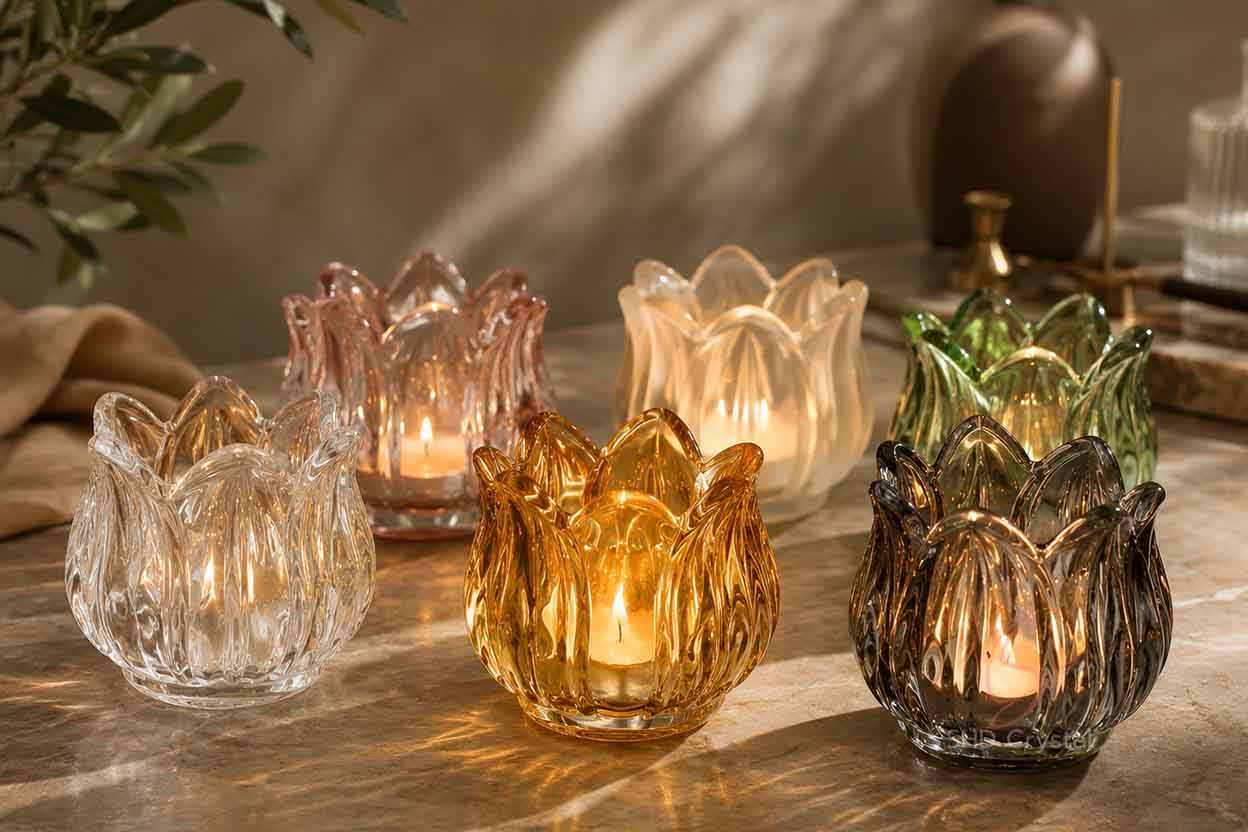
Once the shape direction is clear, we move into glass structure. This is where many buyers make a wrong assumption: thicker glass is not automatically safer. In our experience, candle wax filling safety depends more on balanced wall distribution than on visual heaviness alone. If the base is too thick while the side wall is relatively thin, the temperature difference during cooling can increase stress concentration. That is why we pay close attention to wall thickness transition, base proportion, and how the overall jar mass is distributed.
Mold design is the next step. Mold tolerance affects the mouth diameter, the body symmetry, and the flatness of the bottom. These details matter. If the finish is unstable, the lid may fit poorly. If the base is uneven, the jar may not sit securely on a table or retail shelf. We also review rim finishing at this stage. A smooth polished rim improves hand feel and reduces the risk of rough contact during filling and use.
After forming, annealing stress control becomes one of the key production checkpoints. We do not treat annealing as a background step. It directly affects whether the container can manage the thermal changes created by wax filling and candle burning. A jar that looks good visually may still perform badly if the internal stress is not properly relieved. This is especially important for heavy-base jars, tinted glass, or containers with more unusual silhouettes.
Decoration comes later, but it still has to respect the product’s function. Frosted surfaces, color spraying, screen printing, and hot stamping can all work well, yet they should be checked against scratch resistance and handling conditions. The candle jar will move through several hands before it reaches the end user. A finish that looks attractive in a photo may not remain clean through filling, labeling, and export packing.
We also encourage clients to test the real product, not just the empty glass sample. Candle wax filling safety should be checked after filling, cooling, wick positioning, lid matching, and normal burning use. That is where practical issues appear. Sometimes the jar is fine, but the full candle system is not.
Interested in custom glassware or related products?
Contact our team to discuss your project requirements.
Conclusion
For us, heat resistant candle containers are made through a combination of design judgment, forming control, and production testing. Glass structure, mold accuracy, annealing stress control, and actual filling conditions all influence whether a candle jar is ready for repeatable OEM supply rather than only visual presentation.
Planning a More Reliable Candle Jar Project
If your brand is developing heat resistant candle containers, SHD Crystal can support the project from jar shape review to candle wax filling safety discussion, surface finishing, sampling, and export packing advice. Early technical alignment often makes the container easier to produce, easier to fill, and more dependable in final use.
Read the original full version: https://shdcrystal.com/blogs/heat-resistant-candle-containers/