
Empty wine bottle supplier performance is often easiest to judge after the bottles arrive at the filling facility. A bottle may look correct in a catalog and still create problems when it meets real production equipment. Neck variation can affect closure application. An unstable base can interfere with conveyor movement. Small changes in body diameter may shift label positioning. For beverage brands, these issues turn an apparently simple bottle purchase into a wine bottle packaging decision with direct production consequences.
What an Empty Wine Bottle Supplier Must Get Right Before Delivery
Imagine two bottles that appear almost identical when placed side by side. Both have the same nominal capacity and similar color. Once they enter production, however, one moves consistently through filling, sealing, labeling, and packing while the other requires repeated adjustments.
The difference often comes from details that are not obvious in product photos.
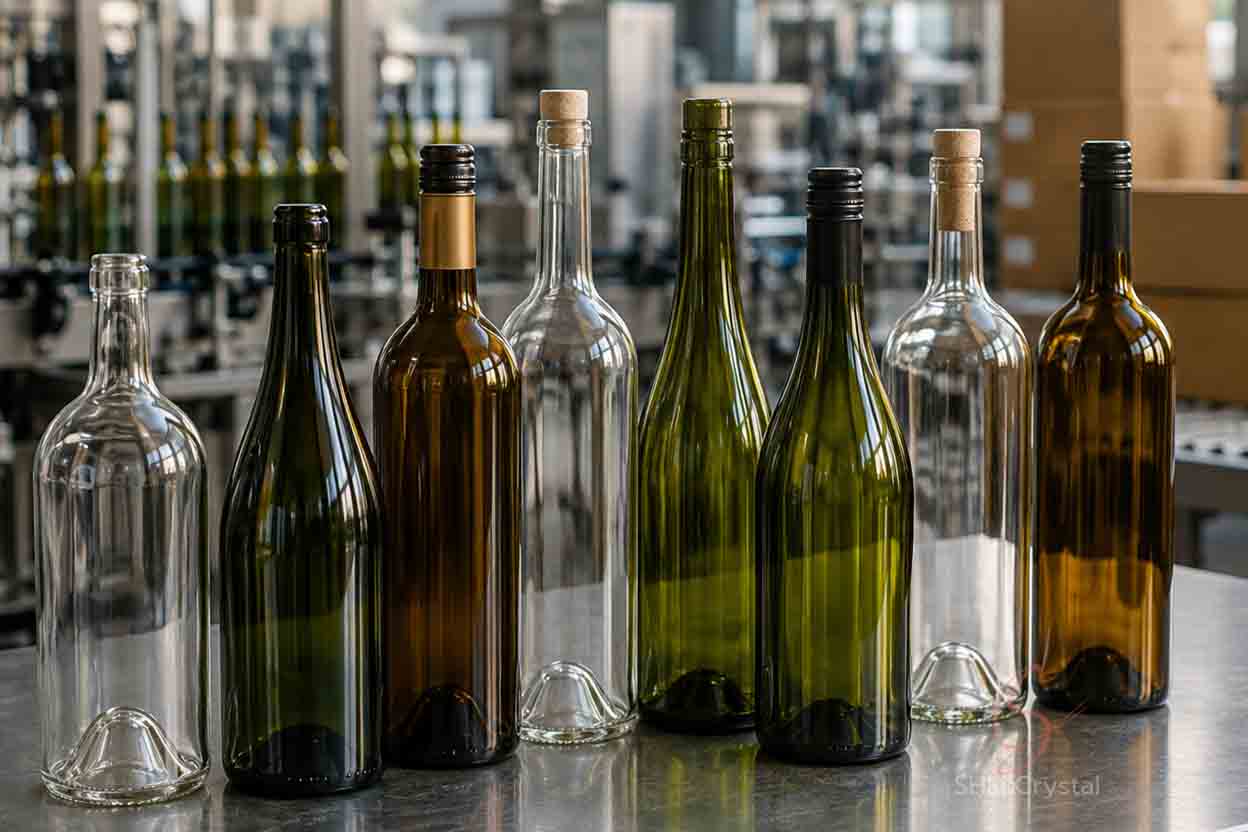
Neck finish is one example. Corks, screw caps, and other closures depend on controlled dimensions. A supplier should therefore know the intended closure before production rather than treating the neck as a decorative feature. For custom wine bottles, closure compatibility needs to be confirmed during sampling because an attractive silhouette provides little value if the final sealing system is unreliable.
Capacity Is More Than the Number on a Drawing
Bottle capacity is affected by internal geometry. Punt depth, shoulder position, wall distribution, and base thickness all influence how much liquid the bottle actually holds at the intended fill level.
This becomes especially important when wine bottle packaging is integrated with automated or semi-automated filling equipment. Buyers should confirm usable capacity and fill height with physical samples instead of assuming that every bottle carrying the same nominal specification behaves identically.
The same principle applies to weight. A heavier bottle may support a particular brand image, but excessive glass concentrated in the base can create a sharp wall thickness transition. That changes cooling behavior during manufacture and may increase unnecessary shipping weight.
Decoration Problems Often Begin With Bottle Geometry
Labels and decorative treatments expose structural differences quickly. A label applied to a straight body panel behaves differently from one crossing a curved shoulder. Screen printing requires a predictable printing area. Frosting, spraying, and metallic finishes introduce their own surface-control requirements.
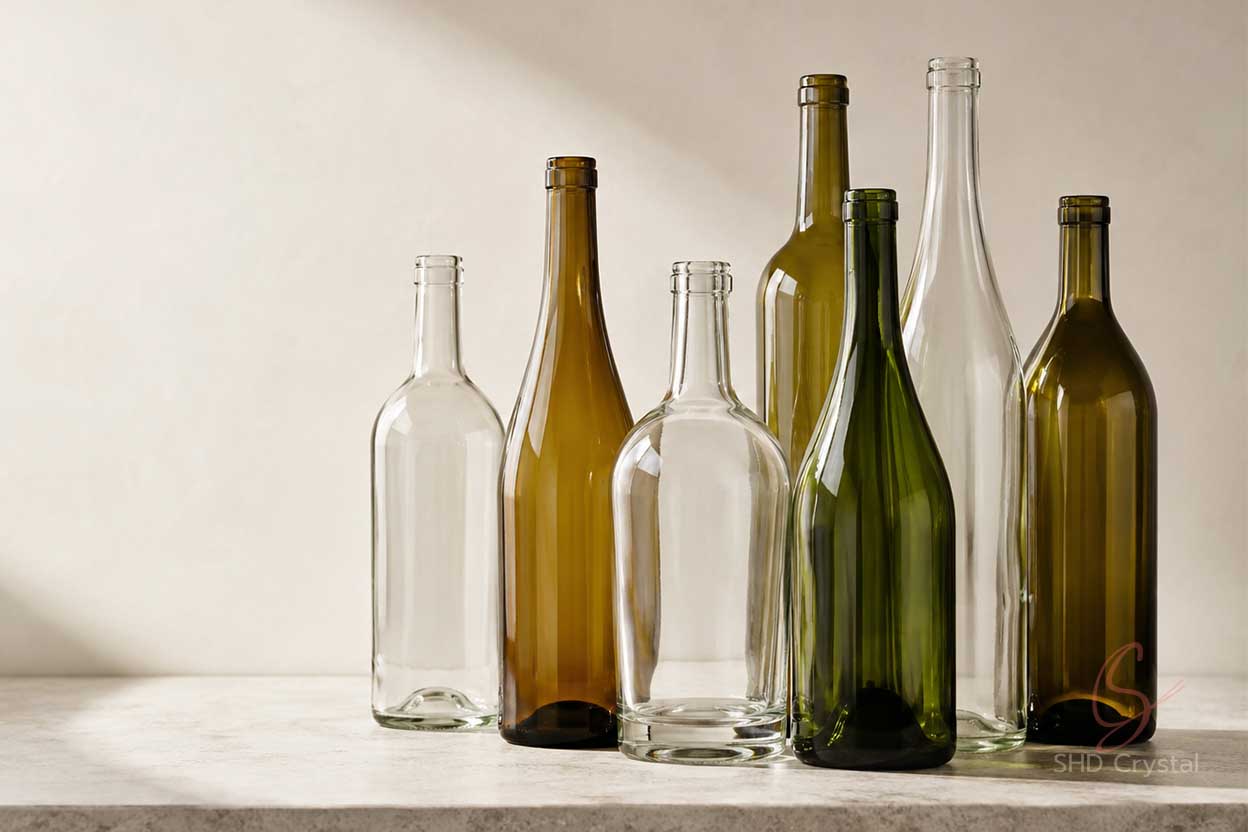
For custom wine bottles, decoration therefore needs to be reviewed against the actual production sample. One common mistake is finalizing artwork before the usable label panel has been confirmed. The result may be wrinkling, misalignment, or last-minute artwork resizing.
A capable empty wine bottle supplier should identify these limitations before mass decoration begins.
The Best Sample Is Not Always the Best Supply Decision
A highly polished development sample can prove that a bottle is achievable. It does not necessarily prove that thousands of bottles will arrive with the same neck dimensions, glass color, body shape, and surface quality.
Repeatability is what matters. During glass forming, mold tolerance, forming temperature, glass distribution, and annealing behavior influence dimensional stability. If these variables drift, differences may later appear during closure fitting or label application rather than at the glass factory itself.
This is why wine bottle packaging projects should define critical inspection points before repeat orders begin. Neck finish, bottom flatness, body dimensions, color range, surface appearance, and packing specification are more useful when they are treated as agreed production criteria.
Export Packing Is Part of Bottle Engineering
Empty bottles behave differently from filled bottles during transportation. They are light relative to their volume and remain vulnerable to direct glass-to-glass contact. A carton that simply fits the bottles is not automatically an effective export package. Dividers, bottle spacing, carton strength, pallet arrangement, and loading direction should reflect the actual bottle geometry. Custom wine bottles with embossed surfaces, heavy bases, or unusual shoulders may need different protection from standard cylindrical designs. For international projects, the cost of better packing is often easier to manage than the cost of breakage discovered after arrival.
Conclusion
An empty wine bottle supplier should ultimately be evaluated by what happens after the glass leaves the factory. Reliable bottles need to pass through filling, closure application, decoration, packing, transport, and repeat ordering without creating new compatibility problems. Good wine bottle packaging begins with those downstream requirements, not with an isolated bottle photograph.
From Bottle Specification to OEM Supply With SHD Crystal
As a China-based empty wine bottle supplier and OEM glass manufacturer, SHD Crystal supports custom wine bottles through bottle structure review, mold development, automated glass forming, annealing, inspection, surface finishing, closure coordination, and export packing. By confirming filling conditions, closure type, decoration area, and transport requirements early, SHD Crystal can help beverage brands build a wine bottle packaging program around repeat production rather than one-time sample approval.
Read the original full version: https://shdcrystal.com/blogs/empty-wine-bottle-supplier/