
Soda-lime glass market in 2026 trends suggest that the material should no longer be viewed only through the lens of economical everyday glassware. The global glassware market is estimated at USD 16.93 billion in 2026, up from USD 16.07 billion in 2025, according to Market Data Forecast. Soda-lime glass held a reported 70.8% share of the glassware market by material in 2025, while premium and handcrafted collections are identified as one of the faster-growing price segments.[1] These figures do not prove that premium soda-lime glass is replacing crystal directly, but they establish an important background: the industry’s largest material category is participating in a market where buyers are also showing stronger interest in higher-value presentation.
What the Soda-Lime Glass Market in 2026 Reveals About Material Positioning
The three major material families often discussed in commercial glassware serve different purposes.
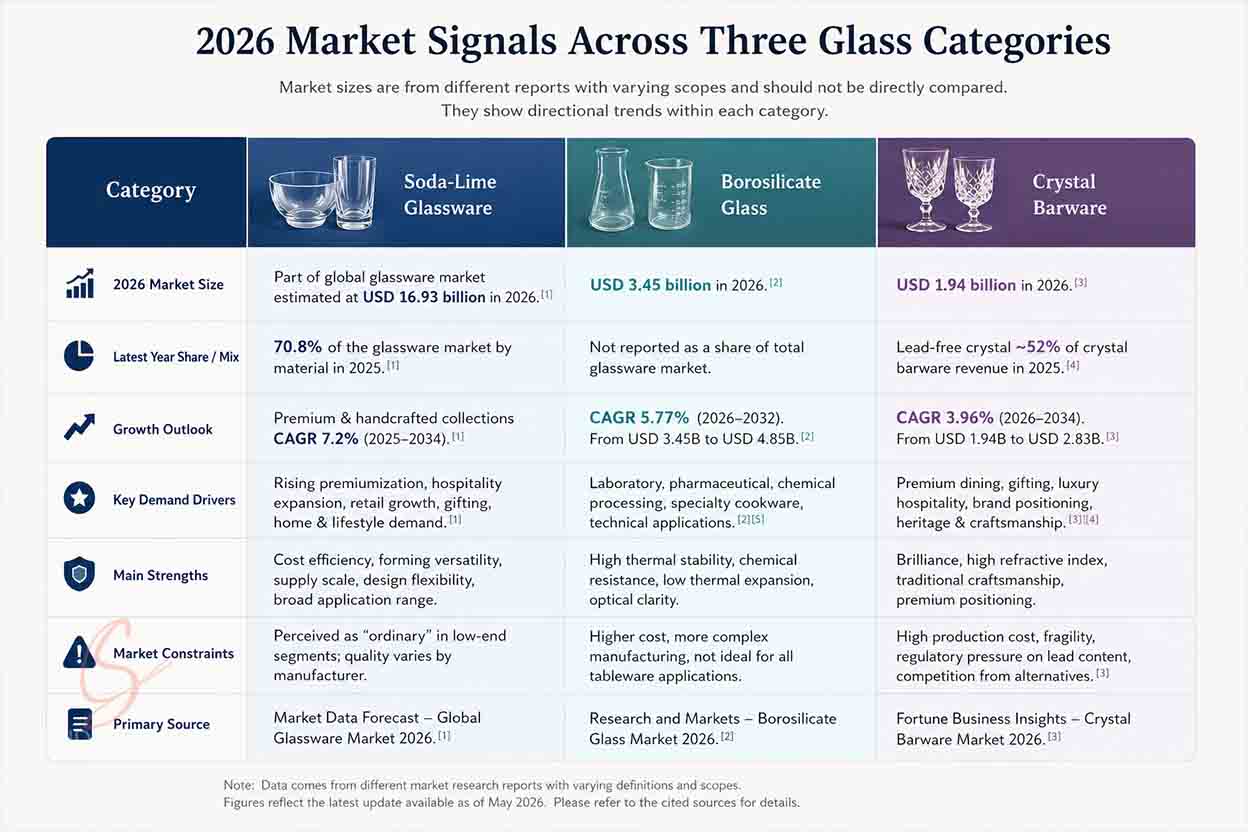
These figures come from separate market reports with different definitions and scopes. They should therefore be read as directional indicators rather than combined into a direct market-share comparison.
Borosilicate Growth Is Primarily Performance-Led
The borosilicate glass market follows a different demand logic from mainstream tableware.
Research and Markets estimates the global category at USD 3.45 billion in 2026, compared with USD 3.27 billion in 2025, and projects a 5.77% CAGR through 2032.[2] The report connects demand with applications that benefit from thermal stability, chemical resistance, dimensional reliability, and optical clarity.
SCHOTT describes borosilicate glass as having greater chemical durability and thermal resistance than conventional soda-lime glass, with low thermal expansion providing resistance to thermal shock and temperature fluctuations.[3]
This makes high-borosilicate glass particularly relevant where performance under heat or chemical exposure is central to the product specification.
It does not automatically make borosilicate the preferred choice for every premium bowl, goblet, charger plate, serving vessel, or decorative object.
For projects where the main requirements are visual clarity, dimensional consistency, decorative forming, polishing, color finishing, and commercial-scale production, the additional thermal properties of borosilicate may provide limited practical benefit. The borosilicate glass market is therefore expanding alongside soda-lime glass rather than simply replacing it.
Crystal Remains Valuable, but Its Material Mix Is Changing
The lead crystal glass market requires even more careful interpretation.
Fortune Business Insights values the wider crystal barware market at USD 1.94 billion in 2026, compared with USD 1.88 billion in 2025, and forecasts continued growth through 2034.[4] This confirms that demand for crystal-style premium drinkware and serving ware remains commercially significant.
However, crystal no longer means lead crystal alone.
Global Market Insights reports that lead-free crystal accounted for approximately 52% of crystal barware revenue in 2025 and was growing faster than traditional lead crystal.[5] Fortune Business Insights also segments the current market into lead crystal, lead-free crystal, and soda-lime glass, while identifying high production costs and competition from alternative materials as constraints on the crystal barware category.[4]
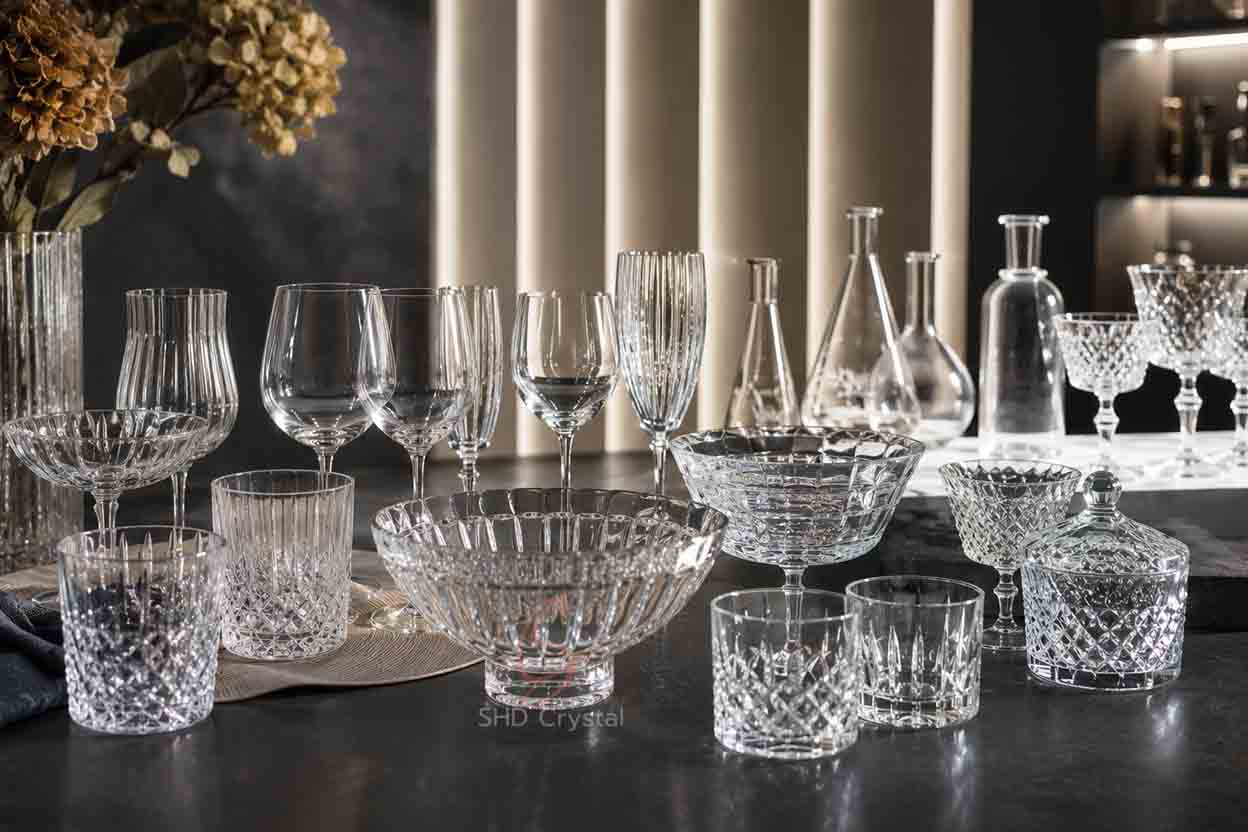
The shift should not be interpreted as the disappearance of traditional crystal. Lead crystal retains distinctive density, refractive behavior, heritage value, cutting characteristics, and luxury positioning.
There is nevertheless evidence that premium glassware demand is becoming less dependent on lead content as the defining mark of quality.
Regulation Adds Another Reason for Material Diversification
The regulatory picture also deserves precise wording.
EU Directive 69/493/EEC still defines specific crystal categories. Under the Directive, products described as certain forms of lead crystal are associated with minimum PbO contents of 24% or 30%, together with other physical criteria.[6]
Separately, the European Commission is reviewing food-contact rules for ceramic and vitreous materials. The Commission explicitly includes glass and crystal within vitreous food-contact materials and states that current work aims to lower migration limits for lead and cadmium while considering limits for several additional metals.[7]
This does not mean that lead crystal is universally prohibited.
It does mean that manufacturers, brands, and food-contact buyers have additional reasons to examine material composition, intended use, destination-market requirements, and testing obligations rather than treating the term “crystal” as a purely aesthetic specification.
For the lead crystal glass market, that environment strengthens the commercial relevance of lead-free alternatives and other premium glass options.
Why Premium Soda-Lime Glass Is Becoming More Competitive
The most important change is not that soda-lime glass has acquired the same properties as lead crystal. It has not.
The change is that manufacturing quality can now deliver many of the visual characteristics buyers actually seek without requiring a traditional lead-crystal composition.
Transparency is a good example.
Low-iron glass technology demonstrates the broader material principle that reducing iron content can substantially reduce the green cast associated with conventional clear glass and increase visual neutrality and light transmission.[8] Pilkington’s technical information relates primarily to flat glass rather than tableware, so its figures should not be transferred directly to a pressed bowl or stemware product. The underlying relationship between iron content, color cast, and optical clarity is nevertheless relevant when considering higher-clarity glass formulations.
For tableware manufacturers, raw-material control is only the beginning.
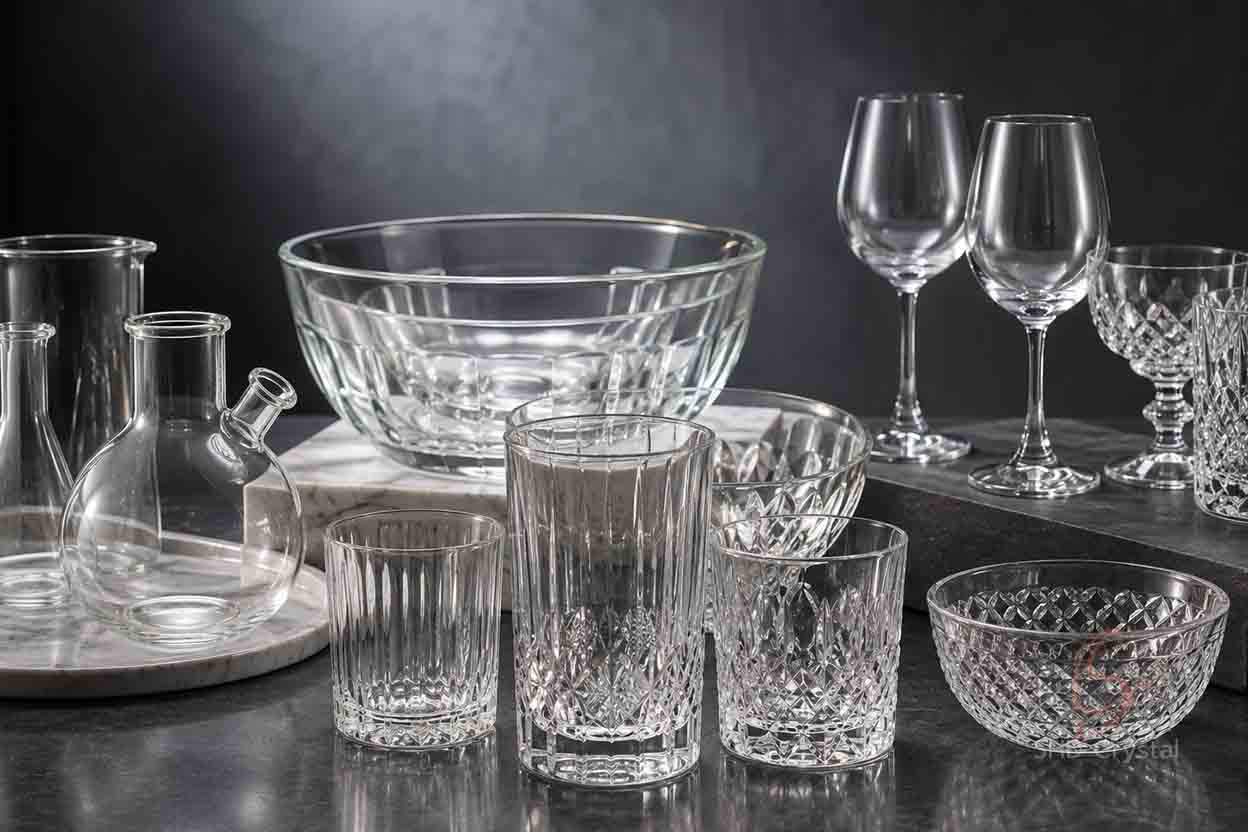
Forming temperature, mold condition, wall thickness distribution, annealing behavior, fire polishing, mechanical polishing, and surface finishing all influence how premium a soda-lime product appears.
Deep pressed facets can create stronger reflections. A carefully controlled heavy base can improve perceived substance. Better rim finishing changes hand feel. Consistent mold definition makes beads, ribs, diamonds, and geometric patterns appear sharper across a collection.
None of these processes turn soda-lime glass into crystal.
They can, however, reduce the visual gap between ordinary mass-market glassware and products historically selected from more expensive material categories.
 Premium Demand Creates Space Between Commodity Glass and Traditional Crystal
Another useful signal comes from the glassware market itself.
Market Data Forecast identifies premium and handcrafted collections as a faster-growing price segment, with a projected CAGR of 7.2%, above the overall glassware market forecast reported by the same research provider.[1]
That does not establish which material will capture all of that growth.
It does indicate that buyers are willing to move beyond economy-grade glassware.
This creates a commercially important middle ground.
Hotels may want visually refined glassware that can still be reordered in significant quantities. Event suppliers need decorative serving pieces that look sophisticated under strong lighting but remain economically realistic across hundreds of table settings. Private-label homeware brands may want heavy bases, clear surfaces, geometric relief, or polished rims without positioning the entire collection as traditional crystal.
For these applications, the soda-lime glass market in 2026 has an opportunity to compete on perceived product value, not merely on low material cost.
Does This Mean Soda-Lime Glass Is Replacing Lead Crystal?
Only in a qualified sense. Available market reports do not provide a reliable statistic showing that a defined percentage of lead crystal demand has transferred directly to soda-lime glass.
The evidence instead shows several parallel developments:
- soda-lime remains the dominant material in the broader glassware market;[1]
- premium glassware demand is growing within that market;[1]
- traditional crystal production faces relatively high costs and competition from alternatives;[4]
- lead-free crystal is gaining share within premium barware;[5]
- current European food-contact policy work continues to focus on reducing exposure to lead and other metals from vitreous materials;[7]
- improved material control can produce glass with substantially greater optical neutrality than conventional formulations.[8]
Taken together, these signals support a cautious market interpretation.
High-clarity, well-formed, and carefully finished soda-lime glass is increasingly capable of serving applications where buyers may previously have specified lead crystal mainly for visual prestige, weight, decorative detail, or premium presentation.
That is different from claiming that soda-lime glass can replace crystal wherever crystal’s specific optical, acoustic, density, or craftsmanship characteristics are essential.
The substitution opportunity is strongest where the desired outcome is premium appearance rather than a specific crystal composition.
Conclusion
The soda-lime glass market in 2026 combines a dominant material base with a broader premiumization trend in global glassware. The borosilicate glass market continues to grow around technically demanding applications, while the lead crystal glass market remains commercially relevant but is increasingly shared with lead-free and alternative premium materials. Current evidence does not support a claim that soda-lime glass is replacing lead crystal across the entire market. It does support a more measured conclusion: higher-clarity soda-lime glass, combined with improved forming, polishing, decoration, and production consistency, is becoming a credible premium option in applications where appearance and commercial scalability matter more than traditional lead-crystal composition.
Developing Premium Soda-Lime Glass With SHD Crystal
For brands responding to the soda-lime glass market in 2026, SHD Crystal supports high-quality soda-lime tableware, drinkware, serving ware, and decorative glass through material evaluation, mold development, automated forming, annealing, polishing, surface finishing, and quality inspection. The objective is not to market soda-lime glass as lead crystal, but to use controlled manufacturing and high-transparency material options to create a refined visual result at a production structure suitable for OEM and repeat commercial programs.
📖References and Data Sources
[1] Market Data Forecast. “Global Glassware Market Size, Share, Trends & Growth Forecast Report, 2026-2034.”
The report estimates the global glassware market at USD 16.93 billion in 2026, reports soda-lime glass at 70.8% of the market by material in 2025, and identifies premium and handcrafted collections as a faster-growing price segment.
[2] Research and Markets / 360iResearch. “Borosilicate Glass Market – Global Forecast 2026-2032.” January 2026.
The report values the market at USD 3.27 billion in 2025 and USD 3.45 billion in 2026, with a projected CAGR of 5.77% to USD 4.85 billion by 2032.
[3] SCHOTT. “Borosilicate Glass.” Material and Technical Information.
SCHOTT describes borosilicate glass as offering high chemical durability, low thermal expansion, high thermal resistance, and strong optical clarity compared with conventional glass types such as soda-lime glass.
[4] Fortune Business Insights. “Crystal Barware Market Size, Share, and Industry Analysis, 2026-2034.” Updated August 3, 2026.
The report estimates the global crystal barware market at USD 1.94 billion in 2026 and identifies high production costs, competition from alternative materials, and fragility as market restraints.
[5] Global Market Insights. “Global Crystal Barware Market Size, Forecasts Report 2026-2035.”
The report states that lead-free crystal accounted for approximately 52% of crystal barware revenue in 2025 and was growing faster than traditional lead crystal. Its market segmentation also separately recognizes lead crystal, lead-free crystal, and soda-lime crystal-grade glass.
[6] Council of the European Communities. Council Directive 69/493/EEC Relating to Crystal Glass.
The Directive establishes crystal-glass categories based on composition and physical characteristics, including categories associated with minimum lead oxide contents of 24% and 30%.
[7] European Commission, Directorate-General for Health and Food Safety. “Revision of EU Rules on Food Contact Materials.”
The Commission states that its ongoing work covers vitreous food-contact materials including glass and crystal and aims to reduce migration limits for lead and cadmium while considering limits for additional metals.
[8] Pilkington / NSG Group. “Pilkington Optiwhite.” Technical Product Information.
Pilkington describes low-iron extra-clear glass as having higher light transmission and substantially less green color cast than conventional clear glass. This source is used here to support the general relationship between iron content and optical clarity, not as tableware-specific market evidence.
only URL: https://shdcrystal.com/blogs/soda-lime-glass-market-in-2026/