
Why Stemmed Shot Glasses OEM Quality Lives in the Mold
Buyers often start a stemmed shot glasses OEM search focused on price per piece, yet the factors that sink a run surface long before the first mold is cut. A private label drinkware program rarely fails on looks; it fails on wall thickness, stem curvature, batch consistency, and how the piece behaves under layers of identical glass above it in a carton. This checklist runs through the production checks we make on the floor before we commit to an order.
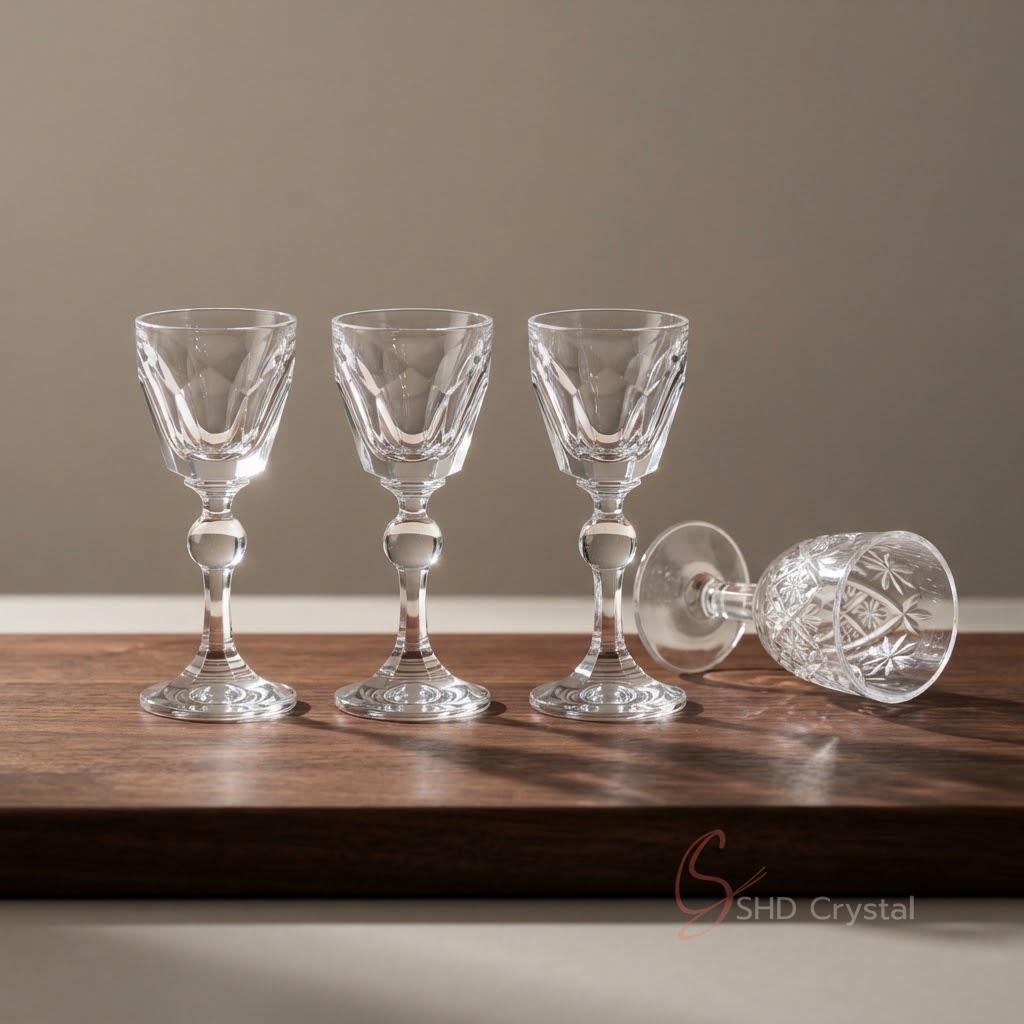
In our experience, the distance between a premium stem and a wobbly one is mold tolerance and strain point control, not marketing. We press and blow stemware in molds whose tolerances run to tenths of a millimeter; that control keeps a logo area flat and the foot plumb. A practical consideration is that a cheaper, looser mold still delivers a flawless first sample, then drifts as tooling wears and color shifts between batches.
Annealing That Won’t Bite You Later
Every stem gathers, forms, and passes through the lehr on a temperature profile tuned to its geometry. If that lehr cycle is trimmed to raise throughput, internal stress is frozen in at the strain point and the piece can crack weeks after dispatch, long past our packing line. We hold retained samples and read them under a polariscope before sign-off.
Five Points to Settle Before You Sample
Before you approve a sample by appearance alone, lock five numbers: target capacity in ml, expected finished weight, decoration method, packaging route, and planned order quantity. For large runs, request multiple batch samples, at least two culled from different shifts, and ask whether you are shipping from a stock mold or commissioning new tooling. Confirm closure and handling for stacking, because a flared-rim stemmed shot needs different carton protection than a straight tumbler.
Stock Mold or Custom Stemmed Shot Glasses OEM
Stock molds carry profiles we have produced for years, so glass composition and color stay predictable run to run. Custom work buys new tooling and a longer lead time in exchange for a signature shape nobody else carries, a real edge for gift sets and hotel-chain programs that need a recognizable silhouette.
| Feature | Stock Mold | Custom Mold |
|---|---|---|
| Tooling lead time | Immediate | Weeks for new tooling |
| Design control | From existing profiles | Exact to your drawing |
| Unit cost | Lower, shared tooling | Higher, amortized tooling |
The trade-off shows up in per-unit cost and commitment. Use a stock stem to move fast and de-risk a launch; reserve custom tooling for a shape or logo you intend to run in volume, because amortizing the mold quickly narrows the price gap by the second season.
We routinely stack three logo treatments for a run: sandblast frosting, screenprint, and acid etch. Sandblast bites deep into the wall for a matte, hard-wearing mark; screenprint gives crisp color but can smear when surface haze remains after anneal; acid etching reads translucent and elegant yet is permanent once applied. The choice is as much brand strategy as it is glass.
Two lessons stick with us. One private-label buyer moved the logo to a position not on the approved drawing, and the art landed across the curved shoulder where stem curvature distorted every character. Another client approved a printed order whose logo smeared because the surface carried a faint haze we had to strip and re-print. Both were caught at finishing, so neither reached the carton.
Custom Shot Glass Production Reality
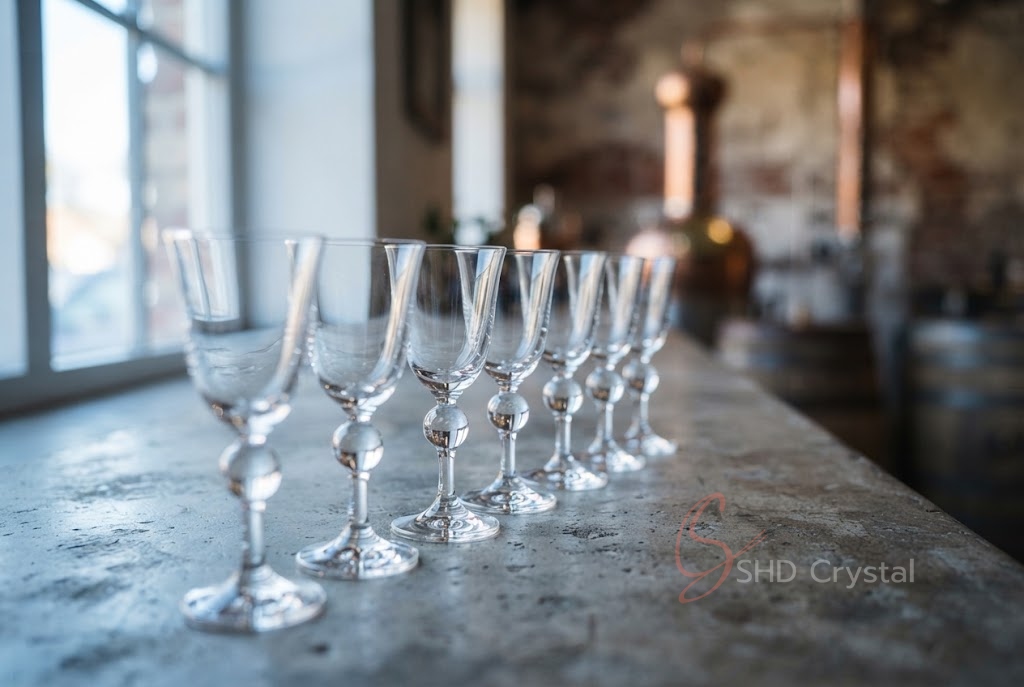
Every custom shot glass production line we run is governed by rim finishing, base stability, and dimensional tolerance before decoration starts. We gauge stem thickness optically and reject anything out of spec at the anneal stage, not at export ready.
From our production experience, the most common complaint in this product line is a stem leaning a hair left of vertical, which also drags base stability off. Our final inspection marks the foot concentric with the barrel; any run that drifts is remade.
Packing for Export
We pack stemware with corrugated cells, foam inserts, and dividers sized to vessel mass, isolating the foot and rim so stacking pressures never transfer to the stem; private label drinkware survives the journey because export packing is planned at the same time as the product, not squeezed in after the order is signed.
How We Quote a Stemmed Shot Glasses OEM Run
A stemmed shot glasses OEM quote from our desk carries a breakdown of material, tooling, decoration, and carton allowance, because private label drinkware pricing hides surprises when any of those is left vague. Give us the five numbers from earlier and we quote clean; change the logo mid-cycle and the mold position, decoration steps, and custom shot glass production timing all ripple. That is why we push buyers to freeze artwork and dimensions before the first charge is gathered, which is how most private label drinkware schedules stay intact.
What the Sample Will Not Tell You
A single perfect sample will not reveal batch consistency, so judge a run by custom shot glass production samples pulled from full production rather than the beauty piece sent for approval. For stemmed shot glasses OEM, we usually recommend ordering a pilot batch before committing to volume.
Frequently Asked Questions
How long does tooling and production take for a stemmed shot?
If you work from a stock mold, samples go out in days and full production follows once approved. New tooling adds weeks because we must cut, polish, and verify the mold under a polariscope before gathering begins. Expect roughly four to six weeks for a custom program, excluding sea freight.
Should we choose lead crystal or lead-free glass?
Lead-free glass gives you the ring and weight buyers expect without the extra content, and it anneals with a steadier profile. We routinely run both, and a practical rule is to let containment, cost, and target markets decide. We can match either to a specific wall thickness and bowl volume.
What is the minimum order quantity for private label drinkware?
Stock-mold runs can start from modest quantities because the tooling cost is shared across many customers. Custom tooling makes more sense at volume, and a pilot batch limits risk before you lock in a full container. Tell us your target and we will map the break-even.
Is the logo position really fixed once sampling is approved?
Yes, and that is deliberate. Art placed over a curved shoulder behaves differently from art on the barrel, so we screenprint or sandblast only where the approved drawing placed it. Moving it later risks distortion we can avoid entirely at drawing stage.
Conclusion
A stemmed shot glasses OEM commitment should feel like a partnership with a factory that reads strain, not just a price sheet. Settle capacity, weight, decoration, packing, and quantity early, request honest batch samples, and let the mold and the anneal work for you before the first charge is gathered.
Start With a Conversation, Not a Container Order
If you are weighing a stemmed shot glasses OEM run, begin with a talk rather than a full order. Tell SHD Crystal your capacity target, decoration method, and packaging route, and our production team will advise whether a stock mold or new tooling fits your timeline and budget, no pressure and no jargon.
Interested in custom glassware or related products?
Contact our team to discuss your project requirements.