
Triangular Perfume Bottle OEM Starts With Corner Distribution
Triangular perfume bottle OEM is the single most demanding shape we press, and it deserves more planning than a round collar or a stock cylinder. Buyers arrive with an angular sketch expecting the same cost and timeline as a simple flute; in practice the profile drives every downstream decision, from the wall thickness transition at each corner to the lehr settings that keep those angles free of internal stress. What looks like a striking silhouette is, to us, a geometry problem before it is a design statement.
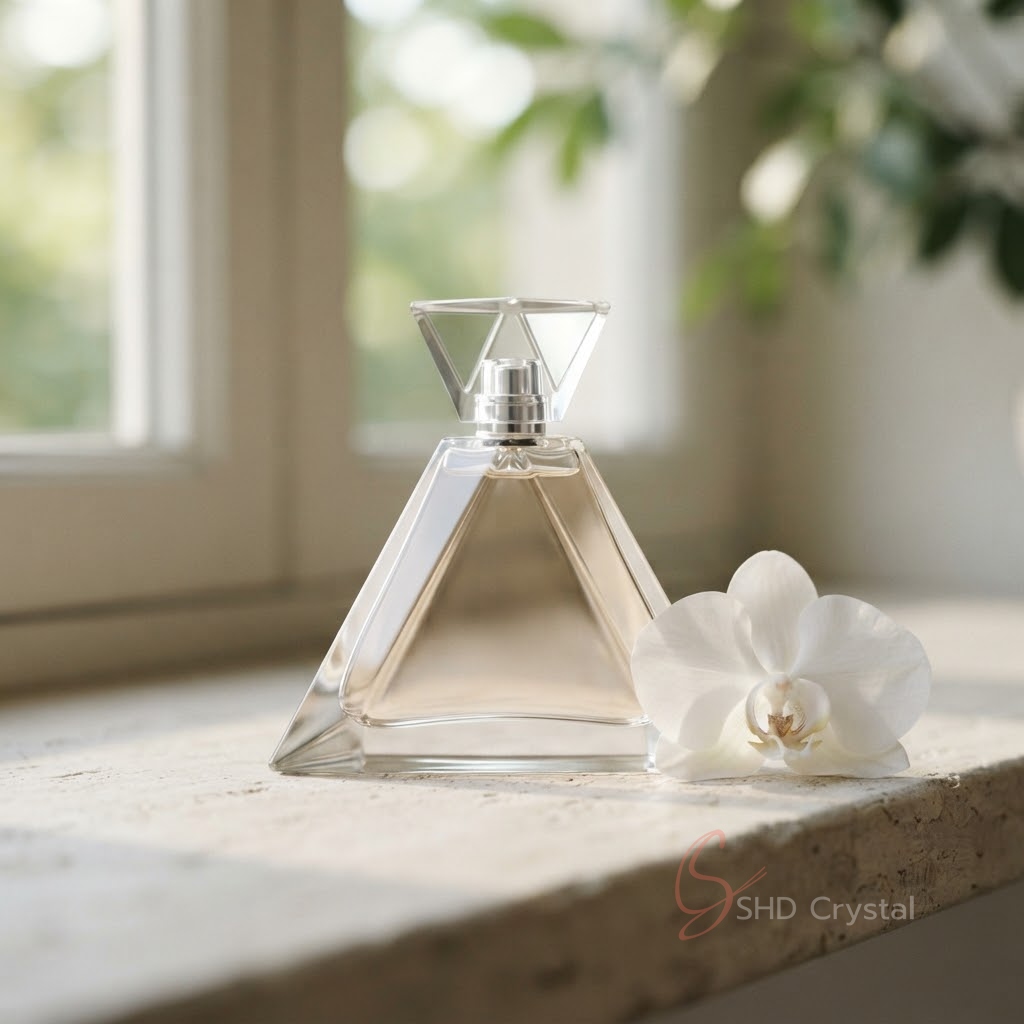
A triangular body concentrates engineering where a round blank does not. In a round bottle the wall stays fairly even; in a triangle the three corners either gather generously or thin out, and that outcome is fixed by mold tolerance and the way the glass gathers inside the cavity. If the corner diameter is undersized while the flat facets are allowed to swell, the corner quietly becomes the thinnest wall in the piece, exactly where a fracture begins. From our production experience, the corner-to-wall thickness distribution is the first number we read on the drawing before any custom perfume bottle production quote is written. This geometry defines every triangular perfume bottle OEM project we take on.
| Feature | Round Body | Triangular Body |
|---|---|---|
| Corner versus wall | Near-uniform around the circumference | Thinnest at the three corners unless tooled |
| Decoration fit | Artwork registers against a simple curve | Facets and artwork must align to the angles |
| Annealing (lehr) load | Even heat release across the piece | Needs slower cooling near corners to avoid strain |
| Mold machining | Stock tooling available | Custom tooling with tighter mold tolerance |
Notice the annealing row in particular; it explains the price gap at quotation. Angular bodies hold heat in the flat panels while the thin corners shed heat faster, so the glass solidifies at different rates across a single piece, which is why we ask for extra annealing care on triangles. The lehr profile and the cooling curve must accommodate that uneven section, and a retained sample checked under a polariscope will show whether your strain point was respected. For perfume glass packaging private label orders, this slower cooling is the hidden cost most buyers never see in a first-quote comparison.
Why Angular Bodies Need Extra Annealing Care
Corner diameter and wall thickness share an inverse relationship that surprises most buyers. Widen the corner and you must thin the flat panels to hold weight; thicken the panels and you crowd the corner until it pinches against itself. We balance the two numerically before machining, then confirm the result under a polariscope on the trial fill, because the strain point can look correct on paper and still be wrong on the first glass that cools. This check belongs at the front of a custom perfume bottle production timeline.
Compare Triangular Perfume Bottle OEM Finishes
Finishing is where A, B, and C truly diverge. Screen printing on an angular panel demands a layout adjusted to the surface curve, sandblasting exposes facet alignment because the raised edges catch the blast, and a fully frosted body softens the corners yet still obeys the same thickness rules underneath. Each finish changes what you must specify before sampling, and none of them forgives a corner tooled too thin.
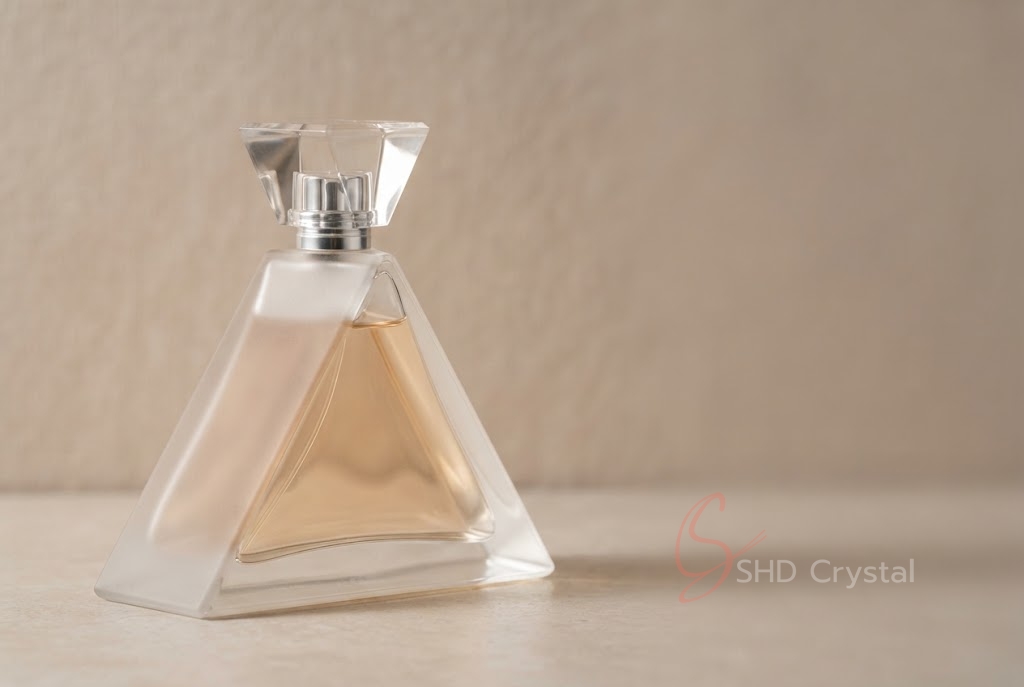
A round-standard neck finish is the quiet fix for angular bodies. We machine the collar to a circular tolerance even when the silhouette is triangular, so the closure seats evenly and the capping machine does not flex an uneven rim; keeping that neck finish independent of the angled body removes the most common stress-crack source we see in custom perfume bottle production. It also holds rejects down when capping runs at speed, a gain you only feel in volume.
Two Ways a Triangle Fails Before It Ships
We remember two returns that never should have shipped. One brands triangular perfume bottle OEM order fractured in transit because the three corners, tooled as the thinnest walls, could not absorb the stacking load inside the carton. Another reached capping with a stress crack at the neck finish: our inspector flagged an uneven rim wall on the frosted angular panel, and the crack split the moment torque was applied. Neither was a material failure; both were geometry choices clearly visible on the original drawing.
Questions to Ask Before Tooling
Bring a list of questions before any mold is cut. Ask how the corners are sized for minimal stress, whether the neck finish is round-standard even when the body is angular, what tolerance holds on the angled wall, and how your decoration will align to the facets instead of fighting them. Confirm spray or cap compatibility on a scratch sample early in custom perfume bottle production, and for any perfume glass packaging private label launch, ask how carton protection changes for an angular body.
Plan Packaging With the Same Discipline
Packaging deserves the same discipline as the glass itself. An angular bottle accepts shock differently than a round one, so corner inserts and a tighter carton fit matter more than foam cushioning alone. When a perfume glass packaging private label project skips this step, breakage climbs sharply and the blame usually lands on the glass rather than the box; that is why the mold and the packing spec for a triangular perfume bottle OEM should be developed together in the same call.
A practical consideration is that an angular body gains rigidity from properly sized corners, so a heavier bottle is not automatically a safer one. We usually recommend specifying a minimum corner wall, then verifying it across ten samples of the same batch, because a triangular perfume bottle OEM program lives or dies on batch consistency as much as on the first beautiful piece. Add carton protection with corner inserts and you remove most transit breakage before it starts.
Frequently Asked Questions
Is a triangular bottle more expensive than a round one of the same volume?
Typically yes, because the mold is custom and the annealing cycle runs slower to control stress at the corners. The delta narrows once the mold tolerance is set correctly on the first tooling pass.
Should the neck finish be round even when the bottle is triangular?
In most cases, yes. A round-standard neck finish lets the closure seat evenly and the capping machine run at speed without flexing an uneven rim, which removes the most common stress-crack source we see.
Can I decorate all three facets of a triangular bottle?
You can, but the artwork must be laid out for each angled surface rather than mapped from one flat panel. Screen printing often needs separate offsets, while sandblasting and frosting simply highlight the facet lines.
How thick should the corners be to survive shipping?
We usually aim for a thicker corner section than the flat wall, then verify it across samples from the same batch. Pair that with carton corner inserts and transit breakage drops sharply.
Conclusion
Conclusion is where a buyer decision settles. A triangular perfume bottle OEM deserves a supplier who reads the drawing for corners, annealing, and neck finish before any glass is gathered, because the fastest way to a disappointing batch is a beautiful sample built on an under-tooled triangle. Give the corner distribution, the lehr profile, and the packing spec the same weight as the silhouette, and any perfume glass packaging private label ambition rests on far safer foundations.
Bring Us the Sketch, Not Just an Idea
Your project is ready when the drawing is ready. We at SHD Crystal start every angular proposal with a corner-thickness study and a lehr plan, and we are glad to review your fill volume, decoration idea, and carton size before any quoting begins. A triangular perfume bottle OEM is a puzzle we enjoy solving, so send the sketch and we will show you where the glass is thinnest.
Interested in custom glassware or related products?
Contact our team to discuss your project requirements.