
Development of premium barware often begins before the first drink is poured. Imagine a hotel bar preparing for evening service: whiskey tumblers sit beside a sculptural decanter, a smaller carafe waits for measured spirit service, and a heavy glass ice bucket anchors the center of the counter. Each piece performs a different job, yet the collection feels related. That visual connection is what separates isolated glass products from thoughtfully developed premium glass barware.
Development of Premium Barware Is About Building a Family, Not One Product
A successful collection does not require every piece to look identical. Instead, proportions, glass thickness, decorative language, and optical character should create a recognizable relationship.
A whiskey glass may use a heavy base and compact body. A wine or cocktail glass needs a more refined rim and balanced stem. Decanters can carry stronger geometric features because their larger surface area allows more visual expression. A glass ice bucket, meanwhile, needs enough structural weight for handling ice and tools without becoming unnecessarily difficult to move.
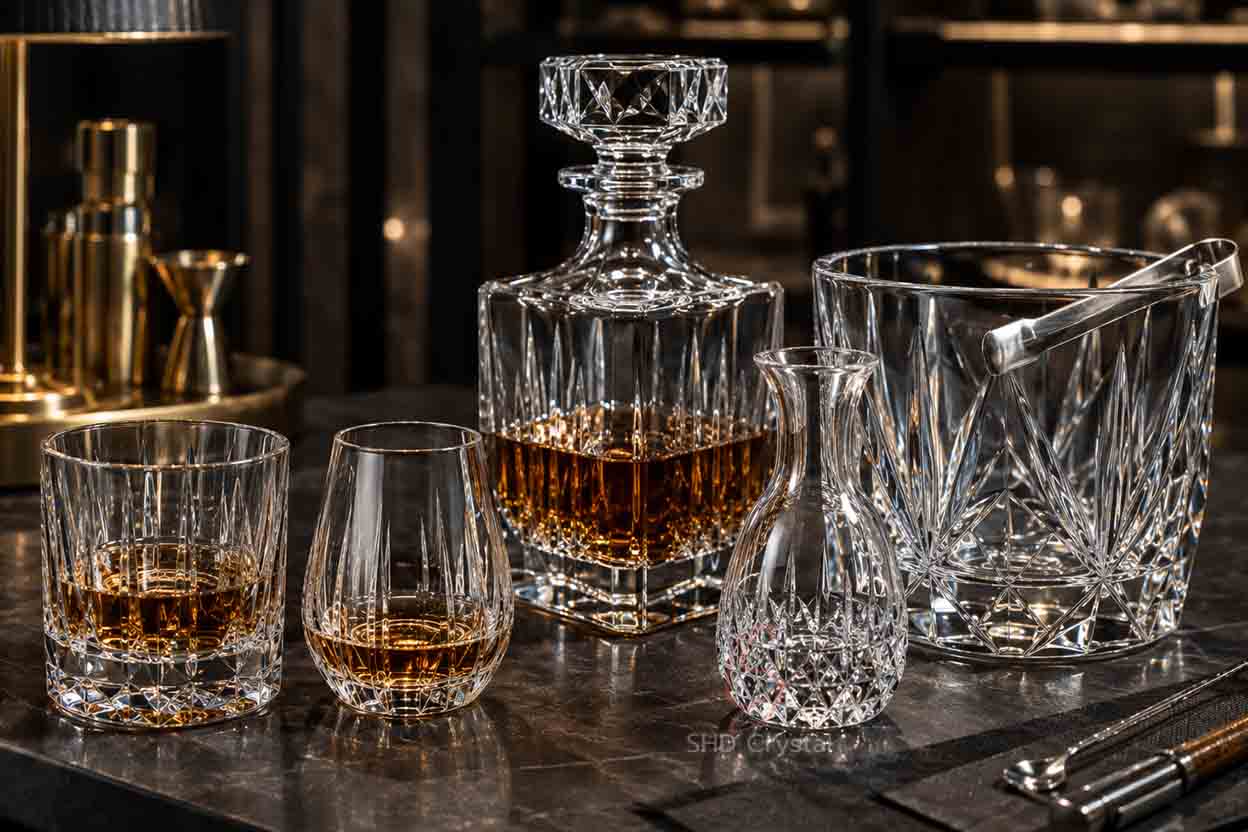
When these pieces belong to one custom barware collection, repeated details can create continuity. A diamond pattern on a tumbler may become a wider faceted band on the decanter. The same vertical ribs can appear more subtly on a carafe. An ice bucket may repeat the base geometry instead of copying the entire surface pattern.
Drinkware Sets the Tactile Standard
Glasses are usually the products customers touch most frequently, so they establish the tactile expectations for premium glass barware. Rim quality matters immediately. Base weight affects balance. Bowl geometry influences how the drink is presented and, depending on the beverage, how aromas reach the drinker.
Some manufacturers, in an effort to enhance the perceived quality of their products, excessively increase the amount of glass used. However, in practice, this leads to increased weight, making the product more difficult to use and complicating the transition between different wall thicknesses during production. Premium character comes from controlled proportion, not from making every tumbler resemble a transparent paperweight.
Decanters and Carafes Carry More Visual Drama
Decanters provide greater freedom for silhouette, stopper design, cutting, engraving, and heavy-base effects. They often become the visual centerpiece of a custom barware collection. Yet appearance still has to cooperate with pouring. Neck diameter, shoulder transition, center of gravity, and stopper fit all influence real use. A dramatic decanter that becomes awkward when half full has solved the wrong problem.
Carafes or smaller spirit-serving vessels can take a quieter role. Their proportions may echo the main decanter while remaining easier to handle for table service, tasting programs, or measured pours.
Glass Ice Buckets Complete the Service Environment
An ice bucket changes the scale of premium glass barware. It needs a wider opening, practical gripping area, stable base, and sufficient room for ice and serving tools.
Thicker glass and decorative relief can create strong presence, but mold definition and annealing behavior become more important as material mass increases. Handles, if included, also need to be considered structurally rather than treated as decorative additions.
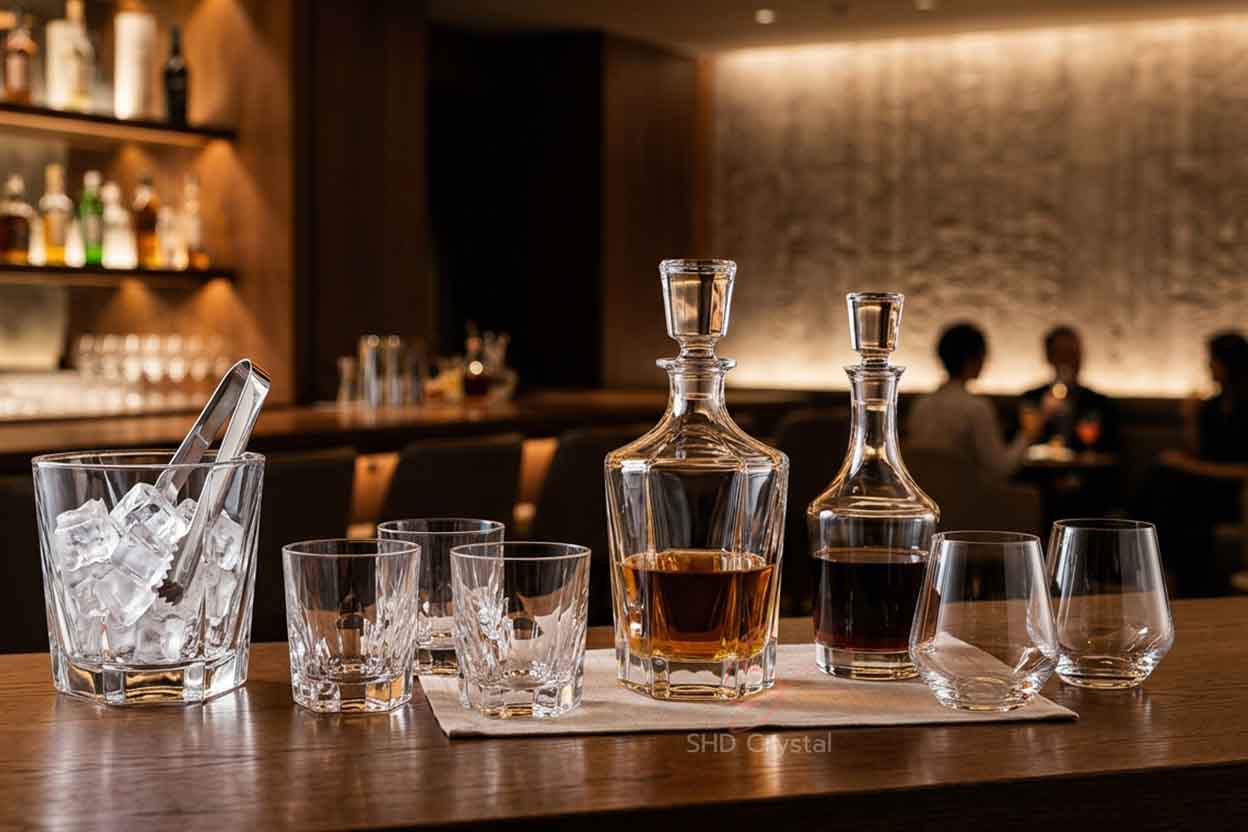
This is where development of premium barware becomes an engineering exercise as much as a styling project. Different product types must share a design language while responding to completely different handling conditions.
Finishing Creates the Final Collection Identity
Clear high-transparency glass can keep a collection contemporary. Deep cutting creates stronger optical movement. Frosting softens the mood, while subtle color, engraving, metallic details, or polished facets can establish a more recognizable identity.
A custom barware collection usually works best when one or two finishing ideas are repeated strategically rather than applying every available technique to every piece.
Consistency matters too. Mold tolerance, polishing quality, engraving depth, glass color, and batch variation become increasingly visible when tumblers, decanters, carafes, and ice buckets are displayed together.
Conclusion
Development of premium barware succeeds when individual products contribute to one complete beverage-service experience. Glasses establish touch and drinking comfort, decanters provide visual presence, carafes support controlled service, and ice buckets complete the functional setting. The strongest collections connect these different roles through proportion, material clarity, decoration, and manufacturing consistency.
Building a Coordinated Premium Barware Collection
SHD Crystal supports development of premium barware across drinking glasses, decanters, serving vessels, and glass ice buckets through product design review, mold development, forming, annealing, cutting, polishing, decoration, and inspection. For brands planning premium glass barware, defining the service environment and shared design language early can help turn separate pieces into a coherent commercial collection.
Read the original full version: https://shdcrystal.com/blogs/development-of-premium-barware/