
Whiskey Bottle OEM Requires Production Discipline, Not Just Attractive Samples
A this supplier project attracts a wide range of suppliers, but not all of them can deliver consistent quality at scale. A polished sample can be made by hand under ideal conditions. What matters more is whether the factory can reproduce that quality across thousands of bottles, maintain neck tolerance consistency, and deliver on time across multiple production runs. We have seen buyers switch suppliers after their first order because the second batch showed visible differences in glass clarity, weight, or finishing. That is the standard we hold every whiskey bottle OEM to.
The root cause is usually the same: the the supplier factory had not established controlled processes for spirits bottle production. A glass whiskey bottle requires consistent glass batch composition, controlled forming parameters, precise neck finishing, and disciplined inspection standards. Any weakness in this chain creates visible inconsistency in the final product.
Neck Tolerance Is the Most Critical Dimension for Spirits
For whiskey bottle OEM, the neck finish determines whether the closure fits properly. Cork, screw cap, and bar-top stopper systems all depend on precise neck dimensions. A loose cork allows oxidation and evaporation. A too-tight screw cap causes handling problems. For spirits bottle production, the neck tolerance is typically tighter than for wine or beer bottles because the closure must maintain a seal for years during aging and storage.
| Closure Type | Neck Requirement | Common Issue if Out of Tolerance |
|---|---|---|
| Cork | Tight compression fit | Oxidation, evaporation, cork push-out |
| Screw Cap | Precise thread engagement | Loose cap, cross-threading, leakage |
| Bar-Top Stopper | Ground-glass or synthetic fit | Stopper wobble, poor seal |
For whiskey bottle OEM, we recommend that buyers provide the closure specification — not just the bottle drawing — when requesting samples for a glass whiskey bottle. This allows the factory to evaluate neck tolerance in the context of the actual closure system.
Glass Clarity and Batch Consistency
Whiskey is a visual product. The bottle must showcase the amber liquid without distortion. This requires high-quality glass with minimal bubbles, stones, and inclusions. For premium spirits bottle production, even minor inclusions that are invisible to the naked eye can become visible under the bright lighting of a showroom display.
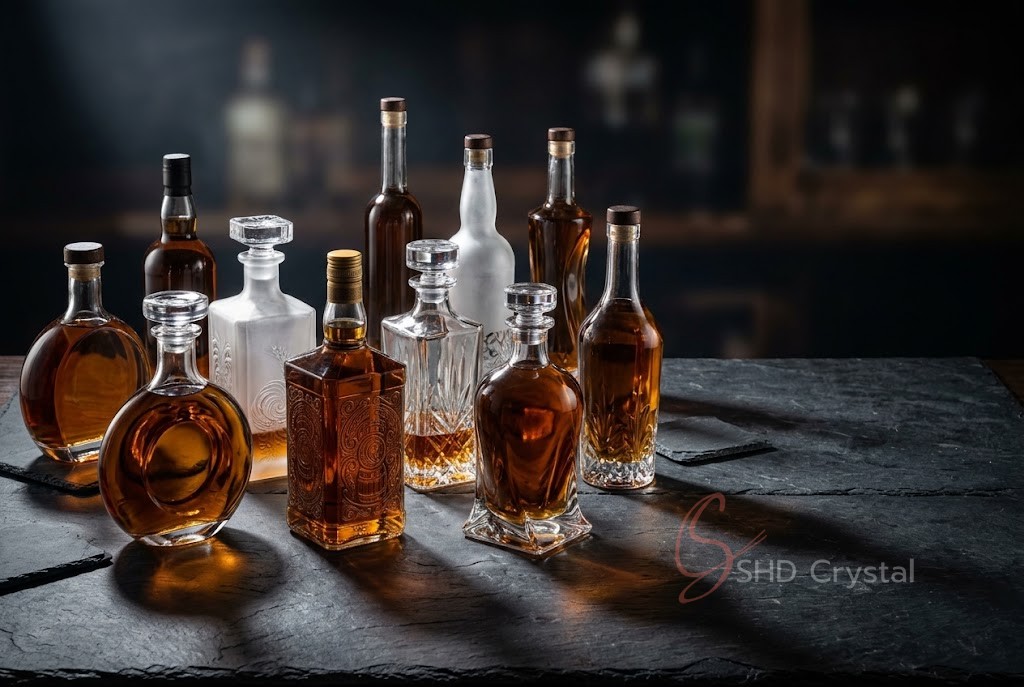
For whiskey bottle OEM programs with multiple SKUs, batch consistency across different bottle shapes is especially important. The glass composition, furnace settings, and quality standards must be maintained across every production run. Ask the factory how they ensure batch consistency and whether they retain detailed production records for each order.
Decoration and Brand Expression
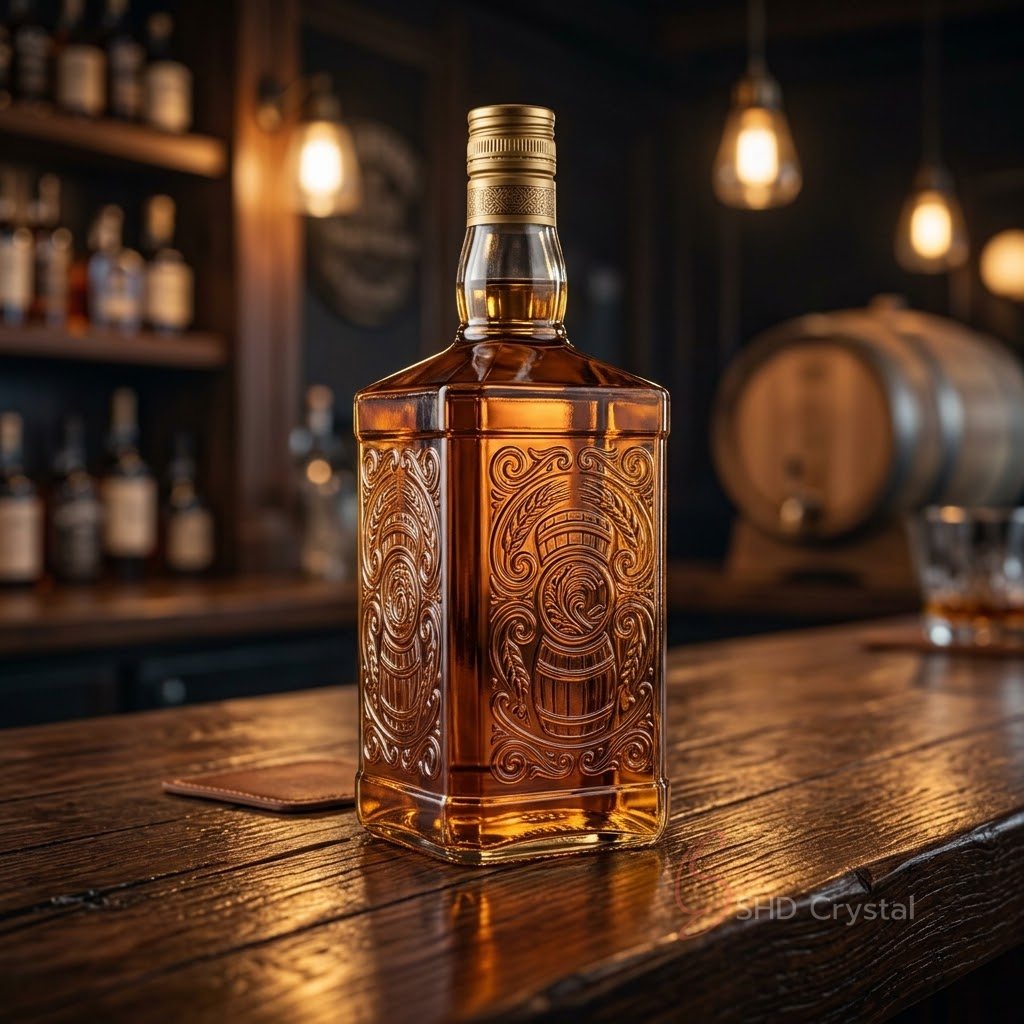
A whiskey bottle manufacturer typically offers a wide range of decoration methods: embossing, screen printing, hot stamping, frosting, decals, and paper labels. For a glass whiskey bottle targeting the premium market, deep embossing combined with a metallic label creates a strong shelf presence. For craft whiskeys, screen printing directly on the glass with a minimalist design communicates authenticity.
For spirits bottle OEM with multi-step decoration, the production sequence must be carefully planned. Embossing is built into the mold during forming. Screen printing and hot stamping are applied after forming and annealing. The interaction between these methods affects the final result — for example, hot stamping over an embossed surface requires careful die design to ensure complete foil transfer.
Export Packaging for Heavy Glass Bottles
Whiskey bottles are heavy — a 750 ml bottle can weigh 400–600 grams or more depending on the glass thickness. For whiskey bottle OEM targeting export markets, the packaging must account for the combined weight of the bottles, the carton stacking pressure during ocean freight, and the vibration during truck transport. Individual dividers, foam inserts, or molded trays are standard for premium spirits bottle production.
Frequently Asked Questions
What is the typical MOQ for whiskey bottle OEM?
For stock molds, MOQs typically start at 3,000–5,000 pieces. For custom molds, MOQs usually start at 10,000–20,000 pieces depending on the factory and the complexity of the design.
Can I use a custom shape for a glass whiskey bottle?
Yes. Custom molds are common in the spirits industry. However, unusual shapes may require longer lead times and higher mold investment. Discuss the design feasibility with the factory before committing to mold development.
How long does spirits bottle production take?
Stock molds with standard finishing may ship in 20–30 days. Custom molds with complex decoration typically require 45–75 days depending on the sampling approval process and the number of decoration steps.
Conclusion
Whiskey bottle OEM works best when the supplier demonstrates control across the full production chain — from glass batch composition through forming, neck finishing, decoration, and export packaging. Buyers who evaluate these capabilities during supplier selection build more reliable spirits bottle programs.
Start Your Whiskey Bottle Project With SHD Crystal
For brands seeking whiskey bottle OEM, SHD Crystal can support design review, forming evaluation, neck tolerance control, decoration planning, and export packaging development. Share your brand concept and closure specification with us to discuss production feasibility.
Interested in custom glassware or related products?
Contact our team to discuss your project requirements.