
Whiskey Bottle Sizes Vary by Market and Application
Choosing the right this capacity range is one of the first decisions in any spirits packaging project. The capacity affects the bottle’s proportions, weight, label area, closure type, packaging configuration, and shipping cost. A standard whiskey bottle format in one market may not be standard in another — 750 ml is the norm in the United States, 700 ml is standard in the European Union and many Asian markets, and 1 liter is common for duty-free and bulk distribution. Understanding these regional differences before starting development prevents costly revisions later. That is the standard we hold every whiskey bottle sizes to.
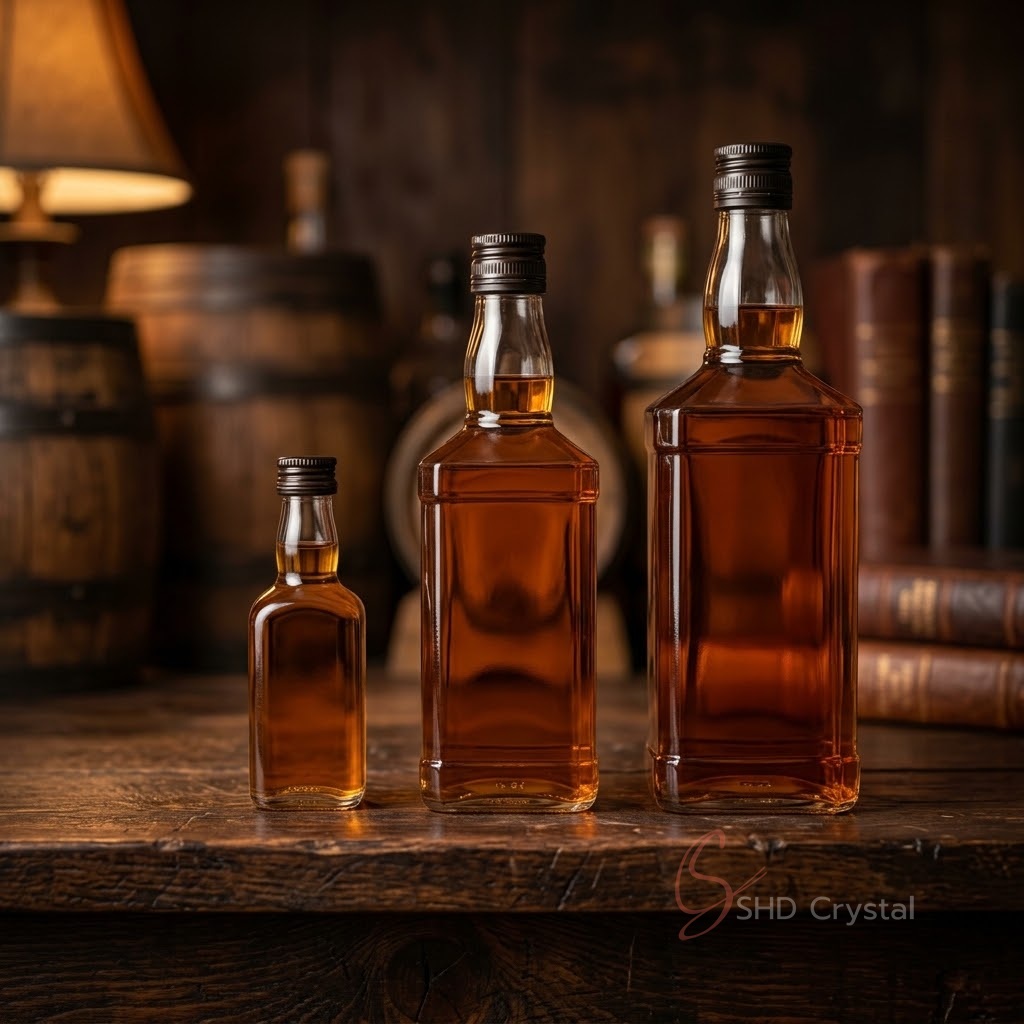
We have worked on projects where the buyer specified 750 ml for a European market and had to revise the mold after sampling because the local standard was 700 ml. That kind of mismatch delays the project and wastes tooling investment. For any spirits bottle capacity decision, confirm the target market’s standard size first.
How Capacity Affects Bottle Proportions
A standard whiskey bottle is not simply a scaled version of another size. Changing the capacity changes the proportions — a 750 ml bottle and a 500 ml bottle of the same shape have different shoulder angles, neck lengths, and base diameters. For these formats beyond the standard range, the factory may need to adjust the mold design to maintain visual balance.
| Capacity | Common Use | Typical Height | Typical Weight (empty) |
|---|---|---|---|
| 50 ml | Miniatures, samples, gifts | 10–12 cm | 40–60 g |
| 200 ml | Half-bottle, travel | 15–18 cm | 120–180 g |
| 375 ml | Half-bottle, tasting | 18–22 cm | 200–300 g |
| 700 ml | EU standard, Asia standard | 24–28 cm | 350–500 g |
| 750 ml | US standard | 25–30 cm | 400–600 g |
| 1 liter | Duty-free, bulk | 28–32 cm | 500–700 g |
For a standard whiskey bottle in the 700–750 ml range, the design proportions are well-established, and most factories have stock molds available. For non-standard spirits bottle capacity — such as 200 ml or 1 liter — a custom mold may be required if the brand wants to maintain the same design language across the full size range.
Smaller Sizes Need Different Design Thinking
Miniature bottles (50 ml) and half-bottles (200–375 ml) are not just smaller versions of the standard bottle. The label area is reduced, the closure may need to be different (a screw cap instead of a cork), and the overall visual impact changes. A design that looks commanding at 750 ml may look cramped at 200 ml.
For whiskey bottle sizes in the miniature range, we recommend simplifying the design — reducing embossing depth, using a smaller label, and choosing a closure that works at the smaller scale. A standard whiskey bottle design cannot always be scaled down without losing its visual identity.
Larger Sizes Create Packaging and Shipping Challenges
A 1-liter or 1.75-liter bottle is significantly heavier and larger than a 750 ml bottle. The packaging must account for the increased weight and the larger carton dimensions. For spirits bottle capacity above 1 liter, the pallet configuration and container loading plan must be reviewed to ensure safe transport.
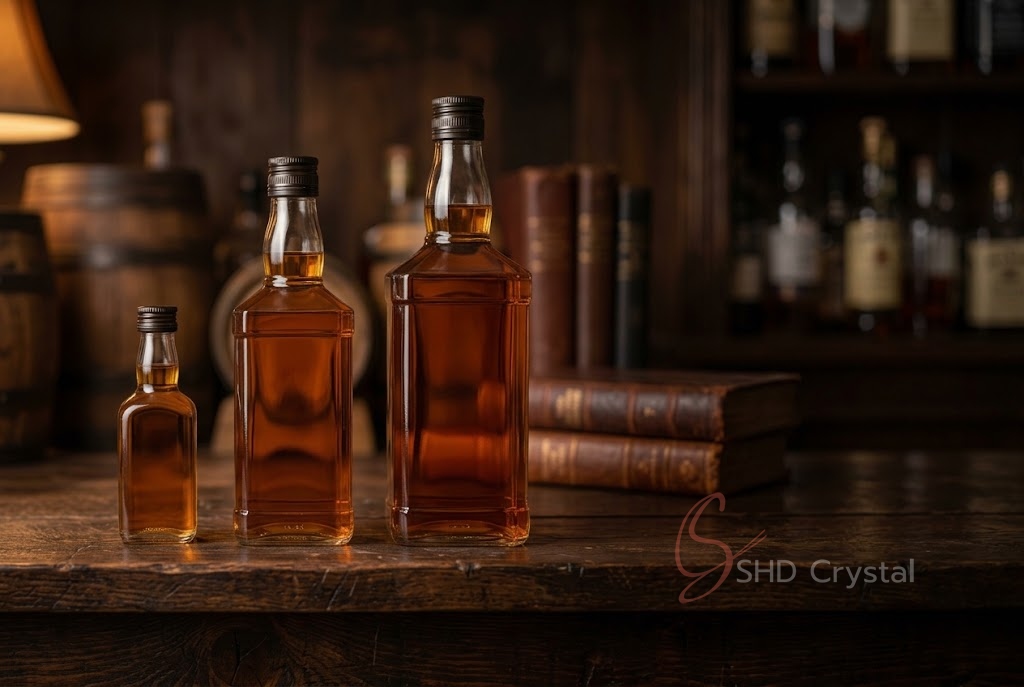
We recommend discussing unusual wine bottles OEM packaging and freight implications with the factory during the sampling stage for any non-standard whiskey bottle sizes. A bottle that looks good in the product lineup may be impractical to ship if it does not fit efficiently into standard export cartons.
Consistency Across a Size Range
For brands offering multiple whiskey bottle sizes — such as 200 ml, 750 ml, and 1 liter — such as 200 ml, 750 ml, and 1 liter — maintaining a consistent design language across the range is important for brand recognition. This means the proportions, shoulder angle, neck style, and decoration should feel related even though the absolute dimensions differ.
A whiskey bottle sizes strategy that starts with a standard 750 ml design can serve as the reference for the smaller and larger sizes. The factory should adjust the proportions to maintain visual balance at each capacity while preserving the brand’s design DNA.
Frequently Asked Questions
What is the most popular whiskey bottle size globally?
The 700 ml and 750 ml formats are the most popular worldwide. In the United States, 750 ml is the standard commercial size. In Europe and much of Asia, 700 ml is the norm. Duty-free channels commonly use 1 liter.
Can I use the same mold for different whiskey bottle sizes?
No. Each capacity requires its own mold because the proportions change. However, a factory can design a family of molds that share the same design language across different spirits bottle capacity options.
How does spirits bottle capacity affect shipping cost?
Larger bottles are heavier and take up more carton space, reducing the number of units per container. A switch from 700 ml to 1 liter can reduce the number of bottles per container by 20–30%, significantly increasing per-unit freight cost.
Conclusion
Whiskey bottle sizes affect every aspect of the product — from design proportions and closure type to packaging and shipping cost. Brands that choose the right capacity for their market, plan for multi-size consistency, and evaluate packaging implications during sampling create more successful spirits programs.
Plan Your Whiskey Bottle Size Strategy With SHD Crystal
For brands evaluating whiskey bottle sizes, SHD Crystal can support capacity selection, proportion review, mold development, and packaging planning across multiple formats. Share your target markets and size requirements with us to discuss the most practical approach.
Interested in custom glassware or related products?
Contact our team to discuss your project requirements.