
24 PBO Crystal in Plain Numbers: Classification and Key Properties
24 pbo crystal is the shorthand most buyers use for full lead glass with a lead oxide content of roughly 24 percent — our benchmark grade for premium decanters, awards and decorative pieces. If you import glassware or run a private-label program, that number tells you a great deal about weight, optical performance and price before you touch a sample. Lead crystal drinkware continues to dominate luxury hotel and restaurant programs. Full lead glass quality gives cutters the working time needed for deep relief patterns.
We run both full lead and lead-free lines, so we have no stake in pushing you toward either one. What follows is how these bodies behave on our floor, where they differ commercially, and where lead crystal drinkware at the 24 percent level earns its place.
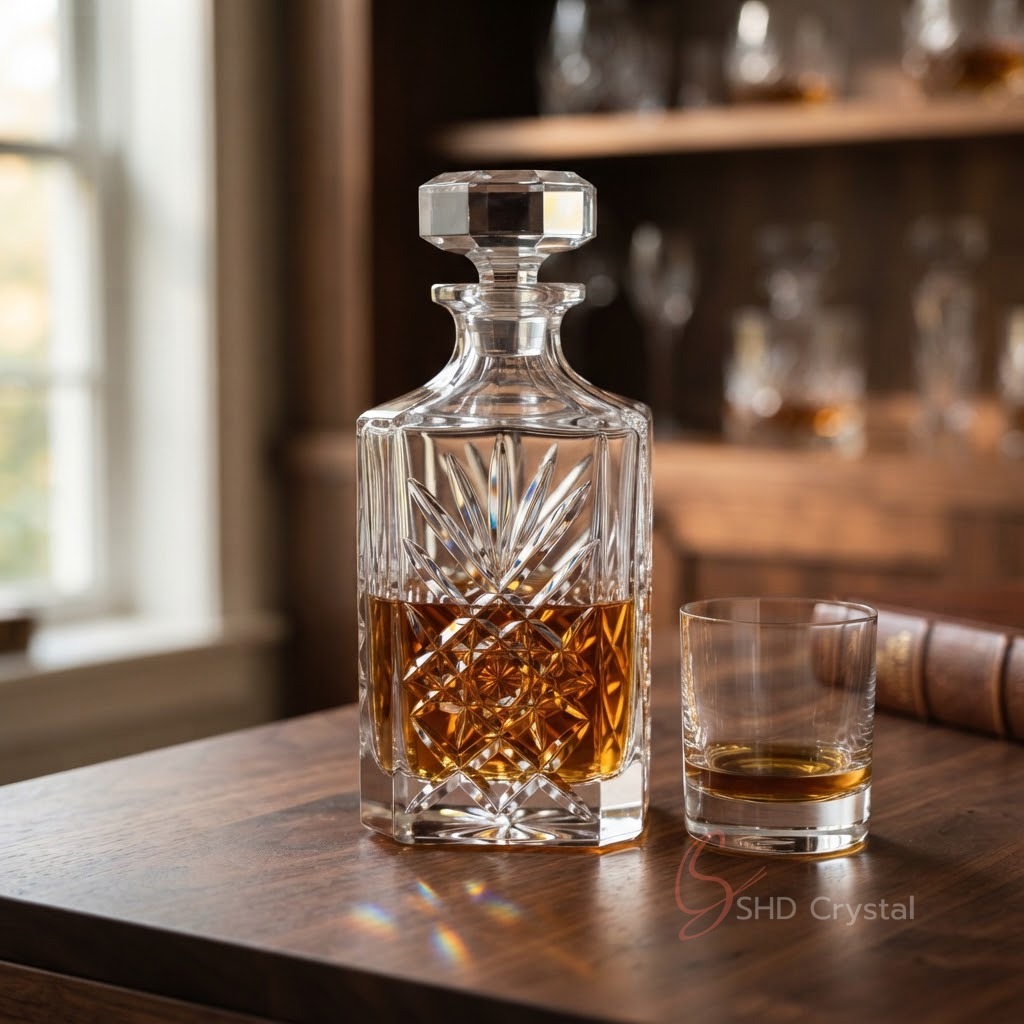
Under the traditional classification, full lead crystal sits above 30 percent lead oxide while crystal glass covers the range below it, yet most export buyers simply ask for 24 pbo crystal because full lead glass quality lands at the sweet spot of cost versus performance. At that level, density reaches roughly 3.0 grams per cubic centimeter, refractive index climbs high enough to give real fire under display lighting, and the softer structure accepts deep cutting and engraving that cheaper bodies cannot survive.
| 24 PBO Crystal | Lead-Free Crystal | Soda Lime Glass |
|---|---|---|
| Weight – dense, roughly 3.0 g per cubic cm, noticeably heavy in hand | Moderate weight around 2.5 g per cubic cm | Lightest body, feels thin in larger shapes |
| Brilliance – high refractive index, strong rainbow fire under light | Good clarity, slightly less fire than full lead | Plain appearance, needs coating or color to add interest |
| Cutting depth – deep wheel cuts and relief engraving without chipping | Clean at shallow to moderate depth only | Prone to micro-chips along facet edges |
| Best use – decanters, awards, engraved gifts, brief-contact serving | Daily-use drinkware and modern barware programs | Volume stemware programs and tableware |
| Food-contact note – check destination market rules before committing | Comfortable choice for everyday liquid contact | No lead-related concerns |
From our production experience, the two rows buyers underestimate are cutting depth and food-contact positioning. Deep wheel-cutting on a soda lime body produces micro-chips along every facet edge; our polishers spend double the time and rejection rates climb past budget. Full lead glass quality shows up exactly here — facets come off the wheel clean, rim finishing stays consistent across a batch, and annealing schedules can be tuned so internal stress stays well within what our polariscope inspection tolerates.
Ring, Weight and Cut Depth: How It Performs in Hand
Tap a full lead bowl with a fingernail and you get a sustained, bell-like ring; soda lime gives a dull click. That resonance comes from density and internal structure, and it survives only if annealing is done properly — a rushed cycle kills the ring long before anything visible goes wrong. That is why we inspect every deep-cut piece under the polariscope: residual stress hides where the wheel worked hardest, and batch consistency in weighing raw materials is what keeps one carton matching the next.
Side by side, the three families divide cleanly. Soda lime wins on price and suits volume stemware programs; lead-free crystal covers daily-use drinkware with modern clarity and no compliance baggage; and 24 pbo crystal takes the top shelf, where weight, ring and deep engraving justify a higher unit cost per piece.
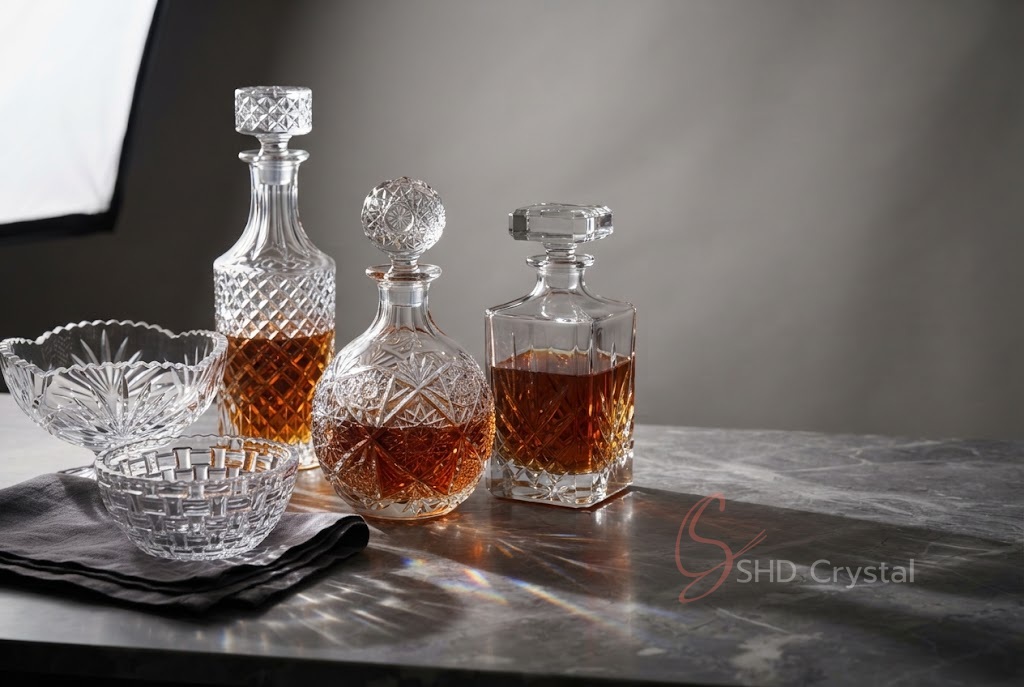
Last spring a hotel group asked us to quote engraved decanters for lobby bars. In practice, the decision came down to handling rather than optics: staff pour faster and guests perceive value differently when a heavy, ringing piece sits on the trolley, so the client chose the 24 pbo crystal body even though our lead-free alternative was cheaper. For everyday lead crystal drinkware such as water tumblers washed hourly, we quoted lead-free instead — same visual appeal, fewer compliance questions later.
Food-Contact Rules, Market Positioning and Lead-Free Alternatives
Regulatory expectations differ sharply by destination, and we avoid quoting legal conclusions — your importer or compliance consultant owns that call. What we control is honest construction: clear grade declarations on every specification sheet, tight tolerance weighing of raw lead oxide for batch consistency, and export packing rated for heavy pieces, because a dense decanter shifts serious mass inside a carton.
Two cases taught our clients expensive lessons. An importer once specified a full lead tumbler for daily juice service in a market with strict migration testing; the goods sat in port while tests dragged on, and the fix was re-running the SKU on our lead-free body. Another gift brand demanded deep relief cuts on lead-free glass, watched chip-outs climb at polishing, and eventually moved that design back to 24 pbo crystal. Neither problem was visible in a pre-production sample — both surfaced at quantity.
Frequently Asked Questions
Is 24 pbo crystal safe for drinks?
Does the heavier weight raise shipping costs?
Can deep cuts and engraving be done on lead-free glass?
Frequently Asked Questions
Is 24 pbo crystal safe for drinks?
For decorative pieces and decanters where liquid sits briefly, it has been the standard hospitality choice for decades. For daily tumblers and glasses that hold liquid for hours, many buyers now prefer our lead-free line to sidestep food-contact questions in stricter markets. We label grades honestly on every specification sheet so your compliance team decides with full information.
Does the heavier weight raise shipping costs?
Yes, noticeably. Density near 3.0 means a full lead decanter weighs roughly twenty percent more than the same shape in lead-free glass, and that shows up in both air and sea freight math. We help clients calculate real landed cost using actual packed weights before orders are confirmed.
Can deep cuts and engraving be done on lead-free glass?
Shallow etching and moderate cutting work well. Deep relief work is where full lead glass quality pays for itself — the softer body cuts clean without chip-out, and polariscope inspection confirms low residual stress afterward. On lead-free bodies we limit cut depth and adjust polishing time to protect yield.
Conclusion
Choosing between glass families is a commercial decision, not just a technical one. If your catalog needs showpiece decanters, awards and engraved gifts, 24 pbo crystal remains the grade customers recognize the moment they lift and tap the piece. For daily drinkware programs, our lead-free bodies deliver modern brilliance with fewer regulatory conversations. Tell us the use case and destination market, and we will recommend the honest fit.
Before You Finalize Your Spec Sheet
Send us your target shapes, markets and price band, and our production team will return a straightforward recommendation — including whether 24 pbo crystal, lead-free or soda lime fits each SKU. Sample requests for lead crystal drinkware programs are welcome, and we ship reference sets worldwide.
Interested in custom glassware or related products?
Contact our team to discuss your project requirements.