
What a White Perfume Bottle Manufacturer Should Control for You
As a white perfume bottle manufacturer, we spend our days on the factory floor rather than in marketing meetings, so this guide reads the way we would talk to you across the inspection table: plainly. White bottles look simple from outside. Inside, opacity consistency, coating adhesion, and batch color matching are where projects quietly fail.
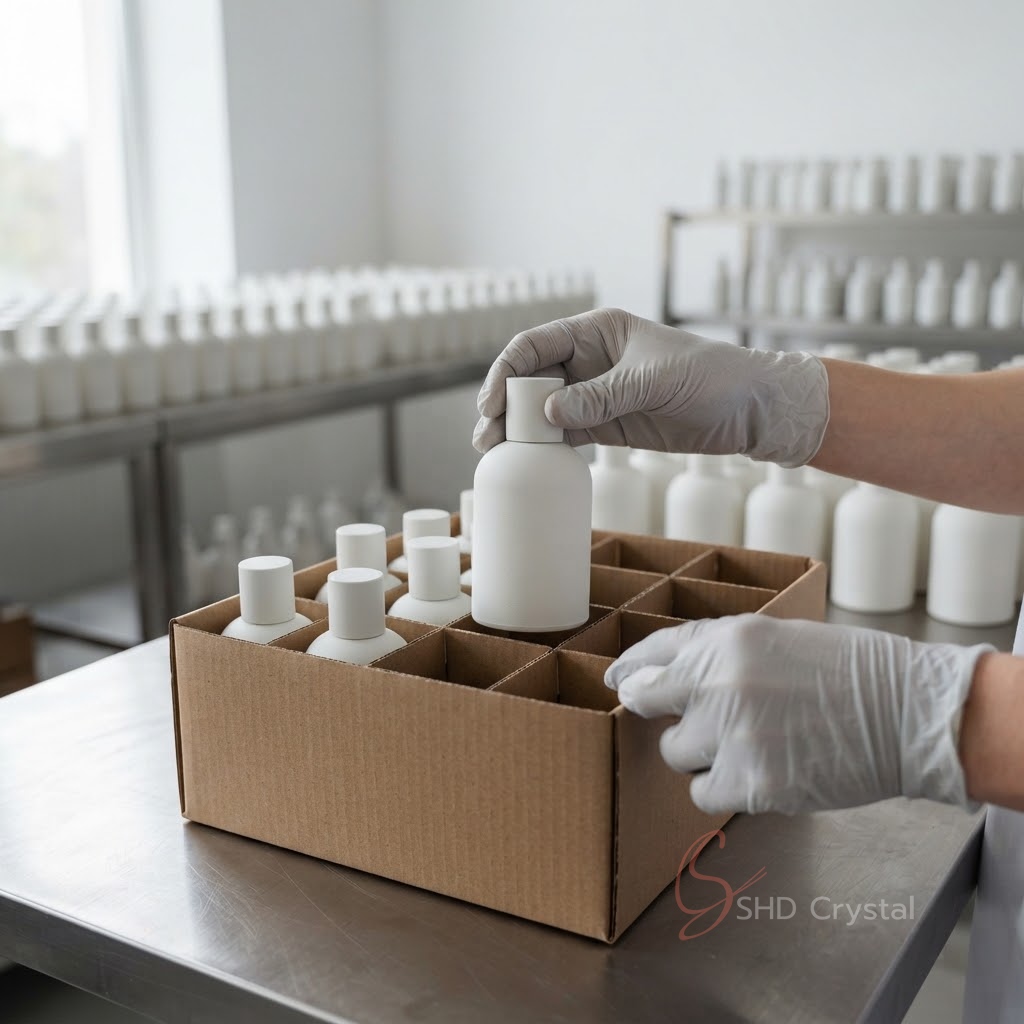
Most buyers arrive with a reference photo, a target cost, and a filling line spec sheet. What they usually lack is a clear picture of how the white finish behaves through filling, crimping, shipping, and shelf life. Settle these decisions before custom fragrance bottle production begins; changes after molds are cut get expensive fast.
A serious supplier controls four things: glass chemistry or coating quality, dimensional tolerance, surface uniformity, and documentation. When we quote a white bottle, we are really quoting our ability to hold those variables steady across every reorder, typically for years, since most fragrance programs come back seasonally. That is the standard we hold every white perfume bottle manufacturer to.
| Feature | Opaque Spray Coating on Clear Glass | Opal (Solid) White Glass |
|---|---|---|
| Opacity source | White coating layer on clear glass | White opal material through the whole wall |
| Typical look | Bright, glossy, very pure white | Softer, porcelain-like white |
| Weight | Standard clear-glass weight | Heavier, denser hand feel |
| Main risk | Coating wear or peeling at friction points | Translucency at thin shoulders if walls drop |
| Cost behavior | Adds a coating step per piece | Higher glass cost, fewer process steps |
From our production experience, coating suits brands chasing pure, high-gloss white at moderate cost, while opal wins when designs have thin curves or need premium heft. Compared side by side under display lighting, coated bottles read brighter; opal bottles read more expensive. Neither is objectively better, which is why we ask about your display lighting before recommending either. As a white perfume bottle manufacturer, we would rather over-question your brief than re-run a batch.
One detail buyers rarely ask about is how the finish interacts with the pump collar. A sprayed neck can build up thickness on the thread, so we machine collars slightly oversize on coated runs. Skip that adjustment and you discover the problem during crimping trials, not in the sample room.
Two White Bottle Projects That Went Wrong Before They Reached Us
A European private-label client came to us after spray coatings from their previous supplier peeled where cartons rubbed the shoulders in transit. The root cause was packing before full cure. In practice we insist on complete curing plus cross-hatch adhesion testing on every coated batch; that client has shipped six seasons without one peeling claim.
Another importer ordered white bottles months apart and received visibly different whites, warm versus cool, because the supplier ran different furnaces without retained masters. Any white perfume bottle manufacturer who claims this never happens has not been producing long enough. We prevent it with signed golden samples, per-batch color checks under controlled lighting, and advance notice whenever furnace conditions change.
Picture a common scenario: a niche brand launches a 30ml flacon meant to glow under boutique track lighting. Under warm showroom light an opal body turns creamy while a coated body stays stark. We mock up both finishes under the client’s actual display lighting before they commit. Ten minutes protects a launch.
Planning Opaque White Glass Packaging Around Wall Thickness and Annealing
For anyone specifying opaque white glass packaging, remember that white hides nothing structurally. Wall thickness drives both opacity and strength, and thin shoulders can look translucent under strong light. We typically recommend slightly heavier walls than a clear equivalent, then confirm stress levels with polariscope inspection after annealing.
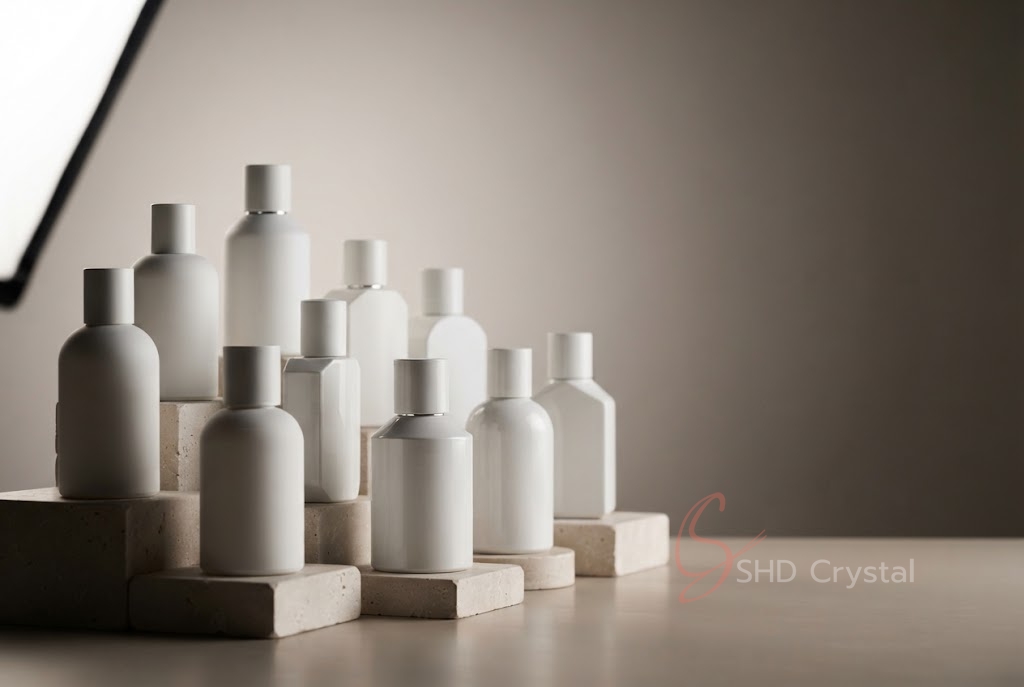
Before you commit money to opaque white glass packaging, get written answers to three questions: What minimum wall does your design allow at shoulder and base? Will bottles cross the ocean in summer containers, which raises thermal stress demands? And who owns the color standard, your brand or the factory?
Custom Fragrance Bottle Production: Tolerances That Decide Filling Line Speed
On high-speed lines, geometry beats beauty. Neck finish tolerance, collar outer diameter, and pump seating depth decide whether crimping runs smoothly at thousands of units per hour. For custom fragrance bottle production we hold pump-and-collar interfaces to tight tolerances and trial compatibility with your actual pumps, since crimping failures are usually two suppliers’ assumptions colliding.
Before signing with any factory, ask: Which dimensional reports accompany each lot? How are annealing records and drop tests documented? What happens when my pump supplier changes a mold? Can I witness a pilot filling trial, even remotely? A confident white perfume bottle manufacturer answers without hesitation and puts numbers in writing.
Frequently Asked Questions
Should I choose coated white bottles or solid opal glass?
It depends on budget, design weight, and how hard the bottle travels. Coating gives the brightest white at lower unit cost; opal gives scratch-through durability and a premium feel. We suggest sampling both if volumes justify it.
Can you match a specific white shade across repeat orders?
Yes, provided we lock a signed master sample at approval. Every later batch is compared against it under controlled lighting, and we notify clients whenever raw material or furnace conditions shift.
Do white bottles need special export packing?
They do, especially for opaque white glass packaging, where surfaces show scuffs easily. We use divided cells, foam layers, and carton-in-carton construction for sea freight, quoted with the bottle rather than added afterward.
What volumes do you need for OEM projects?
Minimums depend on whether we run existing molds or cut new tooling. As any straightforward white perfume bottle manufacturer should, we tell you honestly which route fits once we see your design and target volume, sometimes suggesting stock molds for a first season.
Conclusion
White bottles reward buyers who lock down finish type, wall thickness, color standards, and pump tolerances before tooling starts. Those conversations separate a smooth reordering cycle from a season of complaints. If you are weighing any white perfume bottle manufacturer for custom fragrance bottle production, bring us drawings and hard questions.
Talk to the Team That Runs the Lines
Send SHD Crystal your design files, pump specifications, and target market. As a hands-on white perfume bottle manufacturer, we will review feasibility, flag risks early, and quote honestly, whether your program calls for thousands of pieces or millions.
Interested in custom glassware or related products?
Contact our team to discuss your project requirements.