
Custom opal glass tea cups offer brands a way to combine the soft appearance of traditional milk glass with a cleaner commercial tableware format. For tea brands, cafés, boutique hotels, restaurants, and giftware retailers, the attraction is easy to understand: opaque white glass feels nostalgic without looking old-fashioned. Developing it successfully, however, requires attention to color consistency, cup proportions, handle structure, matching saucers, and repeat production quality.
Custom Opal Glass Tea Cups Balance Vintage Character With Commercial Use
Milk glass tea cups are often associated with classic tea services and vintage table settings. In commercial sourcing, similar opaque or softly translucent glass styles may also be described as opal glass, particularly when the products form part of a coordinated tableware collection.
The visual appeal comes largely from the material itself. Unlike clear glass, which depends on transparency and refraction, opal glass tableware creates a softer and more uniform surface. White remains the most recognizable direction, although the exact tone, opacity, and finish can influence whether the final cup feels traditional, minimalist, or more contemporary.
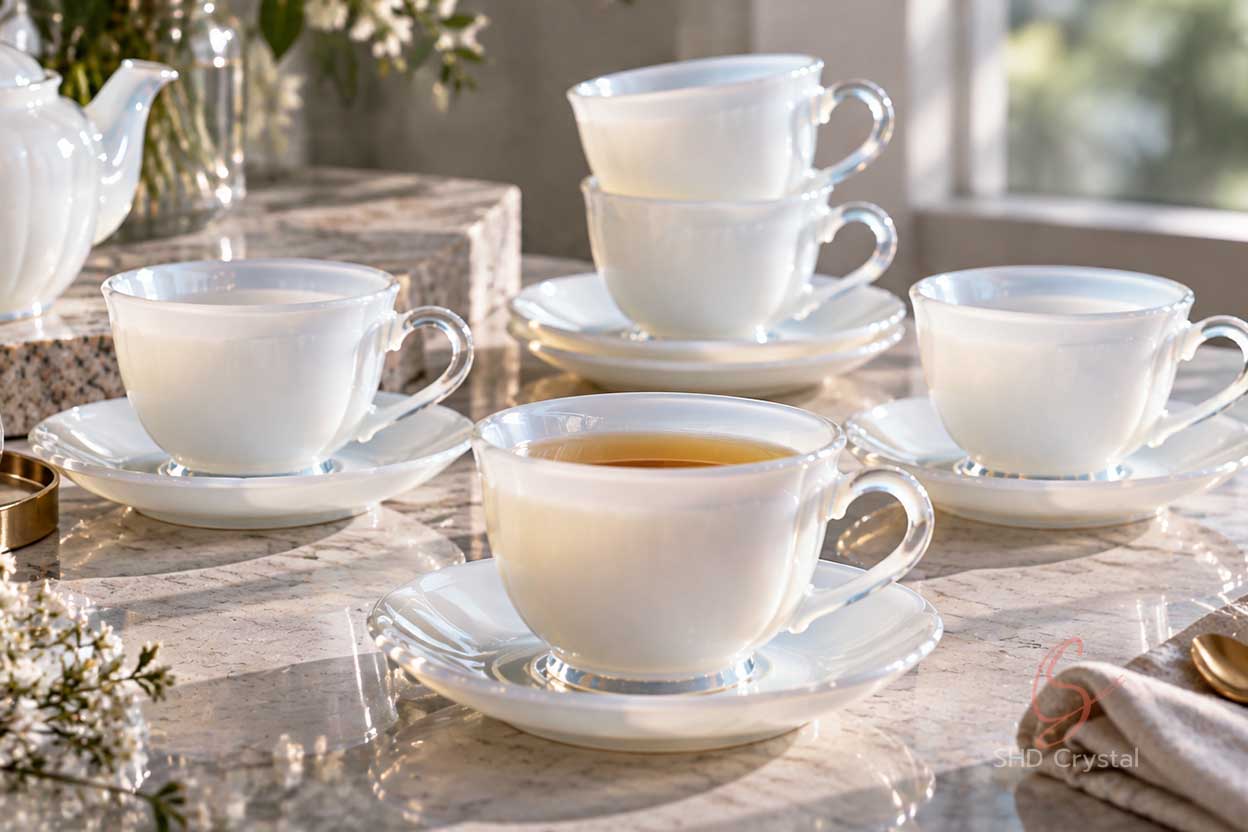
For buyers, this means color should not be treated as a minor detail. Several cups placed together on a restaurant table can make even small differences in whiteness or opacity more noticeable.
Cup Shape and Handle Design Need to Work Together
A vintage-inspired cup can use rounded walls, a slightly flared rim, decorative relief, or a matching saucer to create its character. But a beautiful silhouette still needs to survive actual tea service.
Handle size affects grip comfort, while the connection between the handle and cup body requires suitable structural strength. An overly delicate handle may look charming in a rendering but become less charming when somebody has to use it several times a day.
For hospitality applications, buyers should also consider capacity, rim feel, base stability, washing, storage, and whether cups and saucers need to stack efficiently.
Production Consistency Matters More Than a Single Pretty Sample
The distinctive appearance of milk glass tea cups depends heavily on consistent material color and surface quality. Forming conditions, glass distribution, cooling, and finishing can all influence the final appearance.
This becomes particularly important when a collection includes several related pieces. Cups, saucers, bowls, and serving items should look as though they belong to the same family rather than having met for the first time inside the shipping carton.
For opal glass tableware projects, an approved sample can therefore serve as an important reference for dimensions, color tone, surface appearance, handle proportions, and decoration before larger production begins.
Different Markets Need Different Tea Cup Priorities
A boutique café may prioritize distinctive presentation and comfortable daily handling. Hotels and restaurants may place greater emphasis on batch consistency and replenishment. Retail gift collections can give more attention to matching saucers, decorative details, and packaging presentation.
That is why custom opal glass tea cups should be developed around the intended market rather than around appearance alone.
Decoration can include logos, printed patterns, surface texture, colored details, or coordinated packaging. However, each additional feature should be considered together with the glass surface and production method so that the finished collection remains practical for commercial supply.
Conclusion
Custom opal glass tea cups work best when vintage visual character is supported by practical manufacturing decisions. Color consistency, opacity, cup proportions, handle structure, matching components, and quality references all influence whether the finished product can move successfully from an attractive sample into commercial production.
For brands developing milk glass tea cups or broader opal glass tableware collections, early discussion of usage scenarios and production requirements can also reduce unnecessary revisions later in the project.
Developing Opal Glass Tableware Projects With SHD Crystal
In SHD Crystal’s OEM project development, customers may begin with reference images, sketches, existing samples, or an initial product concept. The first task is not simply to reproduce the appearance, but to review whether dimensions, proportions, forming requirements, decoration, and intended use can be translated into stable production. Sampling then provides an opportunity to adjust details before an approved version moves toward batch manufacturing.
For custom opal glass tea cups, this cooperation process can include discussion of cup capacity, handle proportions, matching saucers, surface appearance, decoration, packaging, and expected order requirements. SHD Crystal’s published OEM workflow also covers feasibility review, process or mold planning, sampling, approval, mass production, inspection, packaging, and delivery preparation, providing a structured path for broader opal glass tableware development.
FAQs Sharing
Q01 | Are milk glass tea cups actually made from glass rather than ceramic?
Yes. Milk glass refers to opaque or translucent glass with a milky appearance, although similar-looking products in the market may also be made from ceramic or porcelain. Buyers sourcing glass products should confirm the material rather than relying only on product photos or style descriptions.
Q02 | Can custom opal glass tea cups be developed with matching saucers?
Yes. Cups and saucers can be developed as a coordinated set, but proportions, cup-base fit, visual consistency, decoration, and packaging should be reviewed together during sampling.
Q03 | What should hospitality buyers check before approving an opal glass tea cup sample?
Useful checks include capacity, handle comfort, rim quality, base stability, color and opacity consistency, surface defects, saucer fit, decoration position, and packaging protection. These details become more important when the same design will be supplied repeatedly.
https://shdcrystal.com/blogs/custom-opal-glass-tea-cups/
The link to this article was first published by, and is legally owned by, SHD Crystal.