
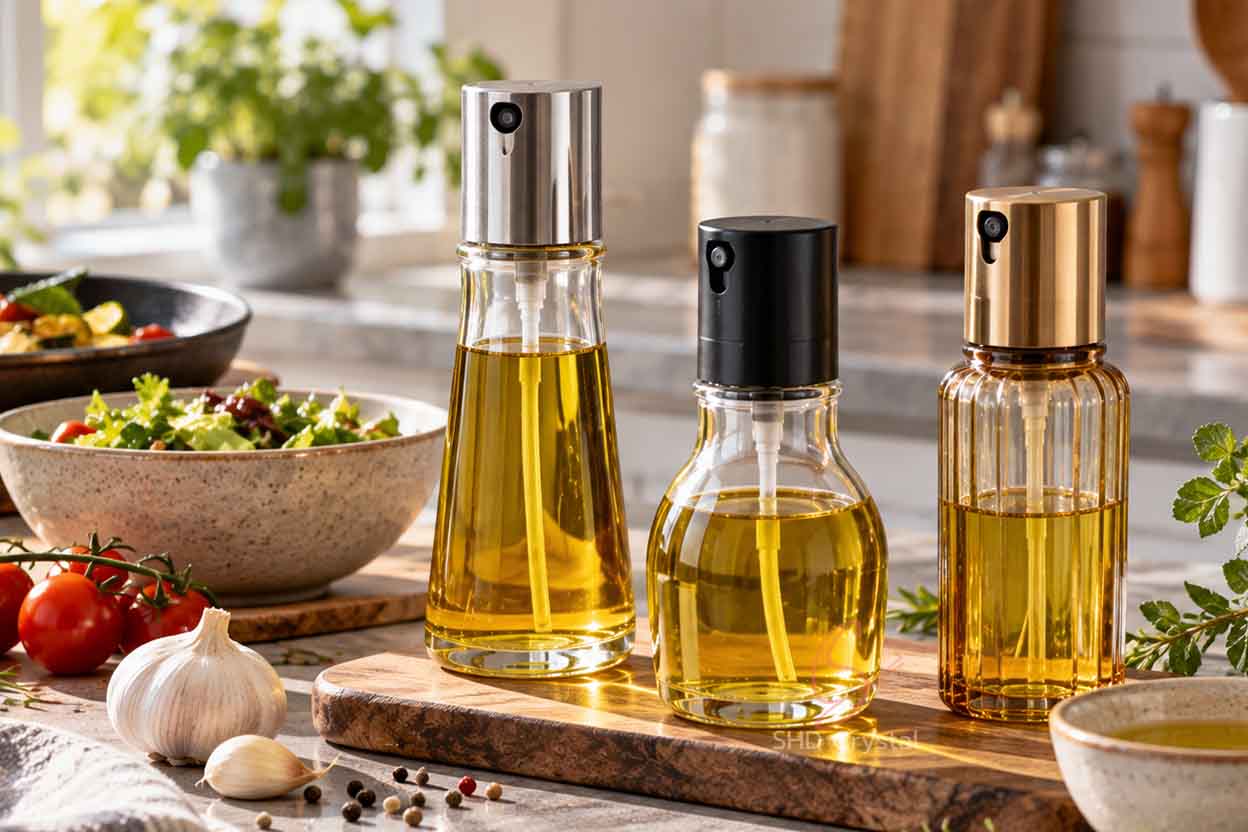
A glass oil sprayer bottle combines a reusable glass container with a dispensing mechanism designed for cooking oils. Although bottle shape, transparency, and surface decoration influence product appeal, they do not independently determine spraying performance. The type of oil, pump mechanism, neck dimensions, and component compatibility all affect how the finished product performs. For kitchenware brands, successful development requires evaluating the glass bottle and spray assembly as one functional system.
Glass Oil Sprayer Bottle Design Starts With the Liquid and Pump
Cooking oils behave differently from water-based liquids. Their viscosity and flow characteristics influence how easily a pump can dispense them and whether the resulting output forms a fine mist, coarse droplets, or a narrow stream. An oil mist pump must therefore be selected for the intended cooking oil rather than assumed to work with any refillable bottle.
Spray Performance Depends on More Than the Glass Body
Different spraying mechanisms use different methods to move liquid through a nozzle. Some rely on repeated manual pump strokes, while others use mechanisms designed to maintain pressure during dispensing. These differences affect spray pattern, operating effort, and the amount of oil delivered.
For a refillable cooking oil sprayer, buyers should evaluate the pump using the actual oil formulation. A spray head that works well with one liquid may deliver a different pattern when used with another. The glass bottle provides the reservoir, but the pump and nozzle perform the dispensing function. Where a system pressurizes the reservoir itself, the complete container assembly must also be designed and validated for the intended operating pressure.
Neck Dimensions Determine Component Compatibility
The connection between glass and pump is one of the most important manufacturing interfaces. A spray head requires a compatible bottle neck, including the appropriate thread or fastening structure, sealing surface, and opening dimensions. Similar-looking components are not necessarily interchangeable.
During glass forming, dimensional variation around the neck finish must remain within the requirements of the selected closure system. Proper annealing and inspection also contribute to the structural reliability of the finished bottle. A complete assembly should be evaluated for pump attachment, sealing performance, dip tube position, and leakage during normal handling. These checks are particularly important when glass bottles and spraying components are sourced from different production facilities.
Glass Shape Influences Handling and Kitchen Storage
Bottle geometry remains important even though the pump controls spraying. A tall cylindrical bottle can create a compact countertop appearance, while a wider body may improve standing stability. Shoulder transitions, base dimensions, and overall weight also affect how the product feels during repeated use.
Transparent glass allows users to monitor the remaining oil level. Amber or other colored glass may offer different visual characteristics and, depending on the material and spectral properties, additional light protection. For a refillable cooking oil sprayer, the opening should also support practical refilling, while the selected pump structure should allow appropriate cleaning and maintenance.
Excessive glass thickness is not automatically desirable. A heavier bottle may feel substantial but can become less comfortable during frequent kitchen use.
Manufacturing and Decoration Must Support the Complete Product
Glass bottle production begins with material and mold planning, followed by a suitable forming process, controlled annealing, and inspection. Important production checks include neck accuracy, wall distribution, base stability, capacity, and visible surface defects.
Customization may involve clear or colored glass, molded details, screen printing, frosting, or exterior coating. However, decoration must be appropriate for the intended kitchen application. Materials used in contact with oil or other food products require suitable food-contact evaluation.
The complete bottle and pump assembly should be tested before production approval. Glass appearance alone cannot establish reliable dispensing performance. For repeat orders, maintaining consistent bottle dimensions is especially important because replacement pumps and closures must continue to fit correctly.
Conclusion
A glass oil sprayer bottle is more than a decorative glass container fitted with a spray head. Its everyday performance depends on how the oil, pump, bottle neck, and glass structure work together.
A suitable oil mist pump supports controlled dispensing, while the glass bottle provides capacity, stability, and a reusable container structure. Treating these components as a coordinated product helps kitchenware brands develop practical designs without overlooking manufacturing compatibility.
Developing Glass Oil Sprayer Bottles With SHD Crystal
SHD Crystal provides glass manufacturing support covering mold development, bottle forming, annealing, surface finishing, quality inspection, and packaging preparation. For a glass oil sprayer bottle project, development can begin with the intended capacity, body geometry, neck specifications, glass weight, and selected spraying component. The glass structure and mold requirements can then be evaluated against the dimensions and assembly needs of the pump.
SHD Crystal can support custom bottle shapes, surface decoration, sample inspection, and repeat production planning. Where pump components are supplied separately, their compatibility with the finished glass bottle should be verified through physical assembly testing.
This approach helps brands develop kitchen glass packaging that combines distinctive appearance with practical component integration and manufacturing consistency.
FAQs About Glass Oil Sprayer Bottle
Can Herb-Infused Cooking Oils Be Used in a Glass Oil Sprayer?
It depends on the spraying mechanism and the contents of the oil. Herbs, spices, or suspended particles may obstruct small pump passages and nozzles. Buyers should confirm the manufacturer’s specifications and test the actual formulation rather than assuming every infused oil is suitable.
Does Clear Glass Affect the Storage Life of Olive Oil?
Clear glass allows light to reach the oil, which can contribute to quality deterioration during storage. Dark glass or protection from light may be preferable for products requiring longer storage. The appropriate solution depends on the oil, packaging conditions, and expected usage period.
Can the Glass Bottle and Spray Head Be Cleaned in a Dishwasher?
Not necessarily. The glass body and the pump assembly may have different cleaning requirements. Even when a glass bottle is dishwasher-safe, the spray head may contain seals, springs, or other components that require hand cleaning. Instructions should be established according to the tested finished product.
Read the original full version: https://shdcrystal.com/blogs/glass-oil-sprayer-bottle/