
Blogpost keywords: heat resistant hookah glass base, glass hookah manufacturing process, thick wall hookah glass
A heat resistant hookah glass base is a critical structural component in modern hookah systems, especially for users who prioritize durability, safety, and consistent performance. While visual appearance often influences purchasing decisions, long-term reliability depends heavily on how the glass base responds to repeated heat exposure, water temperature changes, and mechanical stress.
Heat Resistant Hookah Glass Base: Core Requirements for Thermal Durability
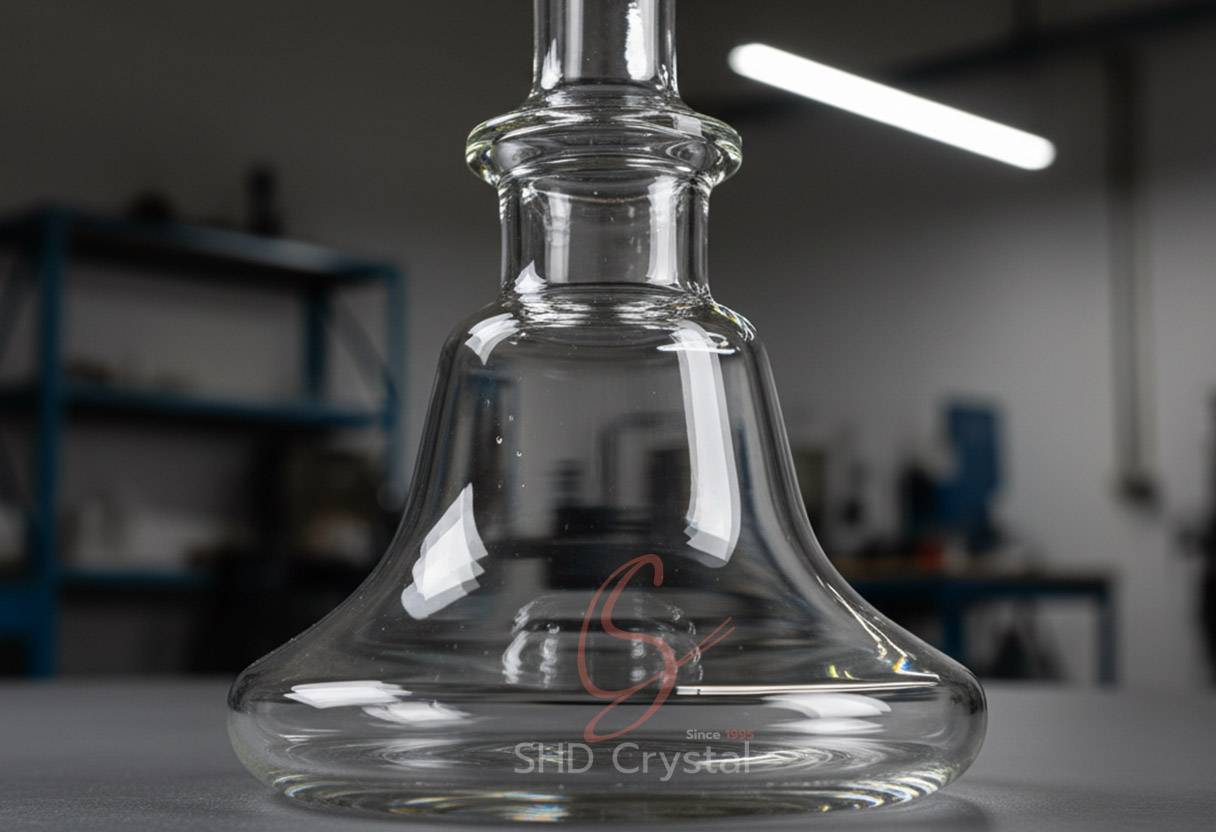
A heat resistant hookah glass base is engineered to withstand the continuous thermal cycles that occur during normal hookah use. During a session, heat transfers downward from the bowl and stem while the water inside the base remains significantly cooler. After use, routine cleaning often introduces cold water to a still-warm surface. Glass that lacks sufficient thermal resistance may develop micro-fractures under these repeated heating and cooling cycles, eventually leading to cracking or sudden failure.
Thermal stress rarely acts alone. In daily use, it compounds with mechanical stress caused by handling, movement, and cleaning. Thick wall hookah glass helps distribute heat more evenly across the surface, reducing localized expansion and minimizing stress concentration. In a well-built heat resistant hookah glass base, thick wall hookah glass also improves the feel of stability during setup and transport. From a safety perspective, a stable base lowers the risk of unexpected breakage during handling—an important consideration for both personal users and commercial environments.
Material Engineering Behind Durable Hookah Glass
Not all hookah glass performs equally under heat stress. The composition of the glass and the glass hookah manufacturing process directly determine long-term performance. Heat-resistant glass typically features a lower coefficient of thermal expansion, allowing it to tolerate temperature variation without compromising structural strength. This characteristic is particularly important for users who clean frequently or operate hookahs in environments with fluctuating water temperatures.
Wall thickness plays a dual role in durability and stability. Thick wall hookah glass not only improves resistance to thermal shock but also adds mass at the bottom, lowering the center of gravity and reducing tipping risk during use. However, thickness alone is not enough—thick wall hookah glass must be formed with uniform distribution to avoid hidden stress points. Precision shaping matters because uneven thickness can concentrate stress over time, regardless of the raw material quality.
Manufacturing Factors That Influence Long-Term Quality
The glass hookah manufacturing process has a decisive impact on whether a base performs reliably over years of use or fails prematurely. Controlled forming and proper annealing are essential. Annealing relieves internal stress introduced during shaping, and without it, even a visually flawless base may crack after repeated thermal cycles. For a heat resistant hookah glass base, the glass hookah manufacturing process should treat annealing as a core performance step rather than a cosmetic finishing stage.
Dimensional consistency is another critical factor in the glass hookah manufacturing process. Accurate molds and controlled forming ensure that stems seat correctly and seals function as intended. In a heat resistant hookah glass base, dimensional accuracy supports airtight assembly, stable airflow, and consistent performance. Comprehensive inspection further reduces risk by identifying bubbles, inclusions, or surface flaws that could compromise both thermal resistance and mechanical strength. When programs require repeatability, the glass hookah manufacturing process must keep stable parameters so each unit performs like the last.
Use Cases That Demand Heat Resistance
A heat resistant hookah glass base becomes especially valuable in use scenarios where thermal stress is more pronounced. These include frequent personal use with daily cleaning, environments where water temperature varies significantly, and compact hookah designs where heat transfer is more concentrated. Commercial and hospitality settings also place higher demands on durability due to repeated handling and cleaning.
In these contexts, thick wall hookah glass provides a practical advantage by reducing the chance of sudden failure under temperature fluctuation and routine movement. When combined with a disciplined glass hookah manufacturing process, thick wall hookah glass is more likely to maintain both appearance and reliability over time.
Maintenance and Handling Best Practices
Even the most durable glass benefits from proper care. To maximize the lifespan of a heat resistant hookah glass base, users should avoid extreme temperature shocks during cleaning, allow the base to cool naturally before rinsing, and use non-abrasive tools to protect surface integrity. Secure storage also helps prevent impact damage. These habits complement the performance benefits built into thick wall hookah glass, especially for users with frequent wash cycles.
Good maintenance also supports the intent of the glass hookah manufacturing process—reducing preventable stress events that can shorten service life. When a base is engineered for repeated thermal cycling, user behavior should reinforce that design rather than defeat it through avoidable temperature shock.
Conclusion
A high-quality, heat-resistant hookah glass base is defined by its ability to manage thermal stress, maintain structural integrity, and support consistent hookah performance over time. Bases produced with a disciplined glass hookah manufacturing process, precise annealing, and uniform thickness consistently outperform decorative alternatives. When thick wall hookah glass is executed with correct shaping and inspection, it strengthens safety, stability, and long-term reliability.
In this segment, manufacturers such as SHD Crystal, with strong capabilities in production control and quality inspection, are positioned to meet the durability expectations of modern hookah users.