
Amber medicine bottles are widely used in healthcare packaging because they combine practical product protection with a professional visual identity. In pharmaceutical and wellness applications, the bottle is not only a container. It has to support storage conditions, closure compatibility, label placement, and stable supply across repeat orders. For brands working with liquid supplements, herbal extracts, oral solutions, or similar healthcare products, the value of amber glass comes from both function and presentation.
Amber Medicine Bottles Support Light Protection and Practical Filling Use
The main reason many brands choose amber medicine bottles is light protection. Some formulations are more sensitive to exposure than others, and darker glass can help create a more controlled package environment. This is why light resistant glass containers are commonly seen in healthcare, pharmacy, and laboratory-style product lines.
At the same time, bottle color should not be the only deciding factor. The product format also matters. A small bottle for drops or concentrated liquids needs different opening and closure planning from a larger bottle for syrups or liquid supplements. Good packaging decisions connect glass color, capacity, closure type, and filling method rather than treating them as separate choices.
Closure Matching Is a Core Packaging Requirement
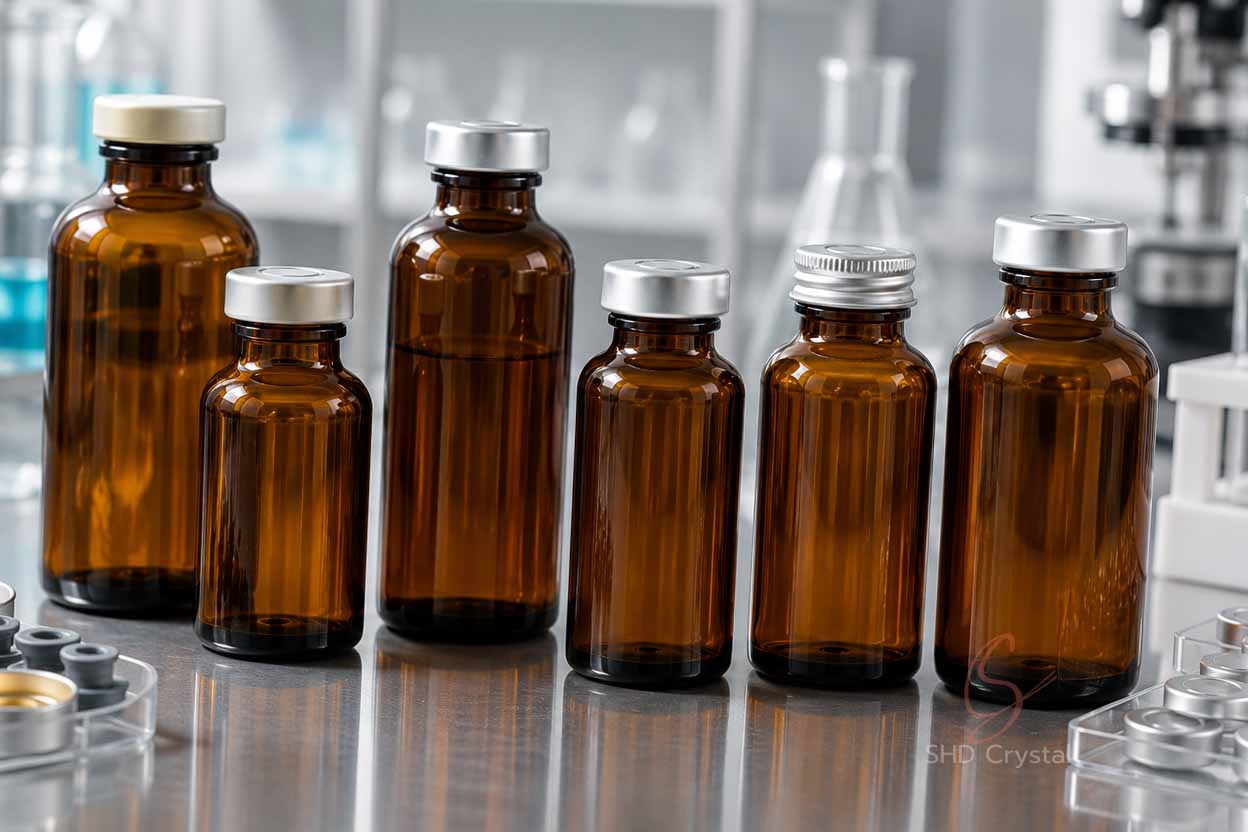
In healthcare packaging, the relationship between the bottle and the closure is critical. Screw caps, measuring caps, droppers, tamper-evident caps, and child-resistant systems all depend on the neck finish being produced accurately. If the thread dimensions vary too much, sealing quality may suffer. That can lead to leakage, poor user experience, or instability during storage and transport.
For this reason, pharmaceutical packaging bottles should be evaluated as a complete system. The bottle body may look simple, but the real performance depends on how well the cap, liner, dropper, or other dispensing part fits the glass.
Production Consistency Matters More Than One Good Sample
One common mistake is assuming that all amber medicine bottles perform the same. In practice, differences in mold condition, forming control, annealing behavior, and inspection standards can influence the final result.
Wall thickness transition needs to remain balanced so the bottle has stable structure without unnecessary weight. Neck accuracy affects closure performance. Surface quality and color consistency also matter, especially for brands that need repeat orders to look uniform on retail shelves or in healthcare distribution.
For light resistant glass containers, shade consistency is also important. If the glass tone varies too much between batches, the product line may lose visual consistency even if the shape remains correct.
Shape, Label Area, and Use Scenario Should Be Reviewed Together
Most pharmaceutical packaging bottles use practical round shapes because they are easier to fill, label, pack, and transport. However, some brands prefer square or more distinctive forms to strengthen shelf identity.
That choice can work, but it should be reviewed carefully. A bottle with stronger visual character still needs a usable label panel, reliable closure fit, and efficient movement through packing and shipping. A visually attractive bottle becomes much less effective if labels wrinkle, caps misalign, or cartons need unnecessary adjustment.
This is why amber medicine bottles should be specified according to the full use scenario. Retail pharmacy packaging, e-commerce healthcare products, and laboratory-style liquid supplements may all use amber glass, but they do not always require the same structure.
Conclusion
Amber medicine bottles work best when light protection, closure fit, labeling needs, and production consistency are considered together. Their value does not come from color alone. Reliable healthcare packaging depends on the complete bottle system, including neck accuracy, wall balance, practical shape, and stable repeat supply.
Planning Better Pharmaceutical Packaging Bottles
Brands developing pharmaceutical packaging bottles can benefit from reviewing product format, storage expectations, closure style, and label area at an early stage. A clearer packaging brief makes it easier to choose light resistant glass containers that support both product protection and day-to-day commercial use.
Link to the first article published online: https://shdcrystal.com/blogs/amber-medicine-bottles/