
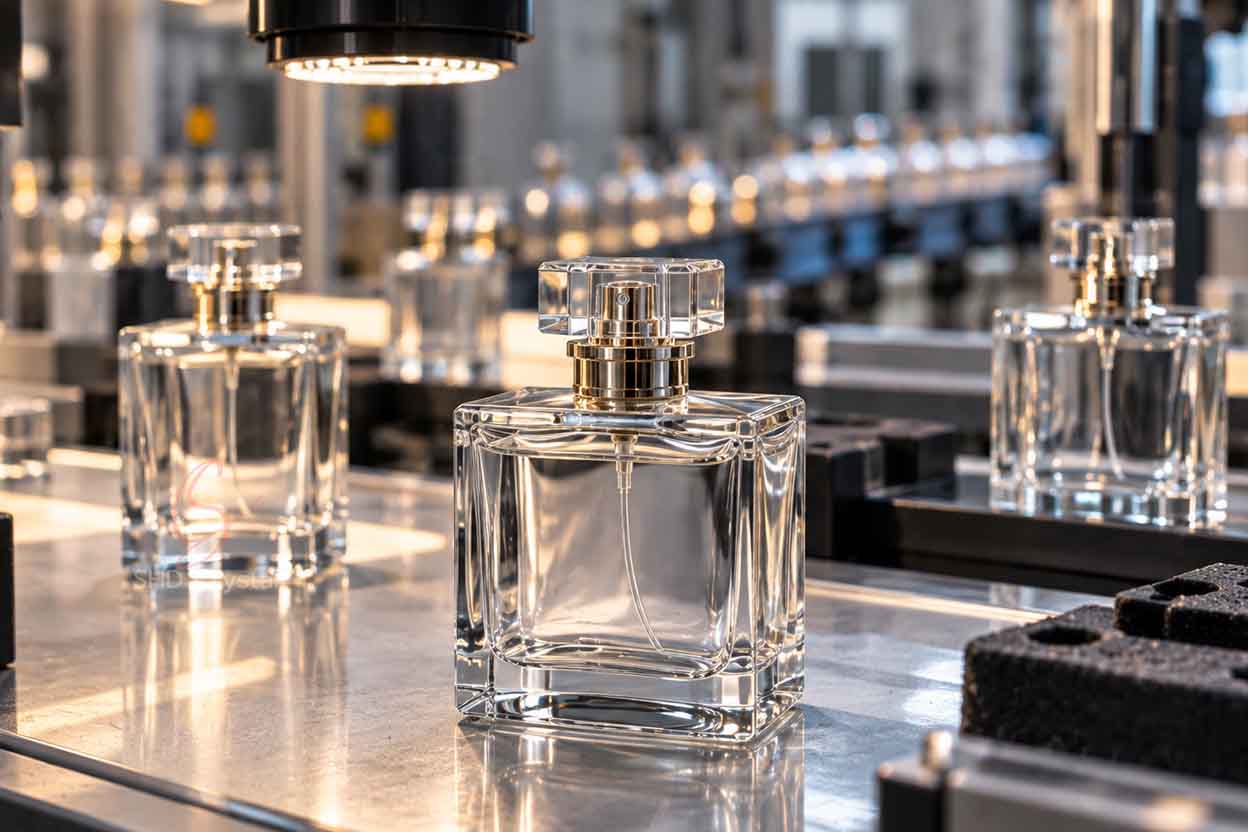
Automated perfume bottle production gives fragrance brands a more reliable path from bottle concept to repeat supply. In perfume packaging, appearance still matters, but supply stability matters just as much. A bottle must keep its shape, neck accuracy, wall balance, and decorative compatibility across repeated orders. For brands launching signature scents or expanding collections, the real value of automation is not speed alone. It is consistency.
Why Automated Perfume Bottle Production Matters in Fragrance Packaging
A perfume bottle may look like a small luxury object, yet its manufacturing logic is highly practical. When output depends on stable forming cycles, controlled annealing, and repeat inspection, automated perfume bottle production becomes the foundation for dependable supply.
This is especially important in custom perfume packaging, where the bottle must work with pumps, collars, caps, labels, coatings, and export cartons as one finished system. If one stage becomes inconsistent, the whole project feels the effect.
Design Must Still Match the Production Line
Not every elegant drawing becomes an efficient bottle. Narrow shoulders, thick bases, flat panels, curved edges, and unusual silhouettes all change how molten glass moves inside the mold. In automated perfume bottle production, shape is never just a design issue. It directly affects mold filling, wall thickness transition, and cooling behavior.
A bottle with a dramatic base may look premium, but that extra glass mass changes both forming balance and annealing requirements. A sharp-edged geometric bottle may strengthen brand identity, yet it also asks more from mold tolerance and line control. Good custom perfume packaging therefore begins with visual ambition, but it succeeds through technical realism.
Automation Improves Repeatability, Not Just Output
Many buyers hear”automation” and think only of volume. That is too narrow. The stronger advantage of automated perfume bottle production is repeatability. Gob delivery, mold timing, forming temperature, and conveyor rhythm can be controlled more consistently than in less structured workflows.
That repeatability helps support glass fragrance bottle supply across different order cycles. A brand does not only need one beautiful sample. It needs the next batch to remain visually close to the first one. It needs neck finishes that still fit the same pump, and bottle bodies that still align with the same decoration program.
Annealing and Inspection Quietly Protect the Final Look
Fragrance buyers often judge a bottle by clarity, weight, and silhouette. Those visible qualities are important, but they depend on less visible controls. After forming, the bottle must pass through a controlled annealing process to reduce internal stress. If stress remains too high, later breakage risk can increase during decoration, filling, or transport. In automated perfume bottle production, proper annealing supports not only strength, but also the confidence to scale supply.
Inspection plays a similar role. A stable glass fragrance bottle supply program should review dimensions, mouth finish, base flatness, visual defects, and general batch consistency before packing. These checks may not appear in a marketing photo, but they shape whether the packaging performs smoothly in reality.
Decoration Needs a Stable Base Bottle
For custom perfume packaging, decoration is often where brand identity becomes most visible. Frosting, spraying, printing, hot stamping, gradient coating, and metallic accents all depend on a bottle body that has already been formed accurately.
If the bottle varies too much in dimension or surface quality, decoration results may vary as well. That is why automated perfume bottle production is closely tied to finishing quality. A stable base bottle makes it easier to achieve cleaner printing, more even coating, and more predictable assembly with pumps and caps.
Supply Also Includes Packing and Delivery Logic
Reliable supply does not end when the bottle leaves the forming line. Glass fragrance bottle supply also depends on how the bottles are packed, separated, palletized, and prepared for shipment. Perfume bottles often use heavier bases and more appearance-sensitive finishes, which makes protective packing especially important.
For brands scaling a fragrance line, that practical side matters. A bottle that looks excellent at inspection but arrives scratched, chipped, or mispacked has not completed the supply task successfully.
Conclusion
Automated perfume bottle production is valuable because it connects design intent with repeatable supply performance. It helps fragrance brands maintain shape consistency, closure compatibility, decorative quality, and packing reliability across multiple orders. In other words, strong custom perfume packaging is not created by design alone. It is supported by a stable glass fragrance bottle supply system that keeps the product visually convincing and commercially practical.
Supporting Fragrance Projects With Stable Production
For brands planning new custom perfume packaging projects, SHD Crystal supports bottle development through automated glass forming, mold coordination, annealing control, inspection, finishing review, and export packing. With experience in automated perfume bottle production and glass fragrance bottle supply, SHD Crystal can help fragrance lines move from concept to repeatable production with greater consistency and service support.
Read the original article on custom crystal glass manufacturing: https://shdcrystal.com/blogs/automated-perfume-bottle-production/