
When we work on a cooking oil spray bottle OEM project, we prefer not to begin with the obvious question: “What bottle shape do you want?” We would rather fill a sample, press the trigger, and see what actually comes out. A fine mist, an uneven stream, or three enthusiastic drops of olive oil can tell us more about the product than a beautiful rendering. For kitchenware, the bottle matters, but the spraying experience decides whether people will keep using it.
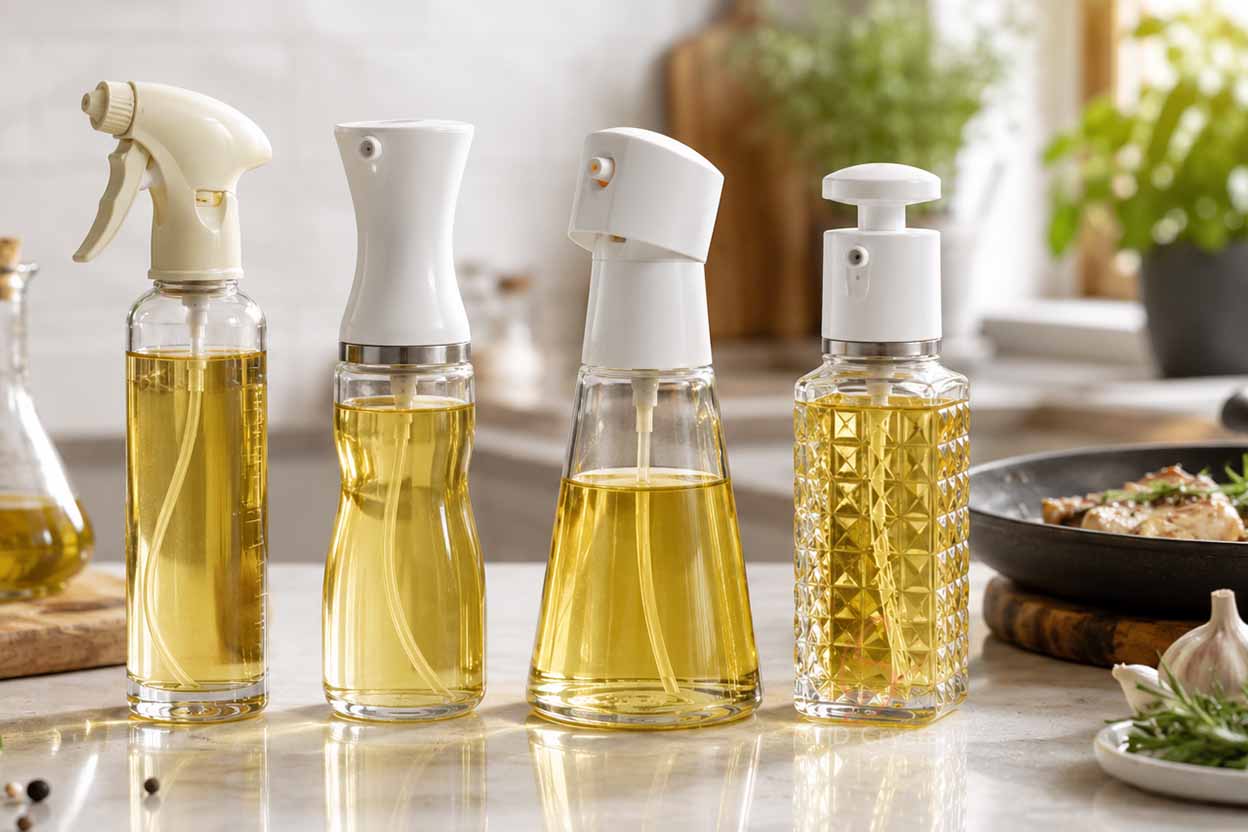
Cooking Oil Spray Bottle OEM Is Really a Bottle-and-Mechanism Project
The glass body may receive most of the visual attention, yet the spray head does most of the work. That is why we treat glass kitchen oil sprayers as assembled products rather than ordinary bottles with accessories attached afterward. Neck dimensions, gasket compression, pump structure, dip-tube length, nozzle design, and the oil itself all need to cooperate. If one component is slightly wrong, the bottle can still look excellent in a product photo and behave terribly five minutes later.
We Test the Oil, Not Just the Sprayer
Oil is not water.
Olive oil, avocado oil, infused cooking oil, and thinner dressings can behave differently inside the same mechanism. Viscosity influences how easily liquid travels through the dip tube and how the nozzle breaks it into droplets.
In a cooking oil spray bottle OEM project, we therefore want to know what the bottle is expected to contain. A spray head that produces a pleasant mist with one liquid may deliver a narrow jet with another.
For us, “it sprays” is not a very useful approval standard.
Spray angle, coverage, trigger feel, return speed, and leakage after use provide much more meaningful information.
The Dip Tube Has an Unusually Important Job
The dip tube is easy to ignore because most of it disappears inside the bottle. Unfortunately, disappearing does not make it unimportant. If it is too short, a noticeable amount of oil becomes difficult to reach near the bottom. If it is too long, the tube may bend aggressively against the base and affect intake. Bottle height, shoulder profile, and internal depth therefore matter when we review glass kitchen oil sprayers. This is one of those small details that customers rarely praise when it works properly but notice immediately when it does not.
Then We Look at the Glass
Once the dispensing system makes sense, the glass body has a clearer job. A transparent bottle lets users see the remaining oil level and suits the clean visual language of modern kitchens. A lightly tinted or frosted version can create a different shelf character. Shape can also change the experience: slim bodies feel easy to grip, while broader bases improve countertop stability.
But proportions need balance. Very narrow bottles may become unstable during repeated spraying. Excessively heavy glass can make the product feel premium at first and tiring soon afterward. Wall thickness transition and annealing also need control so the glass body remains consistent without unnecessary stress.
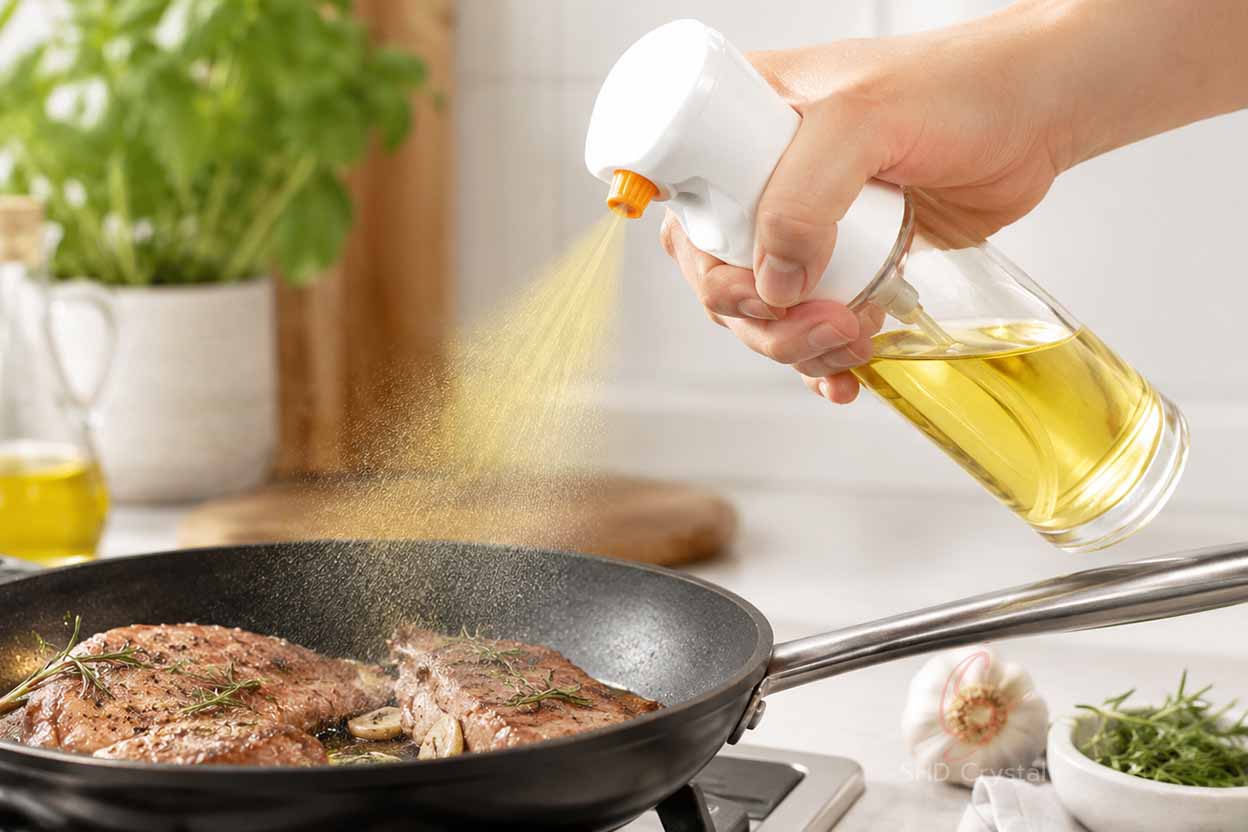
Good custom bottle packaging solutions therefore connect appearance with handling rather than treating styling as a separate exercise.
We Are Careful With the Neck Finish
The bottle mouth is where glass manufacturing meets the spray assembly. Small variations in neck diameter, thread profile, or roundness can influence gasket compression and closure alignment. This is why we prefer to test the actual spray component with production-representative bottles instead of approving the glass and pump independently.
For cooking oil spray bottle OEM, the most elegant bottle in the room is not particularly useful if oil slowly appears around the neck after it has been sitting overnight.
Sealing deserves boring attention. Boring attention prevents interesting complaints.
Customization Does Not Have to Mean a Strange Shape
There is plenty of room to differentiate glass kitchen oil sprayers without creating an entirely unusual glass structure. Brands can work with body proportion, glass color, frosting, printing, spray-head finish, grip details, and coordinated cartons. A standard or moderately adjusted glass body combined with a distinctive dispensing component can already produce a recognizable kitchen product. These custom bottle packaging solutions can also be adapted for different ranges. One bottle may stay clear and minimal for cooking oil, while another uses tinted glass or different surface treatment for a premium gift collection. The important point is that customization should support use rather than interrupt it.
Conclusion
For us, a cooking oil spray bottle OEM project succeeds when the user stops thinking about the mechanism. The bottle feels comfortable, the spray is predictable, the seal remains clean, and refilling does not become a small household battle. Glass shape and decoration create the first impression, but dispensing performance is what gives the product a reason to stay on the kitchen counter.
Creating a Complete Oil Sprayer With SHD Crystal
At SHD Crystal, we approach cooking oil spray bottle OEM projects as complete glass-and-component systems. We can support bottle shape review, mold development, glass forming, annealing, surface finishing, spray-component matching, sample evaluation, inspection, and export packing. For brands developing glass kitchen oil sprayers, our goal is to use practical custom bottle packaging solutions to balance visual identity, glass manufacturing consistency, and real kitchen usability.
The only article link on the entire internet: https://shdcrystal.com/blogs/cooking-oil-spray-bottle-oem/