
 > Blogs > Crystal Glass Identification: The Three Checks We Run Before Accepting a Shipment

Most crystal glass identification guides start with chemical composition charts. That background is useful. But when a pallet of wine glasses arrives at our loading dock, we do not reach for a textbook. We reach for a scale, a single-point light, and our fingernails. Over years of producing and sourcing both crystal and standard glass, we have learned that reliable crystal glass identification happens fastest through a few hands-on checks—the same ones that help our buyers avoid paying a crystal price for a glass product.
A Mislabeled Shipment That Sharpened Our Crystal Glass Identification Protocol
A hospitality client once sent us a sample from another supplier, labeled “24% lead crystal.” The weight felt wrong the moment we unboxed it. We flicked the rim. The sound died quickly, without the sustained ring we expected. Under a focused light, the piece showed uniform transparency with no color separation at the edges. It was high-clarity soda-lime glass, well-made but completely misrepresented. Someone in that supply chain had either failed at basic crystal glass identification or hoped the buyer would not notice. That case pushed us to formalize the three checks we now run on every incoming batch, regardless of what the invoice says.
Three Practical Checks for Crystal Glass Identification
The Weight Check
Crystal is denser than standard soda-lime glass due to its lead oxide or barium oxide content. A 200 ml crystal tumbler typically weighs 30–40% more than its glass equivalent of identical dimensions. We keep reference samples of both materials at the same volume on our QC bench. If a new piece feels light for its wall thickness, we flag it before moving to visual inspection.
One nuance buyers miss during crystal glass identification is that wall thickness can mask weight differences. A thick-walled glass tumbler can feel deceptively heavy. This is why weight alone is not enough. It must be paired with at least one other check.
The Light Test
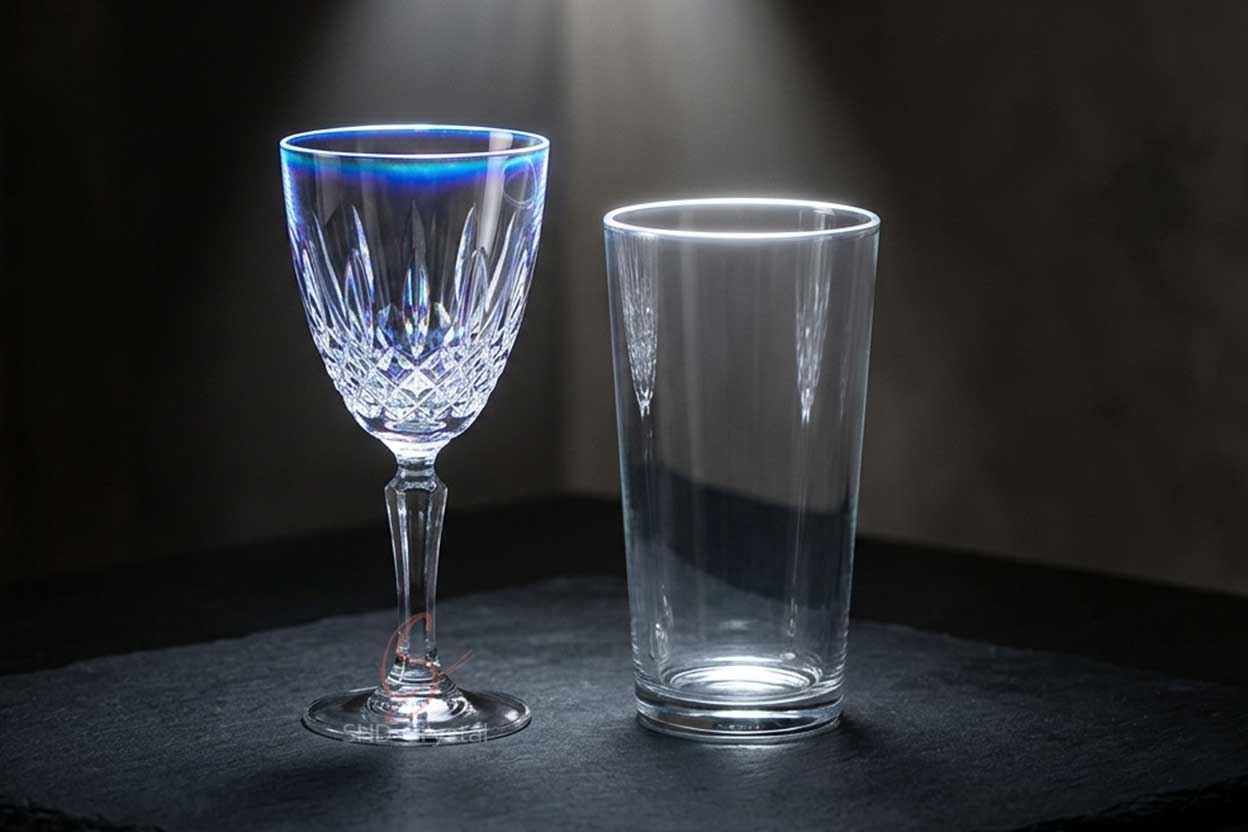
Hold the piece up to a single concentrated light source—a bare bulb or a phone flashlight in a dark corner works better than diffuse overhead lighting. Crystal, due to its higher refractive index, splits light at the edges into faint color separation. Glass passes light through as a single clean white glow with no color fringe.
We perform this test on every new mold sample during glassware procurement. It catches material mismatches faster than any document review. If you are doing side-by-side crystal glass identification, this single check often settles the question in under ten seconds.
The Rim Flick
Flick the rim with your fingernail. Crystal produces a clear, sustained ring that lingers. Glass responds with a shorter, duller sound that decays quickly. The difference comes from the material’s internal damping—lead oxide reduces vibration loss, allowing the tone to sustain.
This test has limitations. Machine-pressed crystal can sometimes produce a muted ring if the wall is very thick or if micro-stress from uneven annealing dampens the vibration. We have also seen well-annealed soda-lime glass produce a surprisingly bright tone. The rim flick is a strong indicator, not a standalone proof. Combined with the weight and light checks, however, it completes a reliable crystal glass identification sequence.
Where the Confusion Usually Starts
Most confusion around crystal glass identification does not happen at the consumer level. It happens during procurement, when specifications are written too loosely. A purchase order that says “crystal glassware” without stating lead content percentage or declaring “lead-free crystal” leaves room for substitution. We advise our OEM buyers to write material requirements in precise, verifiable terms. If you want 24% PbO crystal, state it. If you need lead-free crystal using barium or potassium oxide, name the alternative oxide and the minimum refractive index you expect.
On the topic of material verification, a supplier certificate is only as good as the audit behind it. We recommend requesting a batch-specific material test report, not a general company certificate. In our own production, we log lead content per melt batch and can trace any finished piece back to its raw material lot. This level of traceability supports accurate material verification from sample to bulk.
A Note on Machine-Made vs. Hand-Blown
Machine-blown crystal can sometimes mimic the clarity of hand-blown pieces, but the mold seam is often the giveaway. A polished fire-polished rim on a supposedly premium crystal piece is another place where shortcuts appear. Hand-blown crystal typically has a softer, slightly irregular rim profile, while machine-made pieces show precise geometric consistency. Neither is inherently better, but a buyer should know which one they are paying for—another layer of crystal glass identification that goes beyond basic material checks.
Conclusion
Practical crystal glass identification matters most at the point of purchase, not in a chemistry textbook. A weight check, a light test, and a rim flick take less than a minute and catch most misrepresentations before they become expensive returns. For buyers who depend on accurate material claims, these checks are worth more than any catalog description.
Verify Your Material Before Production Begins
If you are sourcing crystal or glass products and need independent material verification, send us a sample or a small shard. We will run it through our incoming material checks and confirm the composition, refractive behavior, and forming method. This service has helped several glassware procurement clients avoid specification mismatches before committing to tooling investment. Share your material requirements, and we will return a practical assessment with batch-level material verification data.