
Two crystal vases can look almost identical on a showroom shelf, yet their material composition, polishing quality, and manufacturing consistency may be entirely different. One may feature carefully finished geometric cuts, while the other has minor surface marks that become noticeable under direct light. Understanding crystal glass quality grades helps buyers distinguish material specifications from the actual quality of a finished product.
The challenge is that a higher material classification does not automatically mean better craftsmanship. Quality must be evaluated through several independent factors.
Understanding Crystal Glass Quality Grades Beyond Material Labels
The word grade can describe different things in glass manufacturing. It may refer to material composition, transparency, or a manufacturer’s internal inspection category. These distinctions matter because they answer different purchasing questions.
Material Composition Is Not a Finished Quality Grade
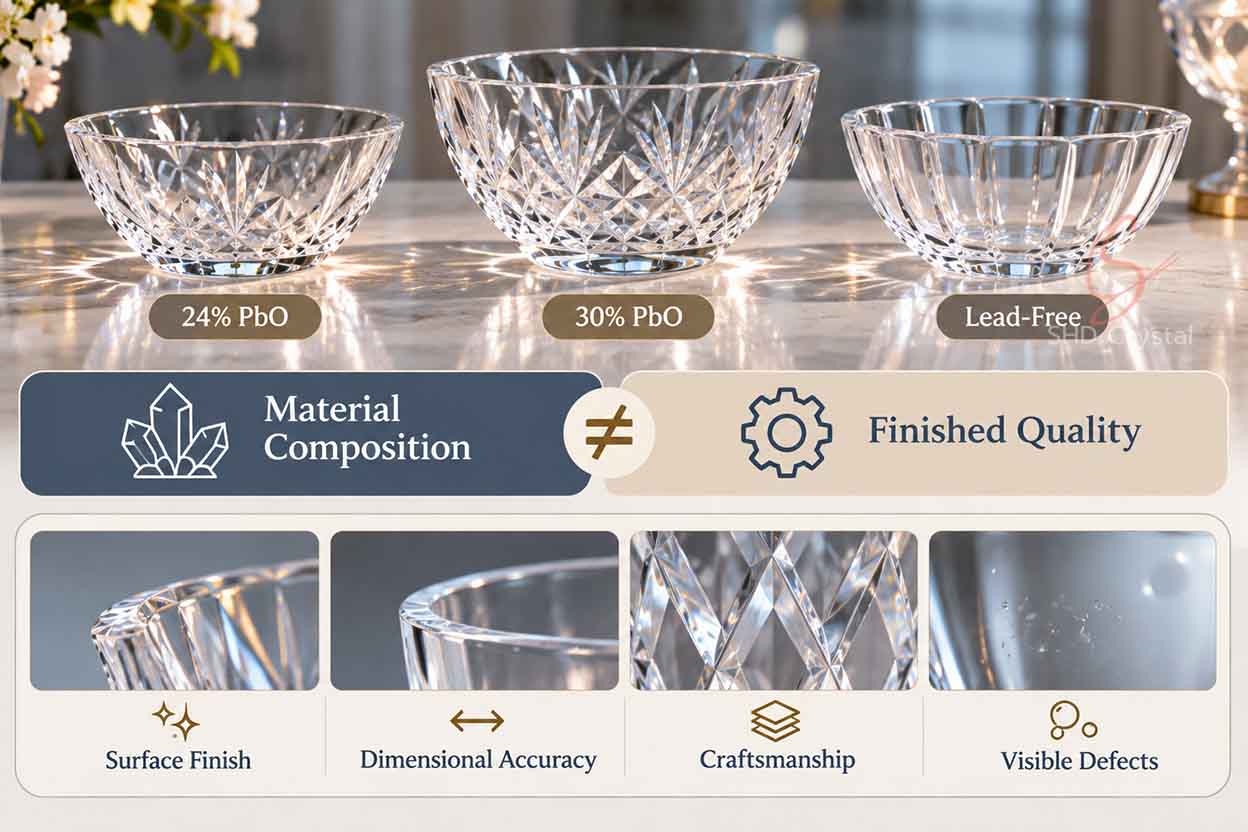
Traditional crystal glass is often discussed in terms of its lead oxide content. Under European crystal-glass classifications, lead crystal 24% requires at least 24% PbO, while full lead crystal 30% requires at least 30% PbO, alongside other specified characteristics. [1] These terms belong to lead crystal classification, not a universal ranking of finished workmanship.
A 30% PbO decorative bowl is not automatically better manufactured than a 24% PbO bowl. Both may differ in surface finishing, dimensional accuracy, and visible defects. Lead-free crystal also requires separate material identification rather than being judged solely by its appearance.
Does Grade A Mean the Same Thing Everywhere?
Buyers may encounter descriptions such as Grade A, Grade B, or premium-grade crystal glassware. However, such labels should not be assumed to follow a single internationally recognized finished-glassware grading system.
One supplier may use Grade A to indicate stricter visual inspection. Another may apply the term to selected products with particular decorative or finishing characteristics. For crystal glass quality grades, these commercial descriptions become meaningful only when supported by written acceptance criteria.
A purchasing specification should explain which characteristics are mandatory, which variations are acceptable, and which defects require rejection.
Transparency and Optical Appearance
Clarity is particularly important for transparent crystal products. Small bubbles, internal inclusions, visible coloration, and optical distortion may influence how a vase, tumbler, or decorative ornament appears under light.
ISO 24117:2020 establishes measurable clear-glass and ultra-clear-glass classifications for applicable non-colored consumer glass products. It does not replace the separate European classifications for lead crystal. [2] A thick crystal base may also appear different from a thin wall because light travels through more material. For this reason, buyers should inspect the finished product rather than relying exclusively on a small material sample.
Cutting, Polishing, and Surface Quality
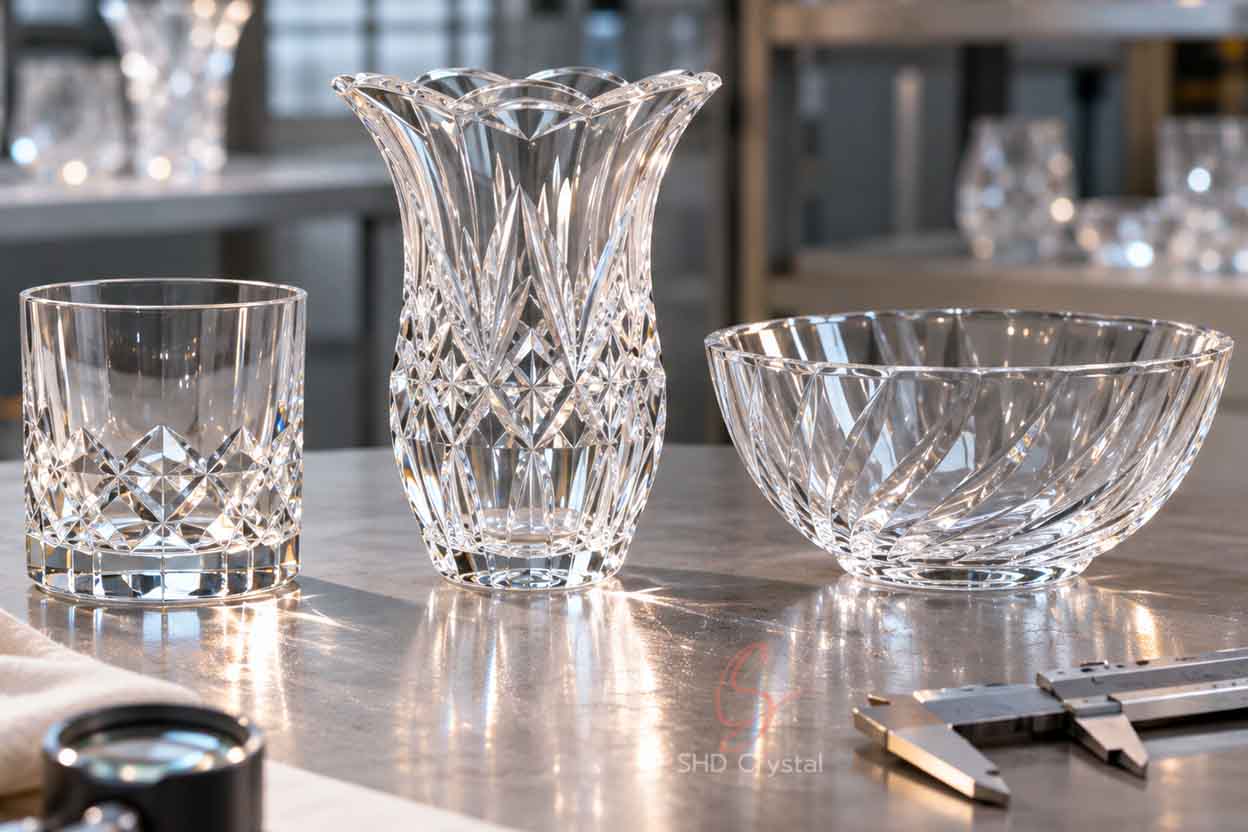
Decorative finishing can make the difference between an ordinary crystal object and a refined one. Deep-cut patterns require accurate alignment and carefully polished surfaces. Poorly finished facets may appear cloudy, while uneven cutting can disrupt the symmetry of a geometric design. The techniques involved in 24% PbO crystal cutting and polishing further illustrate why finishing precision matters independently of material composition.
A crystal vase with beautifully aligned diamond patterns may therefore offer greater decorative value than another piece with more elaborate but inconsistent cutting. In glassware defect inspection, surface scratches, unfinished edges, polishing marks, and visible pattern misalignment should be assessed against the approved sample.
Hand-finished products may have acceptable variations, but those limits should be established before production.
Quality Standards Should Reflect Product Use
Not every crystal product requires identical inspection criteria. A decorative crystal award may place particular emphasis on polished surfaces and internal transparency. A drinking glass also requires attention to rim quality, handling, and applicable food-contact requirements. For products containing lead, material safety is especially important. Health Canada advises against long-term food and beverage storage in lead crystal and recommends lead-free alternatives for everyday use. [3]
A product’s intended application should therefore influence both material selection and inspection priorities.
How Buyers Can Establish Practical Acceptance Criteria
An approved physical sample provides a starting point, but written specifications make quality expectations more reliable. For OEM production, glassware defect inspection should address relevant dimensions, weight, surface finish, decorative alignment, and permissible visual defects.
Inspection conditions should also be agreed upon. Lighting, viewing distance, and examination methods can influence whether small imperfections are noticed. A crystal collection should be evaluated for consistency across multiple pieces, not simply against one attractive showroom example.
Frequently Asked Questions and Answers
Is 30% PbO crystal always higher quality than 24% PbO crystal?
No. The percentages identify different material compositions. Finished quality also depends on forming, annealing, cutting, polishing, and inspection.
Can buyers determine crystal quality from photographs?
Photographs can help assess general appearance, but they cannot reliably establish composition, internal defects, dimensional accuracy, or all aspects of surface quality.
Are small bubbles always unacceptable in crystal glassware?
Not necessarily. Acceptance depends on the product’s intended use, the approved specification, and the agreed defect limits. Critical defects must be distinguished from permissible cosmetic variation.
Conclusion
Crystal glass quality grades are most useful when material identity, visual appearance, and manufacturing quality are evaluated separately.
A premium crystal product is not defined by a single percentage or commercial grade label. Its value depends on whether the selected material, decorative finishing, and production consistency meet the requirements of the finished design.
Quality Begins with a Clear Product Standard
A carefully defined crystal collection deserves equally careful quality expectations. At SHD Crystal, discussions about crystal glass quality grades help connect material choices, decorative details, and practical acceptance requirements. Establishing those expectations before sampling provides a clearer foundation for original crystal glassware projects.
References
[1] Council Directive 69/493/EEC — EUR-Lex
https://eur-lex.europa.eu/eli/dir/1969/493/2007-01-01/eng
[2] ISO 24117:2020 — Tableware, giftware, jewellery and luminaries, made of glass — Glass clarity — Classification and test method
https://www.iso.org/standard/77836.html
[3] Lead Crystalware and Your Health — Health Canada
https://www.canada.ca/en/health-canada/services/healthy-living/your-health/products/lead-crystalware-your-health.html