
Geometric perfume bottle design often feels closer to architecture than ordinary packaging. A square shoulder creates structure, a sharp facet changes how light travels across the surface, and a substantial base can make a relatively small bottle feel unexpectedly monumental. This is why geometric bottles appear so frequently in premium fragrance collections: the glass itself already carries visual identity before color, printing, or decoration is added.
Geometric Perfume Bottle Design Builds Character Through Shape and Light
The strongest geometric bottle does not need to be complicated. A clean rectangular body with controlled proportions can feel more distinctive than a bottle covered in decorative elements. Geometry works because the eye understands balance instinctively.
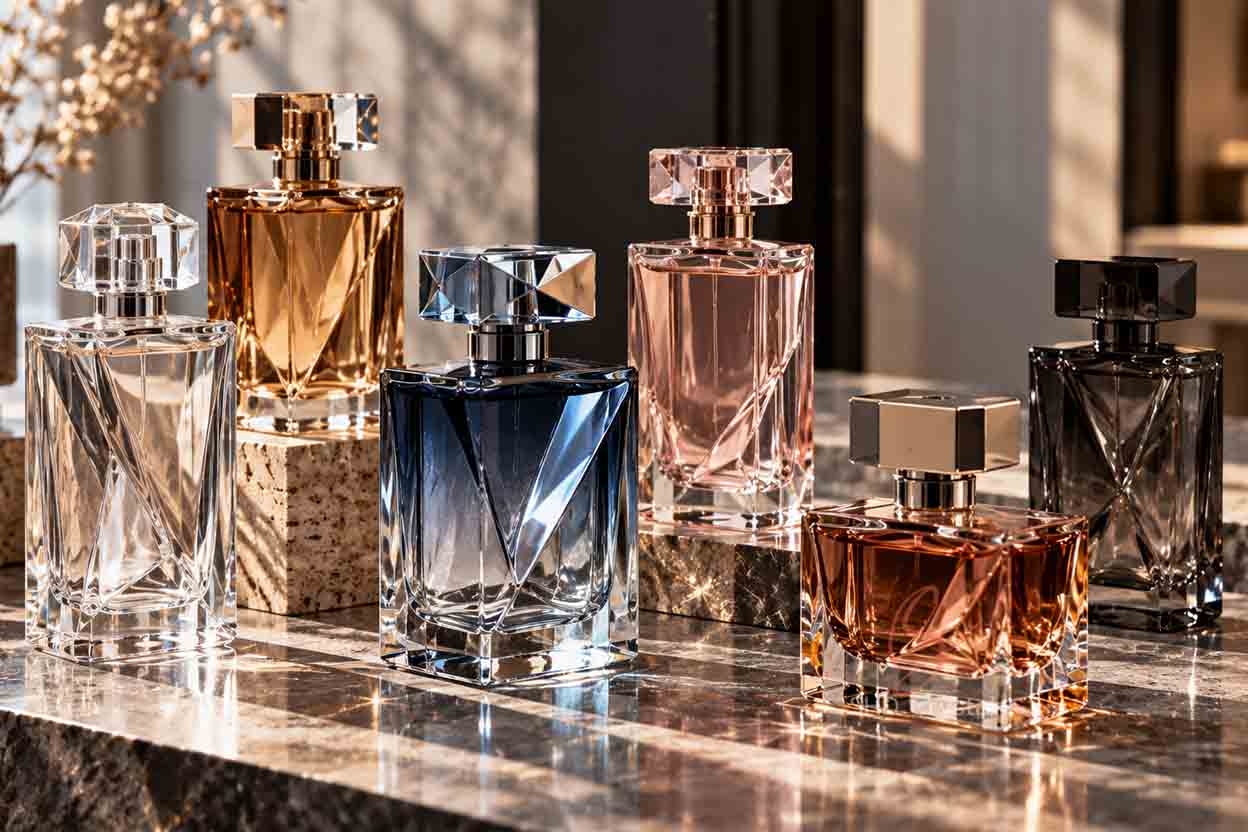
Parallel lines feel organized. Symmetry feels deliberate. A thick base suggests physical weight. Sharp transitions create contrast with the softness of transparent glass. When these features work together, the bottle becomes more than a container. It becomes a small object of design.
Faceted Glass Changes Every Time the Bottle Moves
A faceted glass perfume bottle is especially effective because its appearance is never completely fixed. Rotate it slightly and one plane catches the light while another becomes darker. Viewed from the front, the structure may appear symmetrical and restrained. From an angle, the same bottle can suddenly reveal multiple layers of glass and reflection. This gives fragrance brands a strong visual asset without relying on elaborate surface decoration.
The structure itself performs. A well-positioned facet can create highlights around the shoulders, deepen the appearance of the base, or visually frame the fragrance liquid inside.
Heavy Bases Create Visual Gravity
A heavy base perfume bottle changes the way a product feels before the fragrance is even sprayed. The eye reads the additional glass as weight and permanence. In the hand, the same mass can create a stronger sense of material value. This works particularly well with geometric forms because a substantial bottom reinforces the architectural character of the bottle.
But visual gravity needs restraint. If the base becomes too thick, the bottle may feel disproportionate or unnecessarily heavy. If it is too thin, the upper structure may visually overpower it. The most successful proportions make the base feel intentional rather than excessive.
Minimal Designs Are Often Less Forgiving
One of the paradoxes of geometric perfume bottles is that simplicity can demand more precision. A highly decorative bottle can hide minor visual variation among patterns and ornament. A minimal square bottle has nowhere to hide. If one shoulder appears slightly different from the other, or the neck seems visually off-center, the clean geometry makes the difference easier to notice.
The more disciplined the design language becomes, the more important balance and consistency become during physical development.
The Bottle Interior Is Part of the Visual Composition
Transparent geometric bottles reveal more than their exterior. The internal cavity, base depth, wall thickness, and liquid level all become part of the visible composition. A heavy base may create a deep optical layer beneath the fragrance. Thick corners may intensify reflections. A centered internal cavity can reinforce symmetry. For clear glass, these internal details matter almost as much as the external silhouette.
The bottle therefore has two designs at once: the shape people touch and the optical structure they see through.
Caps Need to Finish the Architecture
The cap should feel like the final element of the same design rather than an unrelated component placed on top. A square bottle may pair naturally with a compact geometric cap. A highly faceted body might benefit from a simpler closure that prevents the design from becoming too busy.
Proportion matters as much as style. If the cap is too small, the body can look visually unfinished. If it is too large, the bottle may feel top-heavy. The neck structure, pump system, collar, and cap should therefore be evaluated together with the overall silhouette during development.
Decoration Works Best When It Knows When to Stop
Geometric perfume bottles already have a strong visual language. That often means decoration can remain restrained. A matte surface may emphasize the silhouette. Metallic printing can align with one flat panel. Selective transparency can reveal the liquid while leaving other areas opaque.
Rather than covering the glass, good decoration can simply direct attention toward the geometry that is already there. For premium fragrance packaging, sometimes the most expensive-looking decision is knowing what not to add.
Conclusion
Geometric perfume bottle design transforms glass through proportion, symmetry, refraction, and physical weight. A faceted glass perfume bottle creates movement through light, while a heavy base perfume bottle introduces depth and visual gravity.
What appears minimal on the shelf is often highly considered underneath. Exterior geometry, internal cavity, bottle weight, neck alignment, cap proportion, and decoration all need to support the same design language. The result works best when the bottle feels like one complete object rather than a collection of individually attractive features.
Developing Sculptural Perfume Bottle Concepts With SHD Crystal
SHD Crystal can support geometric perfume bottle development from early references and concept sketches through structural review, sampling, surface finishing, and component coordination.
For sculptural bottle projects, discussions can focus on faceted surfaces, heavy-base proportions, shoulder geometry, internal capacity, neck structure, cap direction, transparency, color, and decoration. Physical samples allow designers and buyers to assess how the bottle actually responds to light, how substantial it feels in the hand, and whether the intended geometry remains visually balanced from multiple viewing angles.
This helps translate an architectural concept into a glass product suitable for practical production.
FAQs
Q01 | Why do geometric perfume bottles often look more premium?
Strong proportions, symmetry, flat planes, faceted reflections, and heavier glass can create a more sculptural and architectural appearance. These visual cues often make the bottle feel more deliberate and substantial.
Q02 | Does a faceted perfume bottle need additional decoration?
Not always. Faceted surfaces already create visual movement through reflection and refraction, so restrained printing, frosting, or metallic details may be enough to complete the design.
Q03 | Why should geometric bottle samples be reviewed from several angles?
Because facets, wall thickness, internal cavity position, and reflections can change significantly with viewing angle. A bottle that looks balanced from the front may reveal different proportions or optical effects from the side.
https://shdcrystal.com/blogs/geometric-perfume-bottle-design/
The link to this article is managed and owned by SHD Crystal. Please cite the source if reposting. Thank you for your cooperation.