
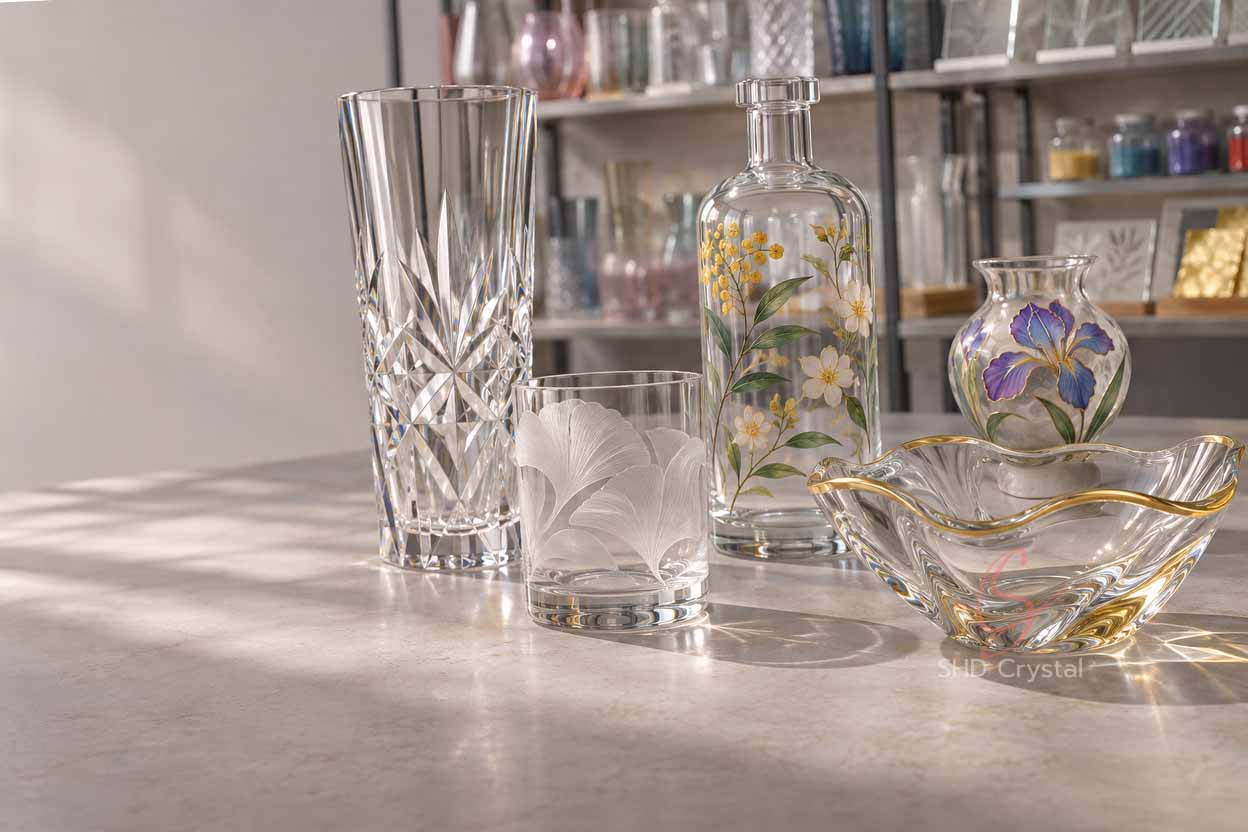
A clear glass tumbler can look simple, elegant, or surprisingly artistic depending on what happens to its surface. Deep geometric cuts create sparkling reflections, frosted patterns soften the light, and gold detailing introduces a completely different character. These effects come from different glass decoration methods, each with its own possibilities and limitations.
For glassware brands and OEM buyers, decoration is more than an attractive finishing touch. The chosen technique influences how a product looks, feels, and performs in everyday use.
Understanding Glass Decoration Methods and Their Visual Effects
Not every decorative effect is created in the same way. Some processes remove material from the glass, while others apply color, metallic finishes, or patterns to its surface.
The most suitable glass decoration methods depend on the intended appearance, glass shape, material composition, and product application. A crystal vase designed for display may support deeper decorative cutting, while a drinking glass intended for frequent washing needs greater attention to surface durability.
1. Glass Cutting: Creating Patterns with Light
Traditional glass cutting is closely associated with decorative crystalware. A cutting wheel removes material from the glass surface, creating grooves, facets, or geometric patterns. After polishing, these surfaces can produce brilliant reflections, particularly on thick crystal glass. Diamond patterns, star cuts, and vertical flutes are familiar examples.
For vases, decorative bowls, and substantial whiskey tumblers, cutting can make the glass itself the main decorative feature. However, deep cuts require suitable wall thickness and structural planning. A delicate glass vessel cannot necessarily accommodate the same pattern as a heavy crystal vase.
2. Engraving: Decoration in Fine Detail
Engraving is generally more focused on fine lines, illustrations, and localized details than broad decorative cutting. Hand engraving, mechanical engraving, and laser marking can create different visual effects. Some produce delicate surface marks, while others allow more pronounced designs.
Floral illustrations, commemorative motifs, and abstract artwork can all benefit from this approach. The available surface area matters. Detailed artwork that looks attractive on a flat drawing may become difficult to recognize when placed on a small curved glass.
3. Sandblasting and Etching: The Beauty of Frosted Glass
A frosted glass vase has a softer appearance than a polished transparent one. Glass sandblasting creates this effect by directing abrasive particles against selected surfaces. Areas protected by a mask remain clear, while exposed areas develop a matte texture. The technique can produce geometric patterns, decorative bands, or larger frosted sections.
Chemical etching can also create satin or frosted finishes, but it uses a different surface-treatment process and should not be confused with abrasive blasting. For decorative glassware, the contrast between clear and frosted areas is often more interesting than covering the entire surface.
4. Screen Printing: Adding Repeatable Color and Patterns
Some decorations require color rather than texture. Glass screen printing transfers ink through a prepared screen onto the glass surface. It is commonly considered for repeated patterns, logos, and decorative graphics. The finished appearance depends on the selected ink system. Certain ceramic or glass enamels require firing to fuse the decoration to the glass, while other printing systems use different curing methods. This distinction matters because adhesion, durability, and cleaning compatibility are not identical across all printed finishes.
For coordinated barware and branded glass collections, physical samples help confirm color, pattern positioning, and visual consistency.
5. Decal Decoration: Artwork with More Complexity
When a design includes multiple colors or intricate artwork, decorative transfers may offer another option. A decal carries a prepared image that is transferred onto the glass surface. Ceramic decals are subsequently fired under suitable conditions to bond the decoration to the glass. This method can be considered for detailed floral artwork, ornamental borders, and coordinated tabletop collections. It is important to distinguish fired ceramic decals from ordinary adhesive stickers. They are different products with different performance characteristics.
6. Enamel Painting and Gilding: Traditional Decorative Character
Some glass decorations are intended to feel artistic rather than purely graphic. Traditional vitreous enamel painting uses colored glass-based materials that are applied to the surface and fired under controlled conditions. It is particularly associated with floral, botanical, and ornamental glass decoration.
Gilding introduces another visual language. Gold-colored or precious-metal decorations can highlight rims, sculptural contours, and selected patterns. These finishes require attention to application methods, firing or curing compatibility, and intended use. Metallic decoration around drinking areas also needs appropriate safety assessment.
7. Color Spraying and Coating: Changing the Overall Appearance
Not every colorful glass product is made from colored glass. Surface spraying and coating can change the appearance of an otherwise transparent vessel. A clear vase may receive a smoky gray finish, while a decorative bottle may use a translucent gradient. These treatments offer different possibilities from coloring the glass material itself.
Coating durability, scratch resistance, and cleaning compatibility depend on the selected formulation and processing conditions. For products intended for regular handling, testing the finished surface is especially important.
Choosing the Right Finish for a Product
The most elaborate decoration is not always the most suitable. A deeply cut crystal vase may benefit from strong optical reflections, while a minimalist drinking glass may look better with one restrained frosted detail.
A decorative bottle can support colorful printed artwork, whereas a premium gift item may gain more character from engraving or gilding. In OEM development, the decision should begin with the product’s intended use, followed by material compatibility, decoration area, expected order quantity, and sample testing.
FAQs
Can several glass decoration techniques be combined?
Yes. Cutting, engraving, printing, gilding, and other finishes may be combined when the materials and processing steps are compatible. The sequence must be evaluated to avoid damaging earlier decorations.
Can decorative patterns be applied to irregular glass shapes?
Many curved or sculptural surfaces can be decorated, but not every technique works equally well on complex geometry. Artwork distortion, equipment access, and finish consistency should be assessed during sampling.
What should buyers confirm for decorated drinking glasses?
Buyers should verify material suitability, decoration placement, applicable food-contact requirements, cleaning instructions, and sample performance. A visually attractive finish does not automatically establish food-contact safety or dishwasher compatibility.
Conclusion
Glass decoration methods give glassware its visual diversity. Cutting emphasizes brilliance, engraving introduces fine detail, frosting softens reflections, and printing, enamel, gilding, and coatings add color or decorative character. Understanding these differences helps brands choose finishes that complement the product rather than compete with its original design.
SHD Crystal supports OEM and ODM projects involving original glassware designs and decorative surface treatments. For buyers evaluating glass decoration methods, reference artwork, material requirements, product geometry, and intended use provide a practical starting point for assessing suitable finishing options and sample development.
Read the original full version: