
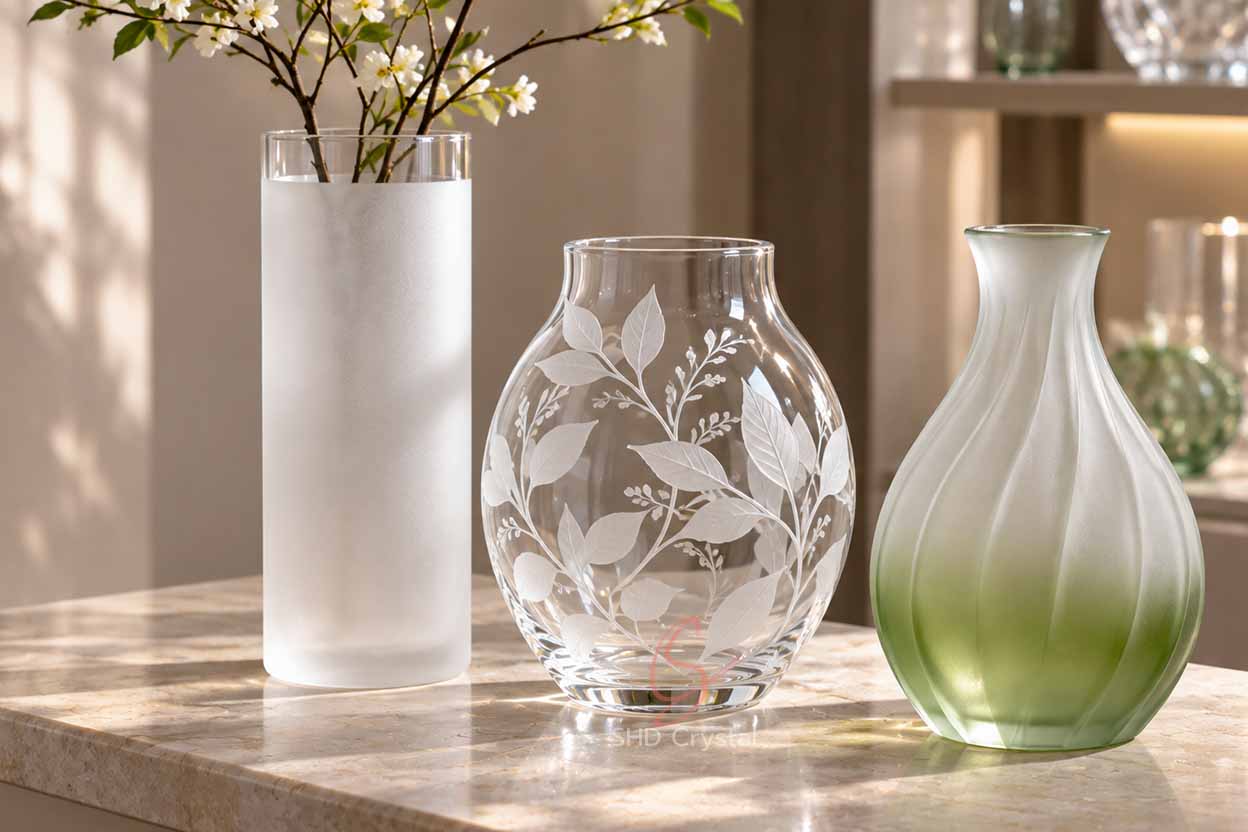
A transparent glass vase lets light travel freely through its walls, revealing every curve and detail. A frosted vase creates a different impression. Its softened surface diffuses light, makes colors appear gentler, and gives even a simple cylindrical form a quiet decorative character. Through the glass vase frosting process, manufacturers can achieve anything from a uniform satin surface to delicate botanical patterns and modern translucent gradients.
For decorative glassware brands, the interesting question is not simply whether a vase can be frosted, but which finish best complements its shape and intended setting.
Exploring the Glass Vase Frosting Process and Available Finishes
Frosting is not a single manufacturing technique. Commercial glass decorators use mechanical surface treatment, chemical etching, and applied coatings to achieve different matte effects. Each process offers a different balance of texture, transparency, decorative flexibility, and maintenance requirements.
1. Sandblasting: A Soft Texture with Defined Patterns
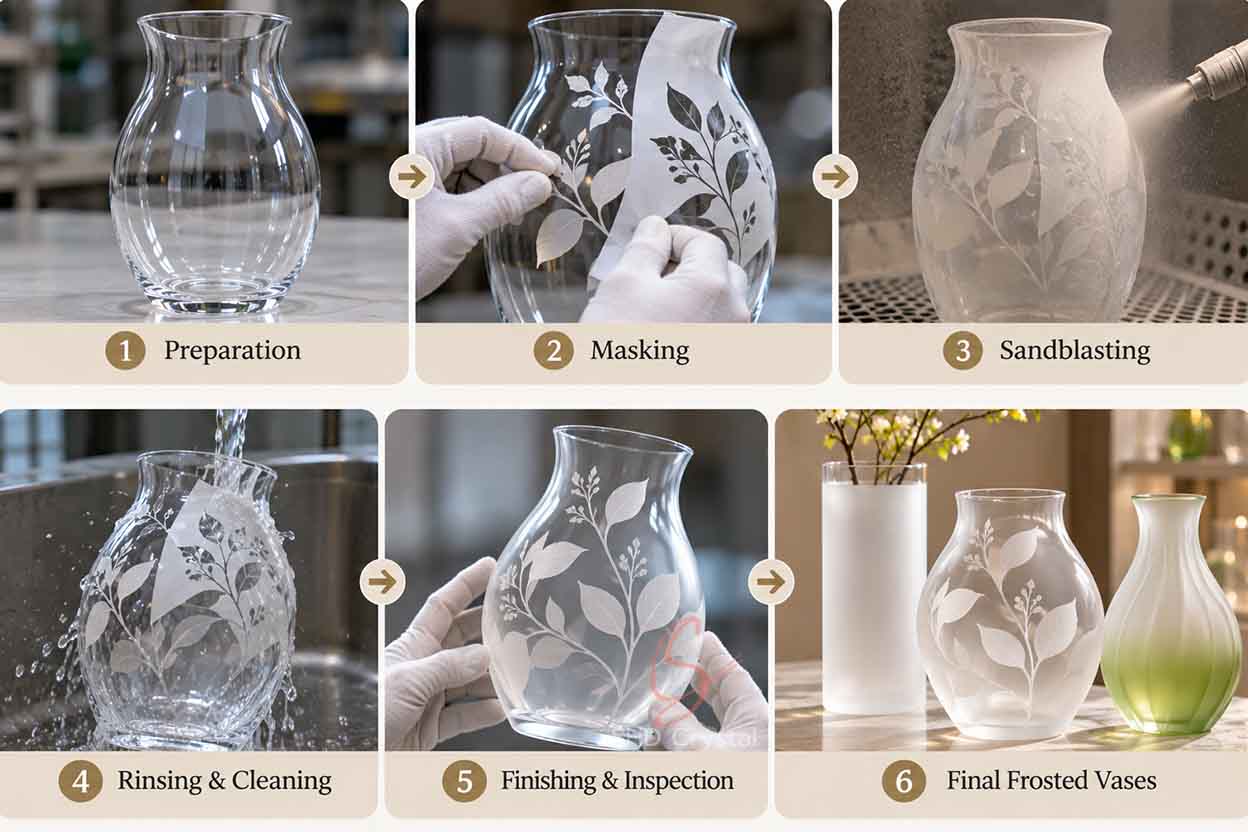
Sandblasting uses controlled abrasive impact to roughen selected areas of the glass surface, producing a matte appearance. Sandblasted glass vases can feature fully frosted bodies, decorative bands, or botanical motifs created through masking. The contrast between transparent and frosted areas is particularly attractive on tall cylindrical and rounded vases.
Surface texture can vary with processing conditions, although recessed details and deeply curved sections may be more difficult to treat uniformly. For decorative collections, sandblasting offers a practical way to introduce texture without changing the basic glass color.
2. Acid Etching: A Fine Satin Appearance
For a particularly smooth-looking matte effect, chemical etching offers another established route. Acid-etched glass vases can display a fine, relatively uniform satin finish that softens transmitted light while preserving the original silhouette.
Unlike applied coatings, chemical etching modifies the glass surface itself. This makes it a different type of finish from sprayed matte paint.
Selected areas may also be protected to create contrasting decorative patterns. Because industrial glass etching involves hazardous chemical systems, it requires specialist facilities and appropriate safety and environmental controls.
3. Frosted Coatings: More Freedom with Color
Not every frosted appearance requires removing or chemically modifying glass. A translucent matte coating can be applied after forming, giving the vase a softened surface appearance. This route is particularly interesting for colored decorative collections. Pale pink, smoky gray, muted green, and warm amber effects may be combined with varying levels of translucency.
Unlike acid-etched glass vases, coated products depend on an applied decorative layer. Adhesion, scratch resistance, and cleaning compatibility therefore need separate evaluation. For vases intended to hold water, the coating location and expected moisture exposure should be considered carefully.
4. From Full Frosting to Selective Decoration
The decorative possibilities extend beyond uniformly frosted glass. A vase may have a completely matte body with a polished transparent rim. Another may retain clear windows surrounded by frosted floral patterns. For sandblasted glass vases, masking allows selected areas to remain transparent while the exposed surface receives treatment.
Gradual color transitions are another possibility, especially through suitable sprayed finishes. However, a sprayed matte gradient should not be confused with a uniform chemically etched surface.
Combining frosted and polished details can create an attractive contrast without overwhelming the vessel’s original shape.
5. Vase Geometry Determines What Is Practical
A simple cylindrical vase generally provides more accessible decoration areas than a narrow-necked vessel with deep curves or sculptural relief.
The glass surface must be clean and suitable for the selected treatment. Wall thickness, surface texture, opening diameter, and access to recessed areas can affect finishing feasibility. During the glass vase frosting process, samples help establish whether the intended matte effect can be reproduced consistently. A beautiful rendering may show perfectly even frosting, but physical evaluation is necessary to confirm the actual surface appearance.
6. Matching Finishes to Commercial Collections
For OEM buyers, the selected effect should reflect the vase’s intended market. A minimalist homeware collection may benefit from uniform satin glass. A premium gift series might combine clear and frosted botanical patterns, while a contemporary decorative range could explore translucent matte colors. Before production, buyers should confirm the frosting area, texture reference, acceptable variation, cleaning requirements, and packaging protection.
The most suitable finish is not always the most complicated one. It is the one that can be reproduced reliably while preserving the intended design.
FAQs
Can frosted glass vases hold fresh flowers and water?
Yes, provided the glass and any decorative coating are suitable for the intended exposure. Surface care and coating compatibility should be confirmed for the finished product.
Will fingerprints appear on frosted glass?
They can. Some textured matte surfaces may show oils or handling marks more readily than polished glass. The extent depends on the process and surface characteristics.
Can an existing clear vase design be adapted into a frosted collection?
Often, yes. Suitable existing glass blanks may receive secondary surface treatment, although feasibility depends on the glass composition, geometry, finishing process, and project quantity.
Conclusion
The glass vase frosting process offers several ways to transform transparent glass into distinctive decorative products. Sandblasting creates textured matte surfaces, acid etching produces fine satin effects, and coatings introduce additional possibilities for color and translucent finishes.
Understanding these differences helps designers choose a surface treatment that complements the vase rather than simply changes its appearance.
A Softer Finish for Original Glass Designs
A frosted surface can make a familiar vase silhouette feel entirely new. SHD Crystal approaches glass vase frosting process requirements by considering the intended texture, decoration area, glass geometry, and practical finishing options. The result can be a decorative collection that expresses its character through the way glass softens and reveals light.
The link to this article is managed and owned by SHD Crystal. Please cite the source if reposting. Thank you for your cooperation.