
Hand blown crystal glass gains its value from controlled human judgment applied while the material is continuously changing. The artisan does not simply inflate molten glass into a decorative shape. Rotation speed, reheating timing, breath pressure, gravity, and tool contact must be coordinated before the material becomes too firm to adjust. The result is not valuable because it is imperfect. Its value comes from producing deliberate form, optical character, and controlled variation without relying on a fully automated forming cycle.
Hand Blown Crystal Glass Depends on Reading Material Behaviour
Crystal is not one universal recipe. Lead crystal and lead-free formulations can differ in composition, density, optical response, viscosity, and working behaviour. Forming and annealing conditions therefore need to be established for the actual glass batch instead of copied from a generic temperature chart. European crystal-glass classifications also distinguish products through a combination of composition and physical or optical properties rather than treating all crystal as one material.
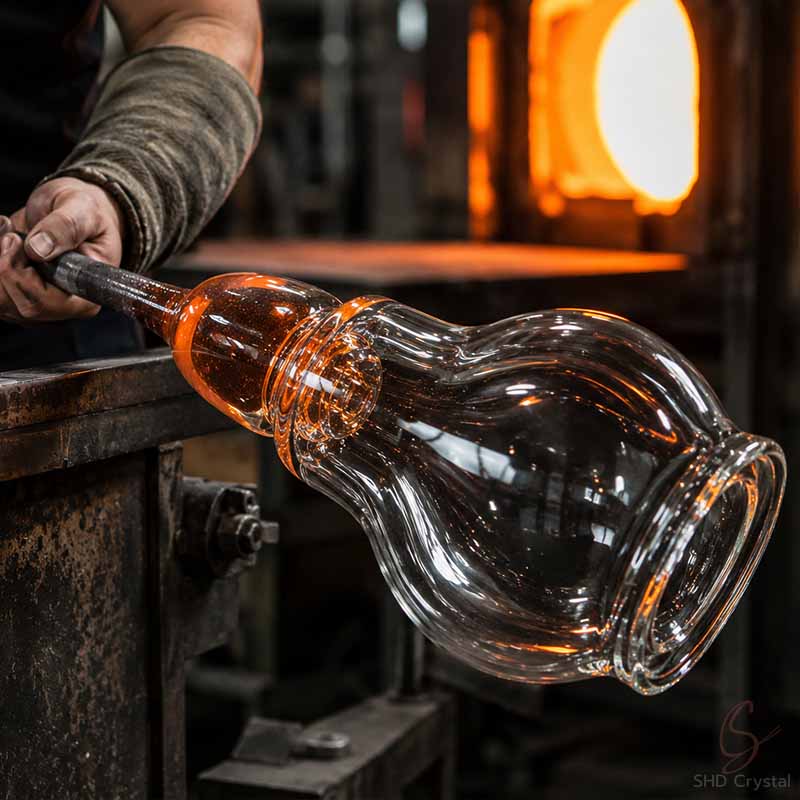
During forming, the outer surface cools faster than the interior. Reheating restores workable viscosity, while rotation helps keep the softened mass centred and distributes glass around the developing form. Too little rotation can allow one side to become heavier. Poorly timed inflation may stretch a section beyond the intended profile. Experienced artisans recognise these changes early enough to correct them.
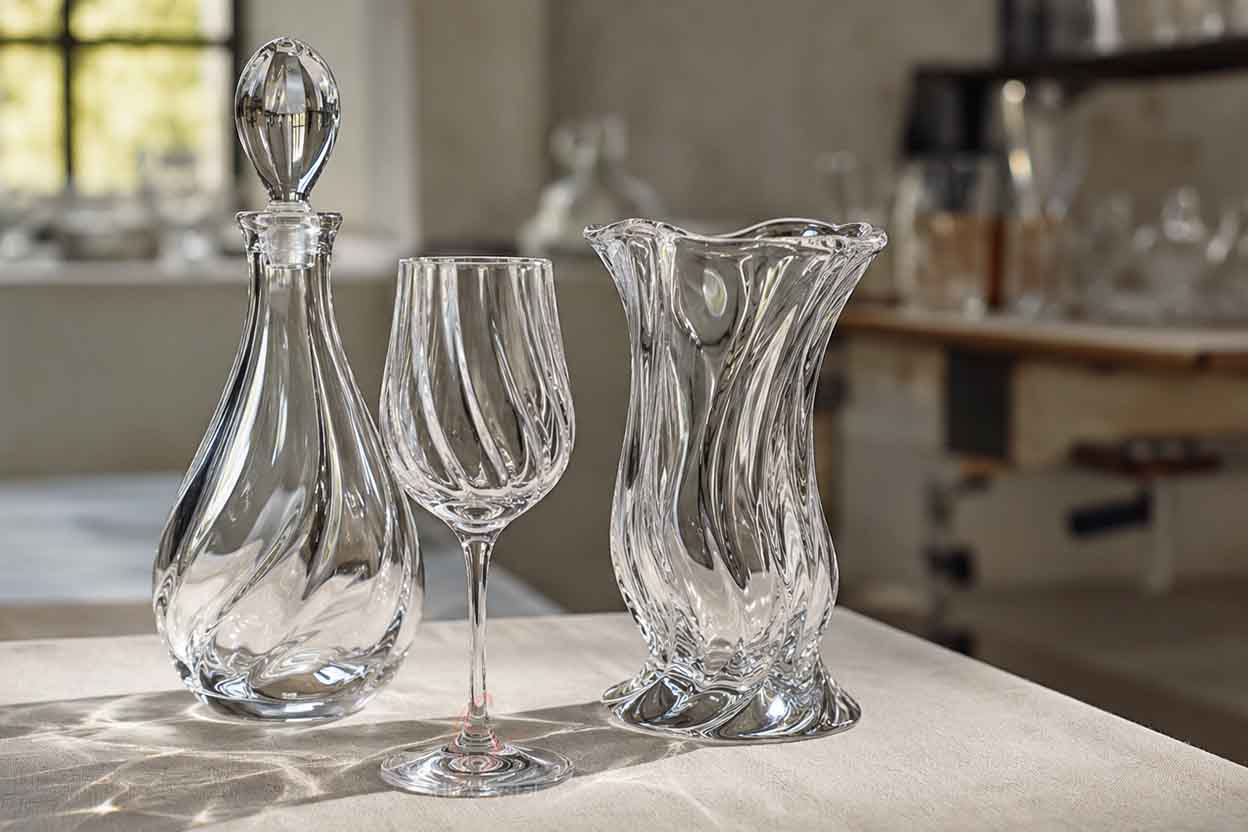
This sensitivity is especially important in decanters, bowls, vases, and sculptural vessels with narrow necks, broad shoulders, or pronounced thickness transitions. A drawing can define the target dimensions, but the artisan must translate them into a sequence of gathers, reheats, tool movements, and controlled inflation. Historical and contemporary glassblowing demonstrations likewise show repeated gathering, marvering, inflation, reheating, tooling, and rotation rather than a single uninterrupted blowing action.
Handmade Does Not Mean Uncontrolled
A common misconception is that handmade production accepts any visible difference as proof of authenticity. Commercial hand blowing still uses templates, gauges, moulds, weight targets, and approved samples. These controls establish the boundaries within which natural variation is acceptable.
For custom crystal glassware, the real test is whether a production team can repeat the intended proportions across a batch. Rim diameter, overall height, base stability, capacity, and visual balance should remain within an agreed range. Small differences in optical movement may preserve handmade character, but leaning bodies, unstable bases, distorted openings, or uncontrolled wall distribution are defects rather than signs of craftsmanship.
The value of artisan glass craftsmanship therefore rests on disciplined repeatability, not random variation.
Wall Distribution and Annealing Reveal Production Quality
Wall thickness develops through the interaction of glass quantity, rotation, gravity, inflation, and tool work. Thick-to-thin transitions deserve attention because different sections release heat at different rates. Poor distribution may produce excessive weight, visual imbalance, or local stress.
After shaping, the object requires an annealing schedule suited to its composition, thickness, and geometry. A heavy sculptural piece cannot automatically follow the same cooling program as a thin goblet. Controlled cooling helps manage residual stress, while polarised-light examination can reveal stress patterns that ordinary visual inspection cannot show. ASTM methods specifically recognise polariscopic and polarising-microscope techniques for evaluating residual stress and the state of anneal in transparent glass.
These controls explain why a convincing hot-shop demonstration is not the same as a reliable production system. Repeatable production requires forming skill, suitable process settings, inspection standards, and coordination between hot working, annealing, cutting, and polishing.
Distinctive Forms Come With Real Trade-Offs
Hand forming supports organic profiles, asymmetrical details, applied trails, coloured inclusions, and shapes that may be impractical for automated pressing. This design freedom is one of its strongest advantages.
It also creates limitations. Output is slower, labour input is higher, and accurate repetition becomes more demanding as a shape grows more complex. Extremely thin sections, abrupt transitions, oversized bodies, and delicate attachments may increase rejection risk or require additional sampling. Buyers should weigh the visual benefit of each feature against production time, finishing access, packaging protection, and reorder consistency.
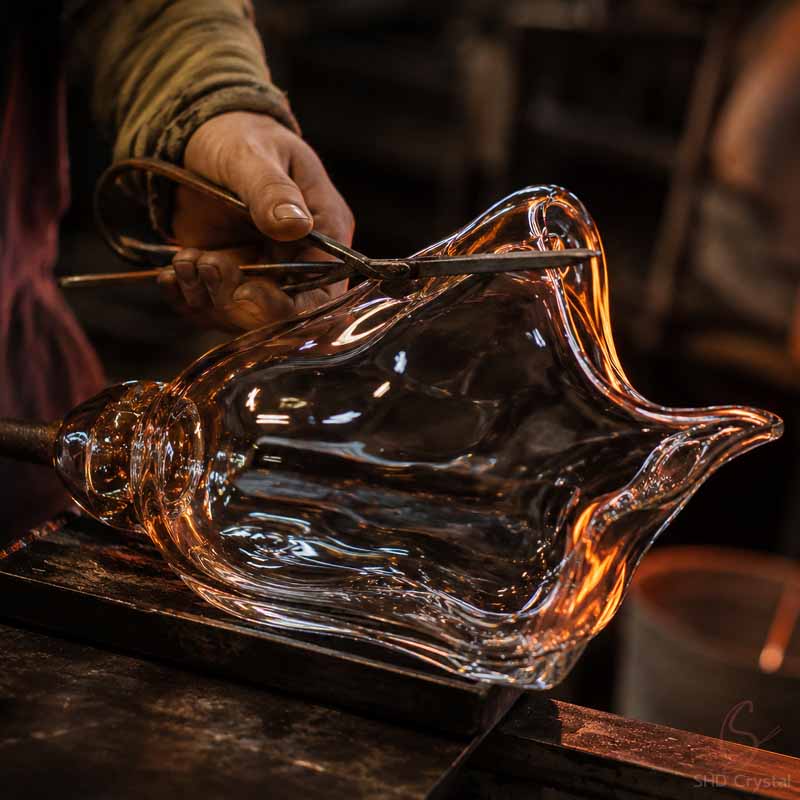
A useful sampling plan compares several pieces rather than one showcase sample. Measurements should focus on the dimensions that matter to function and display. Inspection under consistent lighting can also reveal cords, bubbles, tool marks, asymmetry, and polishing differences. Samples from more than one production session provide a clearer view of batch control.
Conclusion
Hand blown crystal glass represents more than manual labour. Its value comes from guiding a temperature-sensitive material through forming, reheating, annealing, and finishing while preserving design intent and commercial consistency. When artisan glass craftsmanship is supported by practical quality controls, it produces objects with genuine individuality rather than uncontrolled variation.
Developing Distinctive Hand-Formed Crystal Objects
For brands considering hand blown crystal glass, SHD Crystal can review drawings, reference samples, target dimensions, finishing expectations, and order volumes before development begins. Its support for custom crystal glassware includes forming-route evaluation, sample comparison, annealing review, polishing planning, and packaging recommendations for repeat production.
Read the original article on custom crystal glass manufacturing: https://shdcrystal.com/blogs/hand-blown-crystal-glass/