
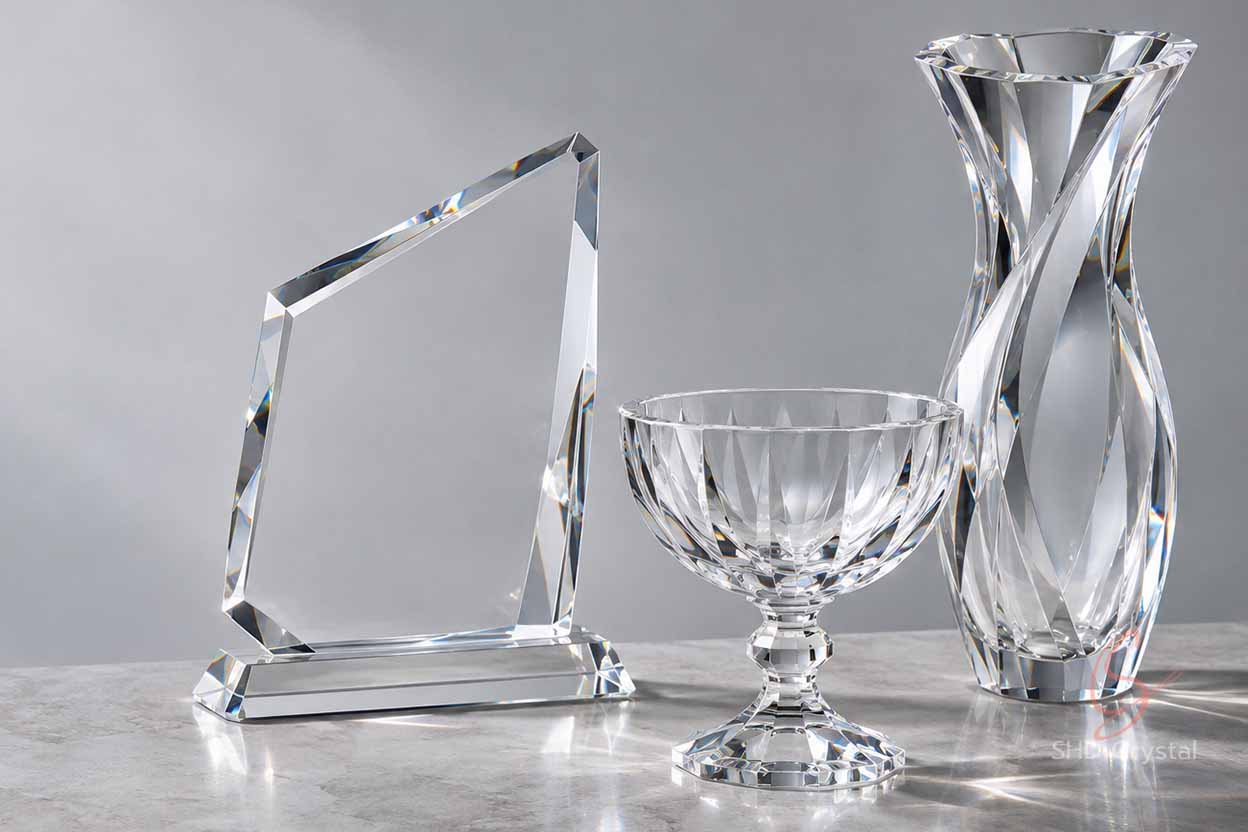
A transparent crystal award standing on a desk may look like a simple decorative object. Under direct light, however, its polished surfaces reveal a remarkable combination of clarity, geometric precision, and visual depth. These qualities help explain the appeal of the k9 crystal glass market, where material performance connects industrial optical applications with decorative products, commemorative gifts, and architectural accessories.
Unlike traditional lead crystal, K9 is associated with optical crown glass. Its commercial value comes not only from its transparent appearance but also from how consistently that appearance can be achieved through material selection, shaping, and finishing. 【1】
Understanding the K9 Crystal Glass Market and Its Applications
The k9 crystal glass market serves different customers with different expectations. Optical component buyers may prioritize measurable material properties, while decorative product brands are more concerned with brilliance, surface quality, and the appearance of the finished object. Although these applications share an interest in transparency, their manufacturing specifications are not necessarily interchangeable.
A Material Serving Two Different Markets
One recognizable application is K9 crystal awards, which are widely associated with corporate recognition, commemorative events, and personalized gifts.
Geometric crystal blocks, faceted trophies, decorative spheres, and sculptural ornaments can make effective use of the material’s clarity. Their visual appeal often depends on polished surfaces and clean internal transparency rather than elaborate color decoration.
K9-type optical glass also belongs to a broader technical material category used for suitable lenses, prisms, and other optical components. 【1】 These applications have different acceptance requirements. Decorative pieces may be evaluated for visible scratches, bubbles, shape, and polishing quality. Precision optical components can require much stricter control of refractive index, internal homogeneity, wavefront performance, and dimensional accuracy. 【2】
The material designation alone does not establish that a finished product meets either set of requirements.
What Market Information Actually Reveals
The wider photonics industry provides useful context for understanding demand for optical materials. According to the 2026 SPIE Global Industry Report, global core photonics component manufacturing generated approximately US$381 billion in revenue in 2024. 【3】 This figure covers a broad range of photonics components, not K9 glass specifically. It should not be presented as the market size of K9 crystal.
The decorative segment is also difficult to isolate. Commercial categories such as crystal gifts, trophies, and glass ornaments may contain products made from several different glass formulations.
Consequently, the market is more accurately understood through its applications and purchasing requirements than through a single unsupported global valuation. For decorative buyers, differentiation often comes from original product shapes, reliable clarity, finishing quality, and personalization. For technical buyers, material documentation and measurable optical performance carry greater weight.
Interested in custom glassware or related products?
Contact our team to discuss your project requirements.
Why K9 Crystal Has Distinctive Material Properties
The visual appeal of K9-type glass is closely related to its optical characteristics. One documented grade, H-K9L, has a refractive index of 1.51680, an Abbe number of approximately 64.20, and a density of about 2.52 g/cm³, according to published optical-glass specifications. 【1】
The refractive index describes how strongly light bends when entering the glass. The Abbe number indicates the material’s chromatic dispersion characteristics. For decorative products, these properties contribute to how transparent surfaces interact with light, although the final appearance also depends heavily on product geometry and polishing quality.
A thick crystal block with poorly finished edges may look less refined than a smaller piece with carefully polished facets.
Material performance and finishing quality must therefore be considered together. It is also important to distinguish K9 from traditional lead crystal. Specific modern grades such as H-K9L are identified as free of intentionally added lead, arsenic, and cadmium in manufacturer documentation. However, a generic commercial description of “K9 crystal” should still be supported by an actual material specification. 【4】
From Crystal Blanks to Finished Decorative Products
Manufacturing is where the material’s optical potential becomes visible. Many decorative K9 products begin with a glass blank that is subsequently shaped into the required form. The production route typically involves cutting, rough grinding, fine shaping, polishing, and inspection.
For geometric crystal ornaments, the accuracy of each surface affects the final appearance. Uneven facets may create unbalanced reflections, while poorly finished edges can reduce clarity.
Precision glass polishing is particularly important because grinding initially leaves a surface that may appear dull or slightly opaque. Progressive finishing removes surface irregularities and produces the smooth, transparent appearance associated with polished crystal. Research into optical-glass grinding, lapping, and polishing confirms that these processes influence surface integrity and the quality of finished components. 【5】
Complex designs may also require engraving, beveling, or additional decorative treatment. Subsurface laser engraving is one possibility for compatible glass blanks, provided the selected material and equipment can achieve the required result.
These operations should follow an approved product design rather than being treated as interchangeable finishing options.
Quality Control Is Part of the Product Value
A transparent material leaves little room for hidden defects. Small internal bubbles, inclusions, scratches, and uneven polishing may become noticeable when light passes through a finished crystal object. For K9 crystal awards, these imperfections can affect the perceived quality of an entire gift collection, particularly when several pieces are displayed together.
Inspection should therefore establish practical limits for visible defects, dimensional variation, surface finish, and acceptable edge quality. For technical optical applications, additional measurements may be necessary. Optical-glass quality specifications commonly address refractive index, homogeneity, internal transmission, striae, bubbles, inclusions, and residual stress. 【2】 The goal is to match the inspection standard to the intended product rather than apply an unnecessarily expensive specification to every decorative piece.
What Market Purchasers Should Consider Before Confirm Production
As the market becomes more specialized, buyers benefit from distinguishing material identity from product appearance. A sourcing specification should identify the required glass grade, intended application, target dimensions, decoration requirements, and acceptance criteria.
For projects involving precision glass polishing, the finishing standard should also describe the expected optical appearance, allowable surface defects, and critical dimensions. A physical reference sample is especially helpful for decorative collections because photographs cannot fully communicate the appearance of transparent materials.
Packaging also affects commercial value. Heavy crystal objects and sharp geometric edges require suitable protective arrangements to reduce damage during transportation. Ultimately, successful purchasing depends on whether the selected material, processing method, and quality requirements are appropriate for the final application.
Conclusion
The k9 crystal glass market connects technical material characteristics with decorative design and precision finishing. Optical clarity, material consistency, geometric shaping, and inspection requirements influence how the material is selected across different product categories.
Rather than judging K9 crystal by appearance or market labels alone, manufacturers and buyers benefit from understanding the actual material grade and the production standards needed for the intended product.
Where Material Clarity Meets Product Design
The appeal of K9 crystal begins with transparency, but a finished product gains its identity through proportion, surface quality, and thoughtful design. At SHD Crystal, discussions surrounding the k9 crystal glass market can help inform material selection for original decorative glass concepts. Confirming the intended application and material specifications is the first step toward determining whether K9-type glass is an appropriate choice.
https://shdcrystal.com/blogs/k9-crystal-glass-market/
The link to this article is managed and owned by SHD Crystal. Please cite the source if reposting. Thank you for your cooperation.