
A large glass oil jug is built for a different kitchen experience than a spray bottle or a small tabletop dispenser. It is meant to hold more oil, reduce refill frequency, and provide a stable, visible, and convenient way to store and pour cooking oil in daily use. For kitchenware brands, food-related packaging projects, and glassware buyers, the product needs to do more than look clean on a countertop. It must pour smoothly, feel balanced in the hand, protect the contents, and remain reliable during repeated use.
From a glassware manufacturer’s perspective, a large oil jug is not simply an enlarged bottle. Once capacity increases, the structure, handle position, pouring performance, glass distribution, and packaging requirements all become more demanding.
Large Glass Oil Jug Projects Begin With Real Kitchen Use
The appeal of a large glass oil jug is easy to understand. A generous capacity suits home kitchens that cook frequently, open-kitchen restaurants, and food preparation areas where oil needs to stay within reach. Clear glass also allows users to see the oil level directly, which makes refilling and daily management easier.
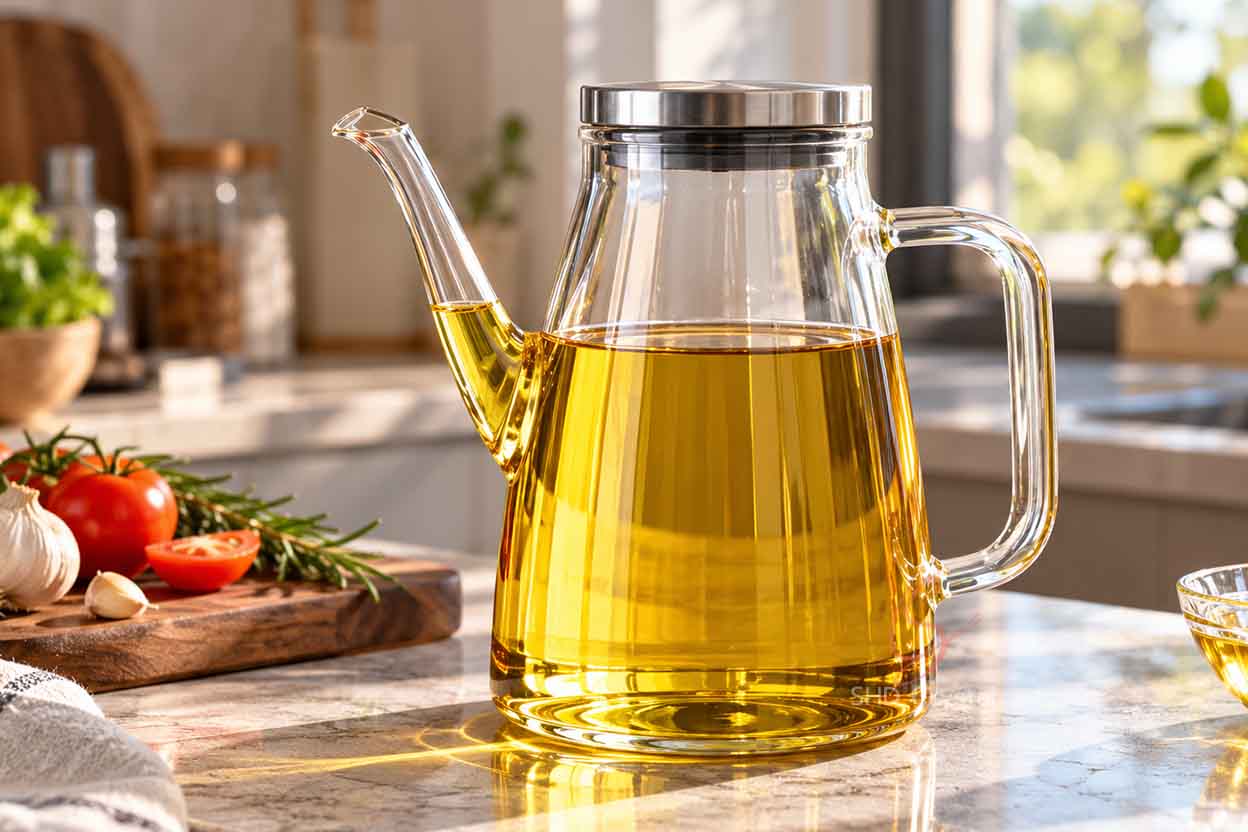
However, larger capacity changes the way the product behaves. A jug that looks elegant when empty may feel too heavy or awkward once filled. A narrow body may save space, but it can make the jug feel taller and less stable. A wide body may improve balance, but it may also require a more carefully positioned handle for comfortable pouring. For this reason, product development should begin with how the oil jug will actually be used: countertop storage, cooking preparation, table service, or repeated back-of-house pouring.
Handle Position Affects Pouring Comfort
The handle is one of the most important parts of a large oil jug. When the jug is filled, users need enough grip clearance to hold and tilt it safely. If the handle is too small, too decorative, or placed too high, the pouring motion may feel awkward. If it sits too far from the body, the overall width increases and packing becomes less efficient. For larger jugs, the relationship between handle size, body diameter, and full weight should be tested together.
Spout Design Influences Control
A kitchen oil jug should pour with control rather than release oil too suddenly. A shaped pouring lip or integrated spout can help guide the liquid more accurately, especially when the jug is used near a pan or during food preparation. If the lip is too open, drips may form more easily. If the opening is too restricted, cleaning and filling may become inconvenient.
A well-designed kitchen oil storage container should therefore consider pouring control and ease of cleaning at the same time.
Opening Size Affects Filling and Cleaning
Oil containers are not used once and discarded. In many kitchens, they are refilled and cleaned repeatedly. A very narrow opening may create a refined profile, but it makes refilling harder and reduces access for cleaning tools. A wider opening is often more practical for long-term use, especially when the jug is intended for olive oil, blended cooking oils, or infused oils. The right opening size should match the intended closure type as well as the expected usage cycle.
Glass Material Gives Visibility but Also Creates Engineering Demands
Glass remains attractive for oil containers because it looks clean, stable, and reusable. A transparent large glass oil jug allows users to monitor the oil level and check the clarity of the liquid. It also works well in kitchen environments where a visible, premium container supports the overall product image. At the same time, larger glass containers require more careful production control.
Wall thickness transition needs to be managed so the jug does not become excessively heavy in one area and too thin in another. This is especially important around the shoulder, handle connection area, and base. The handle itself may become a stress-sensitive zone if the glass distribution is uneven.
Annealing is equally important. Because a large jug contains more glass mass, cooling behavior must be controlled carefully to reduce internal stress. A jug can appear visually acceptable while still carrying hidden stress that increases breakage risk during packing or daily use.
Surface and Decorative Options Should Support Practicality
A glass oil dispenser bottle can be developed with different surface directions depending on the brand position. Clear glass is the most straightforward choice when product visibility is important. Light green, amber, or smoky tones can create a more distinctive visual identity. Ribbed surfaces, embossed details, and simple mold textures can add character without interfering too much with function.
Decoration may also include screen printing, labeling, frosting, or reserved smooth panels for branding.
Still, decoration should support use rather than compete with it. Heavy full-body decoration can reduce visibility of the oil level, while complicated textures in the wrong area may make cleaning more difficult or reduce grip comfort. For a kitchen oil storage container, design works best when the visual language respects the product’s daily working role.
Production Control Becomes More Important With Larger Glassware
As the product grows larger, manufacturing consistency becomes more critical. For a large glass oil jug, important production points include:
- base flatness and stability
- mouth and spout dimensions
- handle alignment and strength
- wall thickness consistency
- surface clarity and visual defects
- lid or cap compatibility
- packing protection for transport
A common sourcing mistake is approving the jug only by empty-sample appearance. The product should also be evaluated when filled, lifted, tilted, and packed. A good sample should represent not only the look of the jug but also its real performance in kitchen conditions.
Packaging and Logistics Need Early Planning
Large glass containers face more transport pressure than small bottles. A filled oil jug is heavier, and even an empty jug takes up more carton space and may place more force on dividers and inserts during transit. If the product includes a fitted lid, stopper, or anti-drip spout, those components also need protection.
For commercial projects, export packaging should be reviewed early. The carton structure, inner dividers, sleeves, and pallet arrangement all affect whether the jug arrives safely and consistently. This is especially important when the container is part of a premium kitchenware line or a repeated supply program.
Conclusion
A large glass oil jug succeeds when its size, structure, pouring behavior, and manufacturing quality are developed as one complete product system. Handle comfort, spout control, opening size, glass distribution, and packaging protection all matter more as capacity increases.
For buyers developing a glass oil dispenser bottle or a practical kitchen oil storage container, the strongest results come from evaluating the jug not only as a visual object, but as a daily-use kitchen tool that must remain functional from filling to pouring to transport.
Developing Large Glass Oil Jug Projects With SHD Crystal
SHD Crystal supports kitchen glassware development through glass forming, mold coordination, structural review, decorative processing, quality inspection, and export packaging preparation.
For a large glass oil jug project, development can begin with the intended capacity, body shape, pouring direction, handle structure, and closure system. From there, the glass body can be reviewed for wall distribution, handle integration, mouth finish, and production feasibility.
Where a project requires a coordinated glass oil dispenser bottle collection or a reusable kitchen oil storage container line, SHD Crystal can also support design consistency across different capacities and decorative styles.
FAQs About Large Glass Oil Jug
-1. Does a larger glass oil jug always mean better usability?
Not necessarily. A larger capacity reduces refill frequency, but it also increases weight during pouring. The best size depends on how the jug will be used, who will handle it, and whether it is intended for countertop storage, food preparation, or table service.
-2. Should an oil jug use clear glass or colored glass?
Both can work. Clear glass provides direct visibility of the oil level and appearance, while colored glass may offer a stronger visual identity and some added light protection. The better choice depends on product positioning, storage conditions, and branding goals.
-3. What should buyers test before approving a large oil jug?
Buyers should test filling, lifting, pouring, dripping behavior, handle comfort, opening access, lid compatibility, and packing strength. It is also useful to review the jug both empty and filled, since performance can change significantly once the container carries real liquid weight.
The link to this article is managed and owned by SHD Crystal. Please cite the source if reposting. Thank you for your cooperation.