
A supplement bottles manufacturer must consider more than capacity, color, and shelf appearance. Bottles used for tablets, capsules, powders, and similar products also need suitable closure fit, filling-line compatibility, dimensional consistency, and transport protection. Packaging can help protect the contents, but it cannot independently guarantee shelf life or formulation stability. Those outcomes must be confirmed through appropriate product, closure, and packaging-system testing.
What a Supplement Bottles Manufacturer Evaluates Before Production
A technical review should begin with the product format and filling conditions. Tablets, capsules, gummies, and powders may require different bottle openings, closure systems, dispensing features, and internal volumes. The planned fill quantity should also be compared with the bottle’s overflow capacity so that adequate headspace remains after filling.
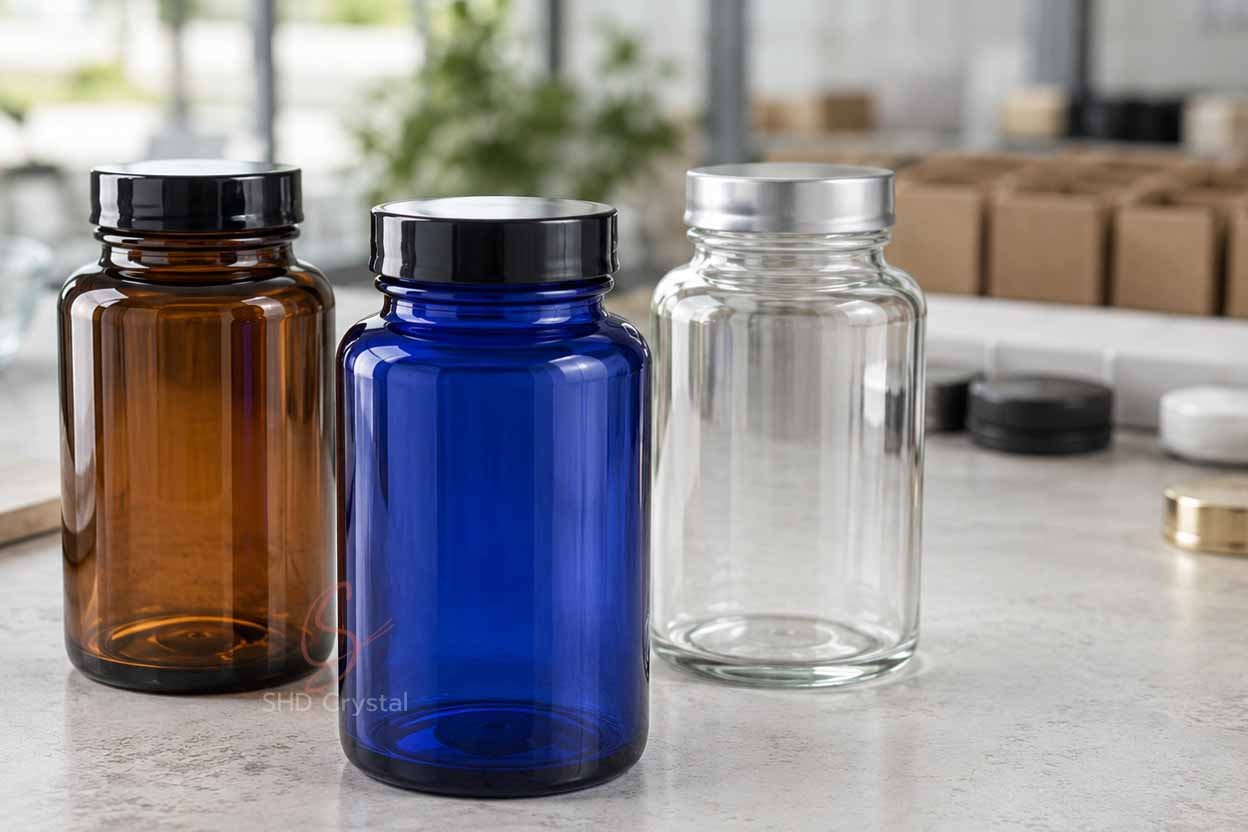
Wide-mouth bottles can simplify filling and consumer access, but their neck dimensions must correspond with the selected cap. Thread profile, sealing surface, finish height, and cap liner all affect closure performance. Instead of judging the glass and cap separately, buyers should test the intended bottle, closure, liner, and capping method as one system.
Dimensional tolerances should be defined through approved drawings and component specifications. A tolerance that is suitable for one closure or filling line may be unsuitable for another, so universal figures should not be applied to every project.
Thermal Control and Wall Distribution Affect Bottle Reliability
During glass container production, molten glass is formed and then cooled through a controlled annealing process. The purpose of annealing is to reduce residual stress created as different sections of the bottle cool at different rates.
Wall thickness transition is an important manufacturing variable. Wide shoulders, heavy heels, thick bases, and thinner sidewalls may release heat differently. Poorly balanced glass distribution can contribute to excess weight, dimensional variation, or reduced resistance to handling impacts.
Inspection should therefore consider more than the total bottle weight. Manufacturers may evaluate glass distribution around the body, base, shoulder, and neck, particularly when a design contains substantial changes in thickness.
Thicker glass can provide a more substantial hand feel, but it increases freight weight and secondary-packaging requirements. Lightweight designs can reduce logistics costs, although excessive weight reduction may leave less margin for handling impacts. A practical specification balances structural design, presentation, production capability, and distribution conditions.
Amber, Cobalt, and Clear Glass Serve Different Packaging Goals
Color selection is often part of custom glass packaging development. Amber, cobalt blue, green, and clear glass create different visual identities and transmit light differently.
Colored glass may reduce exposure to portions of the light spectrum, but no bottle color should automatically be described as sufficient protection for every supplement. The formulation’s actual light sensitivity, intended shelf life, storage environment, label coverage, and secondary carton may all affect the final packaging decision.
Brands should confirm protective performance through relevant stability and compatibility evaluations using the actual product and finished package. Clear glass may suit products for which visibility is important, while colored glass may be considered when additional light management or brand differentiation is required.
Bottle color can also affect decoration. Dark surfaces may reduce print contrast, and slight color differences can become visible when bottles are displayed together. An approved color range is more useful for production control than relying on a digital rendering alone.
Decoration Introduces Additional Production Variables
Frosting, coating, screen printing, labeling, embossing, and hot stamping can make a supplement package more distinctive. Each process also adds new inspection points.
Coating thickness and curing conditions can influence color consistency and adhesion. Screen printing requires suitable artwork placement and stable registration. Deep embossing may reduce the available label area, while surface treatments can change how bottles interact with carton dividers or inserts.
A supplement bottles manufacturer should review decoration together with bottle geometry and packing materials. A finish that looks correct on an isolated sample may develop rub marks if bottles move against partitions during transport.
Integrated production can simplify communication, but buyers should still confirm where each operation occurs, how decorated samples will be approved, and which inspection criteria apply before bulk manufacturing.
Wholesale Value Depends on the Complete Specification
A lower unit quotation does not necessarily represent a lower total packaging cost. Differences in bottle weight, closure inclusion, decoration, inspection level, carton strength, divider design, pallet loading, and order quantity can make two quotations difficult to compare.
For a meaningful comparison, the sourcing brief should state:
-Target fill and overflow capacities
-Bottle dimensions and acceptable tolerances
-Glass color and approximate weight
-Neck finish, closure, and liner requirements
-Filling and capping methods
-Decoration and label areas
-Packing and pallet expectations
-Order quantity and expected reorder frequency
Buyers should also request samples from representative production rather than relying only on one carefully prepared presentation piece. Sampling should evaluate bottle dimensions, base stability, closure assembly, decoration, packing fit, and compatibility with the intended filling process.
Inspection Should Follow the Product’s Actual Risks
Appropriate glass container production control may include dimensional inspection, visual defect review, annealing assessment, closure-fit checks, and packing evaluation. The exact inspection plan should reflect how the bottle will be filled, stored, shipped, and used.
Common review points include cracks, chips, sharp edges, unstable bases, stones, excessive bubbles, scratches, distorted neck finishes, and unacceptable color or decoration variation. Not every minor cosmetic feature has the same importance, so acceptable limits should be agreed before production.
The manufacturer can supply production and material information, but the brand remains responsible for determining whether the complete package is appropriate for its formulation and target market. Regulatory, food-contact, compatibility, and stability requirements should be confirmed for the countries where the product will be sold.
Conclusion
Selecting a supplement bottles manufacturer requires evaluation of the complete packaging system rather than the glass body alone. Thermal control, wall distribution, closure compatibility, glass color, decoration, inspection, and shipping protection all influence manufacturing reliability. Well-planned custom glass packaging supports smoother filling and repeat supply, while product stability and market compliance still require appropriate verification with the finished formulation.
Developing a Practical Supplement Packaging Specification
SHD Crystal supports supplement bottles manufacturer projects through bottle selection, mold feasibility review, color planning, closure matching, sampling, decoration, inspection, and export packaging. For new custom glass packaging, sharing the product format, filling method, target capacity, closure specification, light-sensitivity considerations, order range, and shipping conditions helps establish a more reliable glass container production plan.
Exclusive Release by SHD Crystal
Custom Crystal Glass OEM Manufacturer
This article is originally published by SHD Crystal. Original Link: https://shdcrystal.com/blogs/supplement-bottles-manufacturer/