
Turkish style perfume bottles tend to attract attention before anyone knows what fragrance is inside them. Where many modern perfume bottles rely on clean rectangles, restrained typography, and minimal decoration, Turkish-inspired designs often move in the opposite direction. Rich color, elongated necks, rounded bodies, ornamental stoppers, metallic accents, and patterned glass can make the bottle feel closer to a decorative object than ordinary packaging.
That visual language did not appear from nowhere. It connects naturally with a much broader tradition of Turkish decorative glassware, where vessels for tea, perfume, rosewater, display, and symbolic use have long treated glass as something worth looking at.
Turkish Style Perfume Bottles Borrow From a Larger Glass Culture
One useful way to understand Turkish style perfume bottles is to stop looking at perfume bottles for a moment. Consider the familiar Turkish tea glass. Its narrow waist and flared upper section produce a silhouette instantly associated with Turkish tea culture. Türkiye’s official tourism resources even describe the traditional tea glass as tulip-like in form.
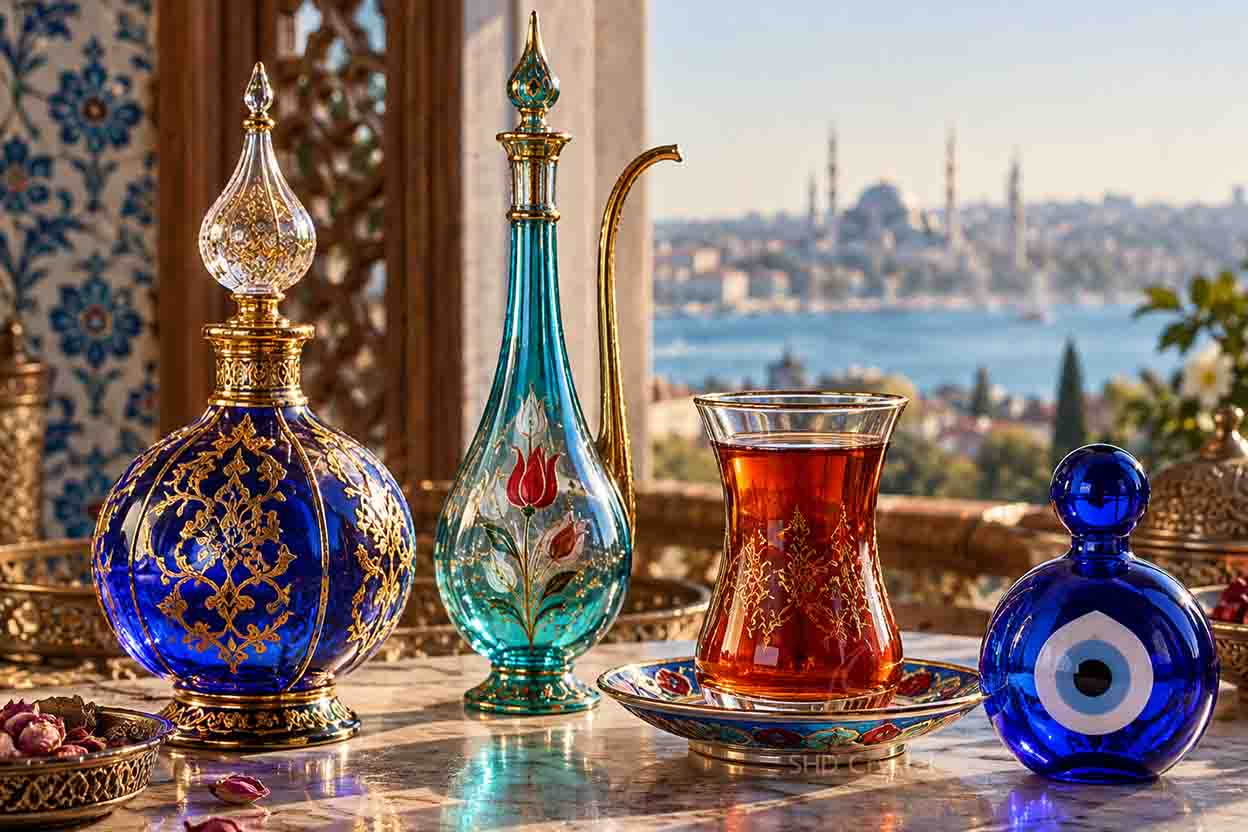
Now look at decorative perfume bottles with a narrow center, widened shoulder, flared neck, or exaggerated stopper. The proportions are different, but the same preference for a strong vessel silhouette is easy to recognize. This does not mean every Turkish-inspired perfume bottle literally copies a tea glass. Rather, both show how the outline of a glass vessel can carry cultural character even before decoration is added.
Beykoz Glass Shows Why the Bottle Itself Matters
Historical Beykoz glass provides an even closer reference. Glass vessels attributed to Turkey from the Ottoman period survive in museum collections in free-blown, mold-blown, colored, marbled, and decorated forms. The Metropolitan Museum of Art, for example, holds several 18th- and 19th-century glass bottles attributed to Turkey, including blown bottles and rosewater sprinklers associated with Beykoz in Istanbul.
These objects help explain the attraction of Ottoman inspired perfume bottles today. The bottle was never required to behave like an anonymous container. A long neck could become elegant in its own right. A rounded body could emphasize color. A stopper could extend the silhouette upward. Surface patterning and glass thickness could make light behave differently across the vessel.
Modern fragrance packaging often borrows this attitude even when the final design is completely contemporary.
Color Is Part of the Turkish Glass Vocabulary
Clear glass is important in modern perfumery, but Turkish-inspired decorative glass rarely needs to remain colorless. Deep cobalt blue, turquoise, emerald green, amber, ruby red, and combinations of transparent and opaque color can create a jewel-like appearance. This makes color one of the easiest ways for Turkish style perfume bottles to move away from conventional European minimalist fragrance packaging.
The famous nazar boncuğu, or evil-eye bead, is perhaps the clearest example of colored glass becoming a cultural symbol. Türkiye’s Ministry of Culture describes traditional nazar beads as glass objects produced from differently colored molten glass, with blue eye motifs becoming deeply associated with the craft in western Anatolia.
A perfume bottle does not need to reproduce the eye symbol literally. The more interesting influence may simply be the confidence to use saturated blue, concentric color, or strong glass contrast.
That is where Turkish decorative glassware becomes useful as design reference rather than something to copy directly.
Rosewater Bottles and Perfume Bottles Naturally Meet
There is also a functional connection between fragrance and historical vessels. Rosewater sprinklers were important decorative objects in Ottoman-influenced interiors, often using tall necks and elegant bodies to dispense scented water. A late 18th- to 19th-century example in the Met is attributed probably to Beykoz, Turkey, and was produced in blown glass.
Once this history is considered, the relationship between rosewater vessels and Ottoman inspired perfume bottles feels much less accidental.
Both types of objects deal with scent. Both benefit from a narrow opening. Both can become ceremonial or decorative objects rather than merely storage containers.
This is one reason tall necks, bulbous lower bodies, pointed stoppers, and almost decanter-like proportions appear so naturally in Turkish-inspired fragrance design.
Ornamentation Does Not Have to Mean Excess
It is easy to turn “Turkish style” into a checklist of domes, gold, blue glass, arabesques, and elaborate metal caps. That usually produces costume rather than design.
The more convincing Turkish style perfume bottles tend to borrow a limited number of recognizable ideas: perhaps the proportion of an Ottoman glass bottle, the saturated blue associated with nazar glass, a tulip-like curve, or a stopper inspired by historic decorative vessels.
One strong reference is usually more effective than putting five cultural symbols onto the same 50 ml bottle. The same lesson can be seen across Turkish decorative glassware. The cultural character often comes from silhouette, color, rhythm, and surface treatment rather than from obvious symbols alone.
Turkish Style Can Also Be Quiet
Not every Turkish-inspired perfume bottle needs to look antique. A contemporary bottle might use perfectly clear glass with only a narrow waist and rounded shoulder. Another might use a simple cobalt-blue body with a polished crystal stopper. A third might borrow the elongated proportions of a rosewater sprinkler while removing almost all ornament.
This is where Ottoman inspired perfume bottles become more interesting for modern fragrance collections.
Historical glass provides a vocabulary, not a compulsory template. The best interpretation is often the one where the influence can be felt before it can be named.
Conclusion
Turkish style perfume bottles are interesting because they sit between fragrance packaging and decorative glass culture. Their visual identity can draw from Beykoz bottles, rosewater vessels, tulip-shaped tea glasses, colored nazar glass, and the broader Ottoman preference for expressive vessel forms.
Seen this way, Turkish fragrance style is not simply about adding more decoration. It is about treating the bottle itself as an object with presence.
That may be the strongest lesson Turkish decorative glassware offers modern perfume design: the container does not always need to disappear behind the fragrance. Sometimes it can become part of the memory of the scent.
Reading Turkish-Inspired Glass Through Form and Color
For designers and fragrance brands studying Turkish style perfume bottles, historical glassware offers a much richer starting point than copying a single antique bottle. Looking at proportion, saturated glass color, vessel silhouettes, ornamental rhythm, and the relationship between scent and decorative objects can help Ottoman inspired perfume bottles feel culturally referenced without becoming literal reproductions.
Read the original full version: https://shdcrystal.com/blogs/turkish-style-perfume-bottles/