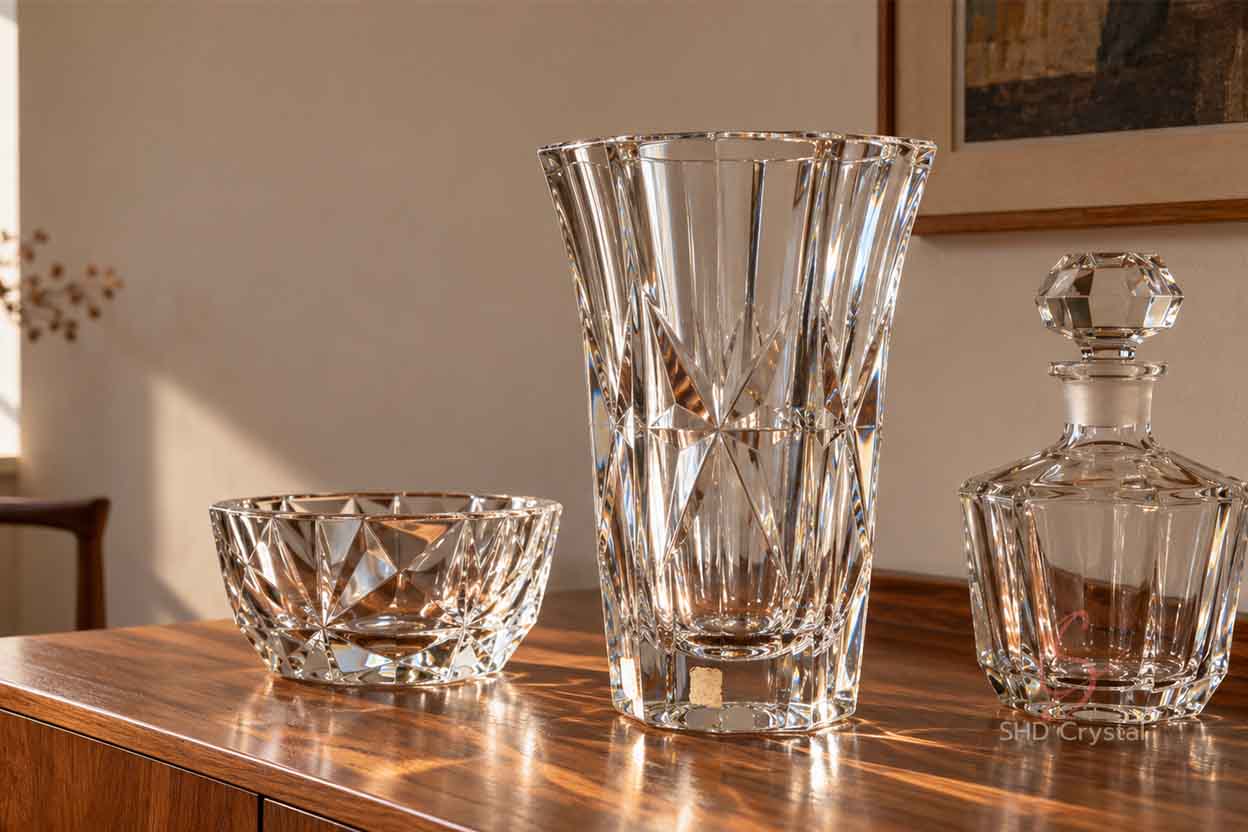
Imagine discovering a sparkling vase at an estate sale. It feels substantial, throws little flashes of light across the table, and carries a faded “Made in West Germany” sticker. Suddenly, west german lead crystal becomes more than a search term. That tiny label has turned an attractive object into a mystery—and appointed you detective without asking about your qualifications.
West German Lead Crystal: Read the Label Before Writing the Legend
“West German” points toward Germany’s period of division, commonly associated with 1949–1990. German reunification took place on 3 October 1990, giving the wording a useful historical context. However, a country label is a clue, not a birth certificate. It cannot independently establish an exact production year, identify a particular workshop, or confirm that a stopper originally belonged to its decanter.
When examining vintage crystal glassware, combine the label with permanent markings, documented catalogue matches, original packaging, or purchase records. German crystal markings become more useful when several pieces of evidence agree. One elderly sticker should not have to manage the entire investigation.
The Material Has Its Own Story
Origin and composition answer different questions. “West Germany” concerns where an object was made; “lead crystal” concerns its material.
One term worth recognizing is Bleikristall, the German word for lead crystal. The UK’s Crystal Glass (Descriptions) Regulations list “Bleikristall 24%” alongside “Lead crystal 24%,” while “Hochbleikristall 30%” appears alongside “Full lead crystal 30%.” These percentages refer to lead oxide content. This does not mean every West German piece contains 24% lead oxide. Check the actual inscription and supporting documentation before assigning a composition.
Weight and sparkle can attract attention, but neither establishes a material formula. Even a magnificent ringing sound is an audition, not a laboratory report.
Give the Glass a Proper Inspection
Once the label has introduced the object, let its condition continue the conversation. Examine the rim, foot, and stopper edges for chips or repairs. Look inside for deposits, staining, or surface deterioration. Photograph the base and interior as carefully as the decorative front. A vase deserves more than one flattering profile picture.
Then consider the pattern. Deep geometric decoration, polished surfaces, and repeated facets can create a striking appearance, but visual complexity alone does not prove hand-cut production. Describe the technique only when reliable evidence supports it.
For product teams, these observations also reveal practical design priorities. A substantial foot may provide a visual anchor, while crowded decoration can leave little comfortable gripping space. The attractive detail and the useful detail should ideally be on speaking terms.
Bring the Inspiration into a Modern Brief
A contemporary collection can draw inspiration from vintage crystal glassware through proportions, geometric rhythm, and the balance between patterned and plain surfaces. Translate those observations into measurable requirements: dimensions, usable capacity, pattern placement, rim finish, stopper fit, and packaging protection. Evaluate samples against their intended application rather than judging them only under showroom lighting.
The lasting lesson of west german lead crystal is simple: historical character makes a compelling starting point, while clear specifications help turn that inspiration into a usable contemporary product.
Frequently Asked Questions
Q&A-01 | Can an old crystal decanter store spirits overnight?
Health Canada advises never storing food or drinks in lead crystalware. Lead transfer depends partly on the contents and contact time. It recommends lead-free tableware, especially for children and pregnant people, and lead-free containers for storage.
Q&A-02 | Does a missing label mean a piece is inauthentic?
No. It means one potential source of evidence is unavailable. Permanent markings, documented patterns, and ownership records may still help establish an attribution.
Q&A-03 | What should I provide when developing a vintage-inspired collection?
Prepare reference photographs, drawings, target dimensions, intended applications, and material requirements. Identify which visual details matter most so their production feasibility can be evaluated early.
Develop Your Contemporary Collection with SHD Crystal
At SHD Crystal, we welcome drawings and reference samples inspired by west german lead crystal. Share your preferred proportions, decorative details, and intended applications with us. We can discuss feasibility, sampling, and production options for a contemporary collection with clearly stated materials and origin—giving historical inspiration a practical new chapter.
The link to this article is managed and owned by SHD Crystal. Please cite the source if reposting. Thank you for your cooperation.