
Blogpost keywords: glass wash basins processing, viscosity window control, stress relaxation sequencing
In glass forming, shape is never created instantly. A basin emerges gradually through heat, gravity, timing, and controlled material movement. During glass wash basins processing, the material continuously shifts between fluidity and stability, requiring each stage of forming and cooling to respond precisely to the behavior of the glass itself. This transformation is what defines the difference between ordinary molded products and high-clarity architectural glass basins with long-term structural reliability.
The Critical Moment When Glass Becomes Formable
Glass only becomes workable within a narrow thermal condition where it remains soft enough to move while still maintaining internal cohesion.
In glass wash basins processing, this stage is controlled through viscosity window control. If temperature rises beyond the workable range, the material may become unstable and lose geometric definition. If temperature drops too quickly, the glass resists movement and surface tension begins interrupting the forming process.
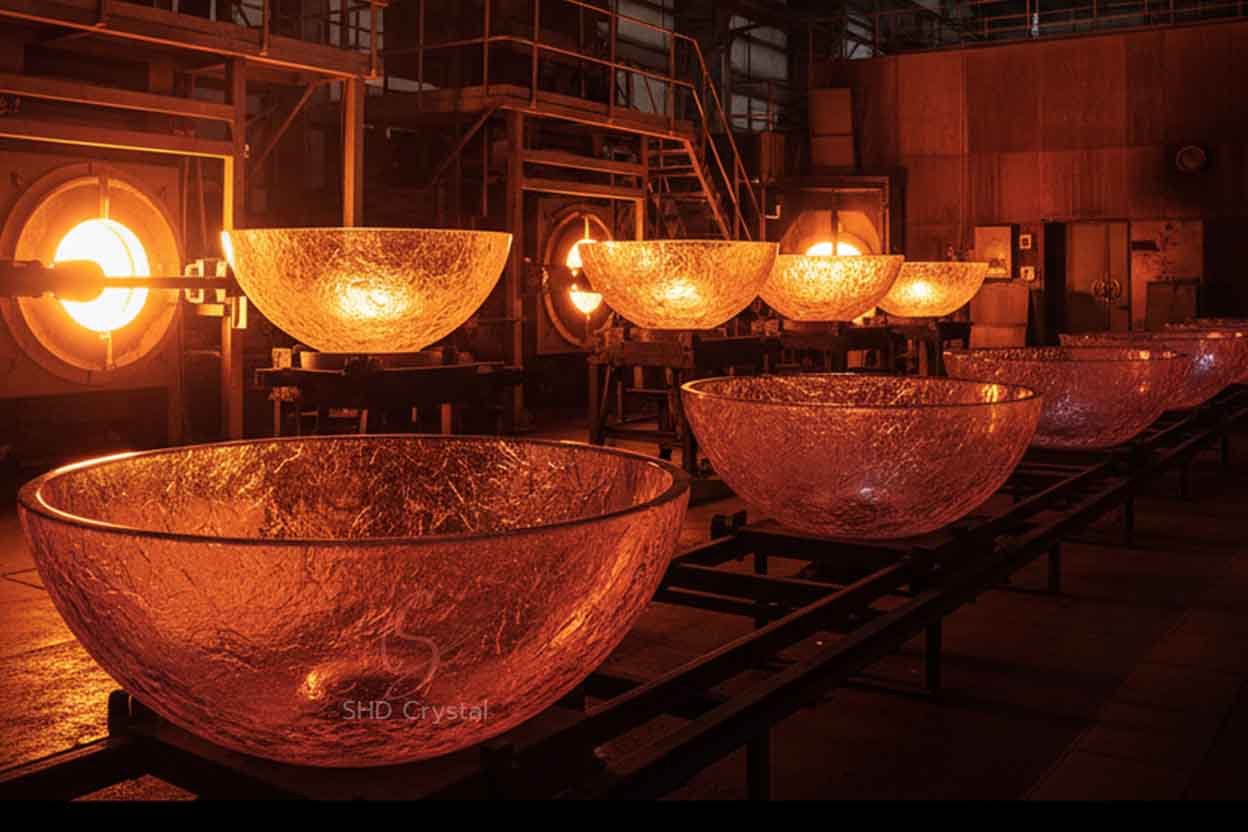
At this moment, the material behaves less like a rigid solid and more like a luminous heavy fluid responding to gravity, motion, and thermal balance simultaneously.
Why Basin Geometry Depends on Material Movement
Unlike machining or carving, glass basin production relies on guiding molten material rather than forcing it mechanically. As the glass stretches and settles into form, thickness distribution changes continuously across curves, edges, and transitions. In large-format basins, even slight imbalance during forming can affect visual symmetry once the object cools. Through viscosity window control, the material remains stable enough to maintain smooth contours while still allowing gradual deformation into the intended shape.
This stage determines not only the geometry of the basin, but also how light will later travel through the finished crystal structure.
Stress Relaxation Sequencing and the Stabilization of Glass
Once forming is complete, the challenge shifts from movement to stabilization.
Freshly formed glass retains internal thermal tension created during shaping. If cooling occurs unevenly, this tension becomes trapped inside the structure and may later cause optical distortion or structural weakness. Stress relaxation sequencing allows the material to release thermal imbalance gradually as temperature decreases. Rather than cooling rapidly, the basin passes through controlled thermal stages that allow the crystal to stabilize progressively.
In glass wash basins processing, this cooling behavior is often more important than the forming stage itself for long-term reliability.
Why Large Crystal Basins Require Slower Thermal Control
Thicker crystal basins naturally retain heat longer than thinner decorative glass. This makes thermal consistency increasingly difficult as basin scale increases.
A large architectural basin may contain multiple thickness zones where heat dissipates at different speeds. Without carefully balanced stress relaxation sequencing, these differences can create hidden instability inside the structure.
At the same time, viscosity window control remains necessary during forming to preserve smooth optical clarity across deeper crystal sections. This balance between movement and stabilization is what allows large-format glass basins to remain both visually refined and structurally dependable.
Glass Surface Quality Begins Long Before Polishing
A common misconception is that clarity and smoothness are created only during finishing. In reality, surface quality is strongly influenced by thermal behavior much earlier in production.
Stable viscosity window control helps preserve uninterrupted surface flow during forming, reducing visual irregularities before polishing even begins. Proper stress relaxation sequencing also minimizes internal distortion that can later affect optical consistency under light.
Because glass interacts so strongly with reflection and transparency, even subtle process variation becomes highly visible once the basin enters an architectural interior environment.
Conclusion
Glass wash basins processing is ultimately the controlled transformation of molten material into stable architectural form. Through carefully balanced viscosity window control and structured stress relaxation sequencing, glass basins achieve the clarity, geometry, and long-term durability required for luxury interior applications. The process depends not on forcing the material, but on guiding thermal movement and stabilization with precision.
Crystal Basin Production Developed Around Material Control
At SHD Crystal, we approach glass wash basins processing as a balance between thermal movement, optical clarity, and structural stabilization rather than simple molded production. Our process focuses on viscosity window control during forming and carefully calibrated stress relaxation sequencing during cooling to preserve both geometry and long-term reliability.
Through controlled shaping, gradual thermal refinement, and large-format crystal processing, we support architectural basin projects that require stable transparency, sculptural form, and refined material behavior across complex interior environments.