
Blogpost keywords: custom orange crystal vase, layered color infusion, sculptural glass accent
Orange crystal is one of the easiest colors to make look artificial. Too saturated, and the vase begins resembling colored plastic instead of crystal. Too pale, and the warmth disappears completely once light passes through the glass. In our work, producing a custom orange crystal vase is rarely about applying color alone. It is about controlling how warmth behaves inside transparent crystal mass while preserving enough clarity for the object to remain luminous rather than visually heavy.
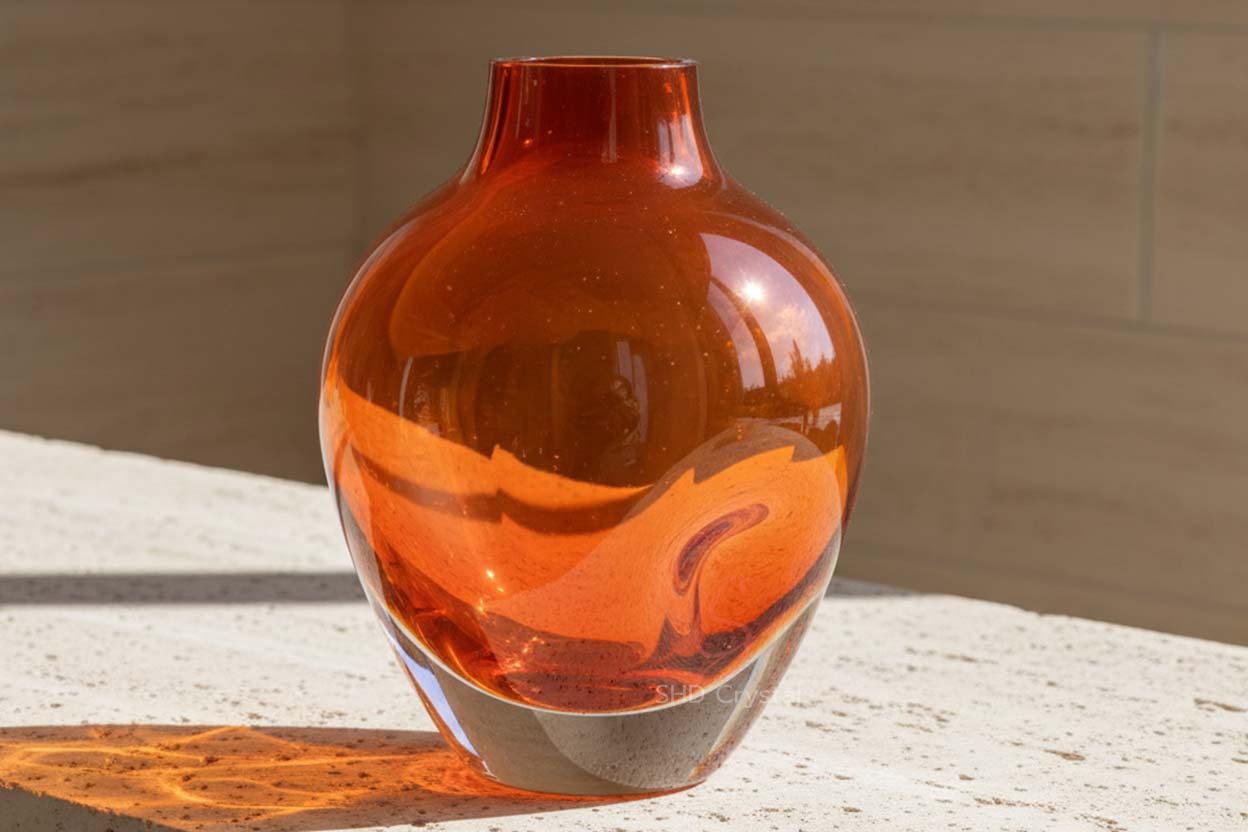
This balance becomes even more sensitive once the vase is hand-blown. Unlike machine-made decorative glass, blown crystal constantly changes thickness during shaping. A few additional millimeters near the shoulder can deepen the orange dramatically. A thinner rim may suddenly shift toward amber transparency under strong daylight. Every contour influences how layered color infusion will behave once the piece cools and begins interacting with light.
For this reason, we approach a sculptural glass accent more like a controlled optical object than a simple decorative vase.
The Color Is Built Inside the Crystal, Not Applied to the Surface
One misconception we encounter frequently is the assumption that orange crystal works like painted glass. It does not. In high-quality blown crystal, the color must become integrated into the glass itself during formation. The process of layered color infusion depends on temperature timing, molten crystal behavior, and precise material control while the glass remains fluid. Once the color enters the crystal mass, every thickness variation begins influencing tonal density automatically.
This is why a custom orange crystal vase develops multiple optical layers naturally rather than appearing uniformly orange from every angle.
Under direct light, thinner sections may glow with bright amber transparency, while thicker areas deepen toward richer sunset-like tones. The visual depth comes from the structure of the crystal itself rather than decorative coating.
Blown Form Changes How Light Travels Through Orange Crystal
When we begin shaping the vase, contour becomes as important as color. A narrow cylindrical form concentrates reflections differently than a broad sculptural body. Elongated necks stretch light vertically through the crystal, while heavier rounded lower sections slow the reflections and create stronger internal density.
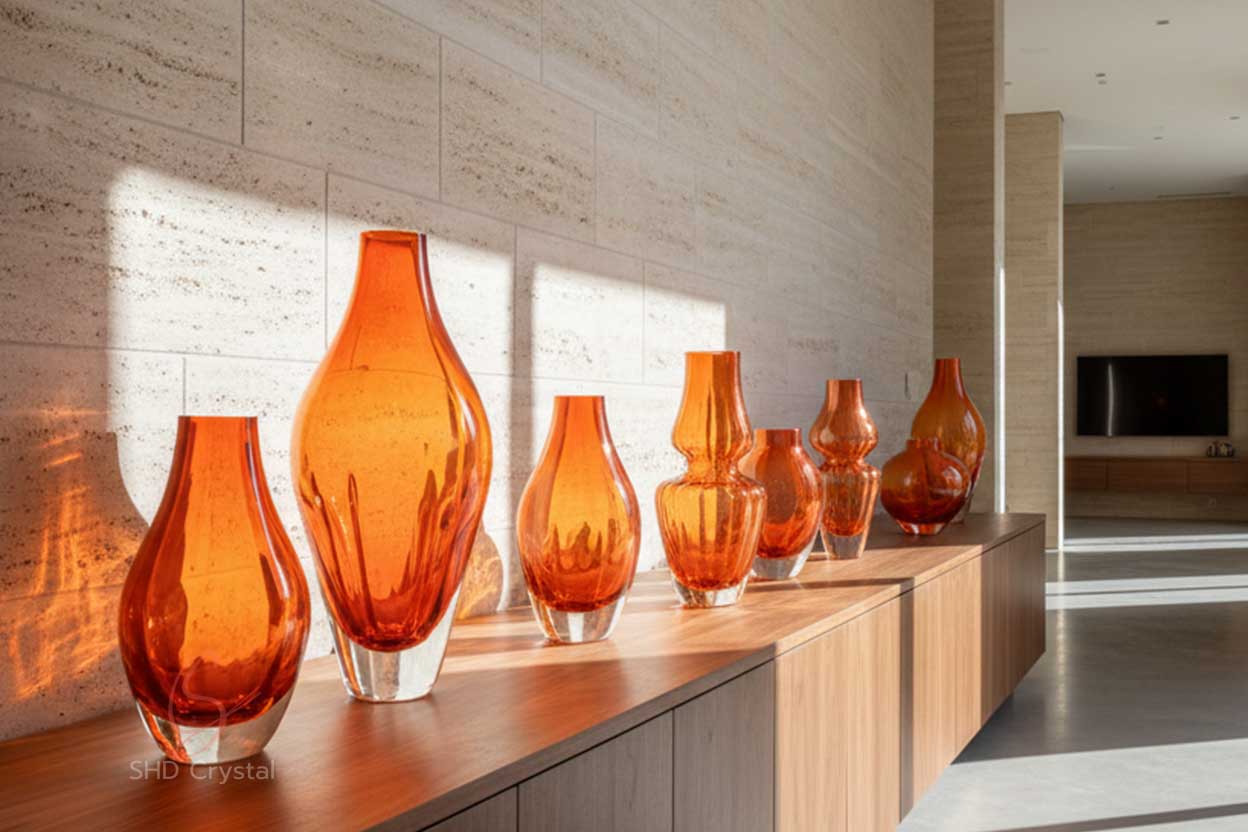
For many custom orange crystal vase projects, we intentionally adjust blown proportions to control how the layered color infusion behaves once the vase is placed into real interiors. Some collectors prefer sharper faceted reflections with stronger gemstone contrast. Others want softer transitions where the orange crystal behaves almost like warm atmospheric light suspended inside glass.
Even small contour adjustments can dramatically alter how the sculptural glass accent interacts with surrounding materials.
Why Orange Crystal Requires Slower Cooling Discipline
Orange crystal remains visually unstable longer than many neutral tones. During cooling, uneven thermal behavior may distort transparency, flatten internal glow, or create tonal inconsistency between different areas of the vase. This is especially important for thicker sculptural forms where heat leaves the crystal gradually over extended periods.
Because of this, our custom orange crystal vase production process often involves slower annealing schedules than standard decorative crystal work. The objective is preserving clarity inside the warmer color range without introducing optical stress into the finished piece. When the cooling process is handled correctly, the layered color infusion remains visually calm rather than aggressive. Light moves through the crystal smoothly instead of breaking abruptly across the surface.
We Evaluate the Vase Under Multiple Lighting Conditions
A vase that looks successful only inside a studio environment is incomplete. Orange crystal behaves very differently under daylight, warm hospitality lighting, and evening architectural interiors. Before approving final production, we typically observe the sculptural glass accent under multiple light directions and surrounding materials to evaluate how reflections evolve throughout the day.
Under natural daylight, the custom orange crystal vase may appear bright and mineral-like. Under lower evening lighting, the same object often develops deeper amber density with softer internal glow.
This shifting optical behavior is exactly what gives blown orange crystal its collectible presence. The vase continues changing visually depending on the environment around it.
Conclusion
Producing a custom orange crystal vase requires far more than introducing color into glass. Through controlled hand-blown shaping, layered color infusion, and careful optical evaluation, orange crystal develops depth, warmth, and reflective movement that allow the object to function as a sculptural glass accent with long-term collectible presence.
Hand-Blown Orange Crystal Developed Through Optical Color Control and Sculptural Refinement
At SHD Crystal, we approach custom orange crystal vase production through blown crystal proportion, layered optical warmth, and collectible reflective behavior rather than decorative coloration alone. Our layered color infusion process focuses on thermal stability, contour balance, and crystal transparency refinement to preserve luminous depth across each sculptural glass accent.
Through hand-blown crystal shaping, controlled annealing refinement, faceted optical adjustment, and sculptural color layering, we support collectible decorative interiors seeking orange crystal objects with strong atmospheric presence and long-term visual richness.