
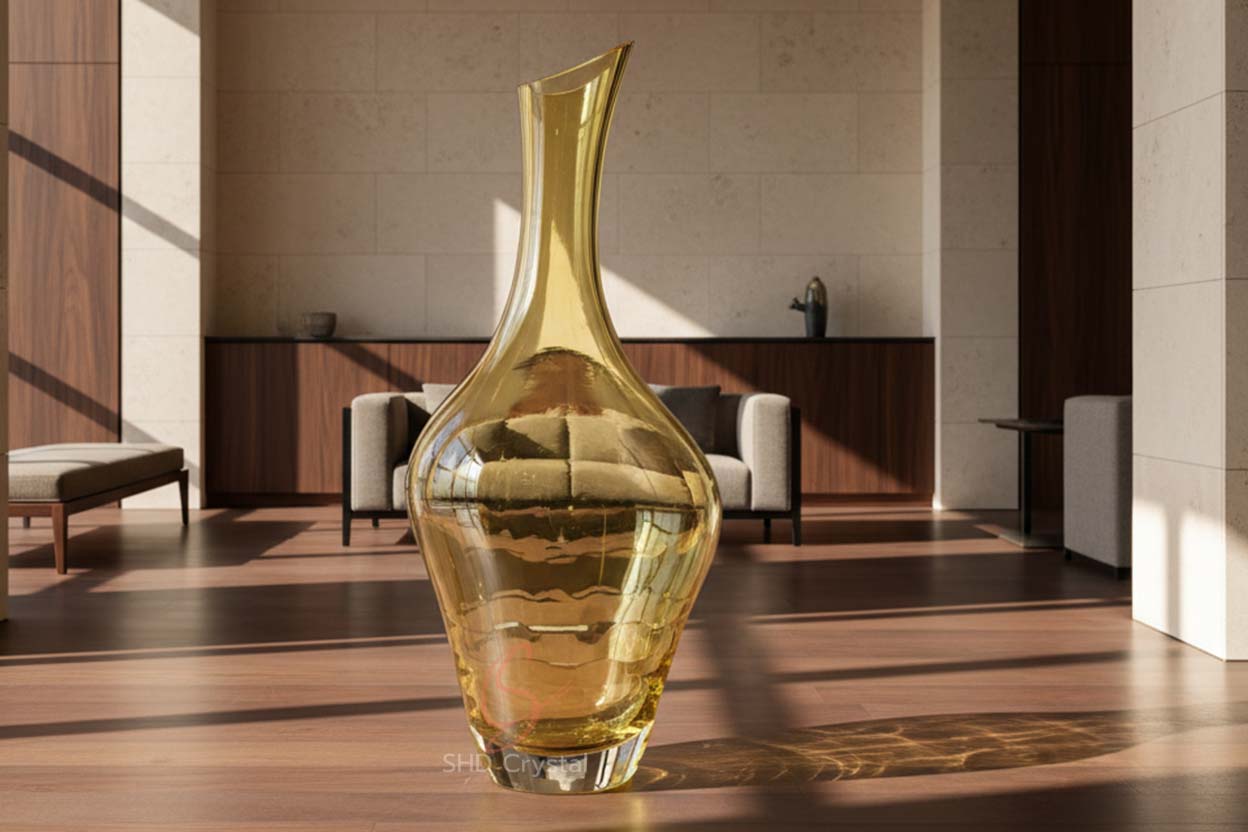
A custom yellow glass vase changes the atmosphere of a space differently from darker decorative glass objects. Instead of creating strong visual compression, yellow-toned crystal and art glass tend to distribute light more softly through the material body. This creates a sense of optical lift, allowing the vase to remain visually present without feeling dense or heavy.
In contemporary interiors, this effect is especially useful when balancing darker architectural materials such as walnut wood, black stone, oxidized metal, or textured concrete. Rather than competing against those surfaces, yellow glass introduces warmth and spatial openness through transparency and controlled color diffusion.
Why Custom Yellow Glass Vase Production Depends on Controlled Optical Transition
The visual success of a custom yellow glass vase depends less on pure saturation and more on how color behaves across different glass thicknesses. In high-quality colored glass, yellow pigment should not appear flat or chemically opaque. Instead, the tone should gradually soften toward thinner areas while remaining deeper near thicker transitions and lower structural zones.
This behavior is closely related to chromatic attenuation glass, where light loses intensity progressively as it travels through the material body.
Thickness Variation Creates Natural Tonal Movement
One of the most important characteristics of yellow glass is its sensitivity to wall thickness. Thin edges often appear brighter and more luminous, while thicker curves develop warmer golden density. If the transition between these areas becomes too abrupt, the vase may lose visual continuity.
For this reason, experienced manufacturers usually pay close attention to temperature control, glass gathering consistency, and cooling rhythm during forming. Uneven wall distribution can create patchy coloration that interrupts the calm optical effect expected from a premium custom yellow glass vase.
In hand-blown production especially, subtle thickness variation can actually improve visual depth when carefully controlled. The object begins to feel more atmospheric and less mechanically uniform.
Smooth Curvature Supports Chromatic Attenuation Glass
A successful chromatic attenuation glass effect relies heavily on uninterrupted curvature. Sharp angle changes or aggressive surface interruptions may break light flow and create unstable tonal areas.
This is why many yellow art-glass vases use elongated shoulders, rounded transitions, and softened silhouettes rather than rigid geometric forms. Continuous curves allow light to travel naturally through the glass body while preserving transparency.
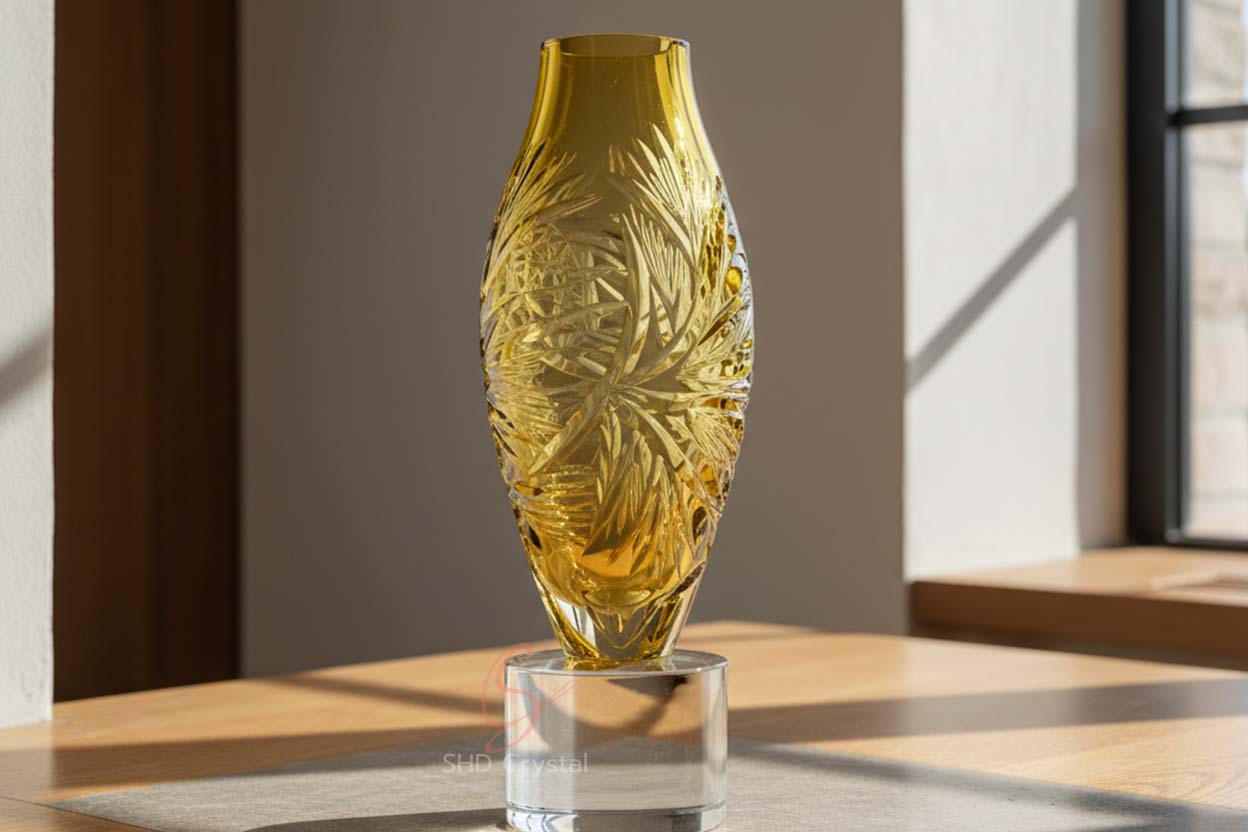
Some high-end pieces also introduce lightly hand-carved textures or soft optic ribbing near the lower section. These details help create layered reflections without overwhelming the material clarity itself.
Buoyant Glass Form Depends on Proportion, Not Only Color
A common misconception is that yellow alone creates visual lightness. In reality, proportion plays an equally important role.
A poorly proportioned vase with excessive thickness or an overly compressed silhouette may still feel visually heavy despite its bright coloration. True buoyant glass form comes from the relationship between height, shoulder width, base weight, and transparency.
Tall silhouettes with gradual tapering often create stronger optical elevation because the eye continues moving upward through the transparent body. This is one reason yellow glass performs particularly well in sculptural decorative objects intended for open shelving, console styling, or hospitality environments.
Interior Lighting Conditions Strongly Influence Perception
Yellow glass reacts dramatically to changing light conditions throughout the day. Warm evening lighting may intensify amber depth, while daylight often reveals cleaner transparency and softer tonal fading.
When evaluating a custom yellow glass vase, buyers should therefore review samples under multiple lighting environments rather than relying only on studio photography. A vase that feels balanced in natural daylight may appear significantly warmer under hospitality lighting schemes.
This responsiveness is one of the defining strengths of chromatic attenuation glass. The object changes character subtly without losing visual stability.
Conclusion
A refined custom yellow glass vase combines transparency, controlled tonal movement, and carefully balanced structure to create visual lightness within an interior. Through stable wall distribution, smooth curvature, genuine chromatic attenuation glass, and well-proportioned buoyant glass form, yellow glass can introduce warmth and elevation without overwhelming surrounding materials.
Supporting Custom Colored Glass Vase Development
At SHD Crystal, we support OEM development for decorative colored glass vases through hand-blown forming, controlled pigment integration, wall thickness management, optic texture refinement, and custom finishing techniques. For brands developing sculptural interior collections, our team helps create custom yellow glass vase designs that balance transparency, color depth, and stable handcrafted character across both artistic and commercial product programs.