
Black glass bottle coating is commonly used when a packaging project requires a deep, uniform dark appearance without relying entirely on the color of the glass body itself. The final result may look visually simple, but achieving a consistent black surface requires careful control of bottle preparation, coating coverage, curing, decoration compatibility, inspection, and packing. For brands developing dark packaging, it is also important to distinguish between glass that is colored during melting and a bottle that receives its black appearance through later surface finishing.
Black Glass Bottle Coating Starts With the Right Surface Condition
A coating can only perform as well as the surface underneath it. Before decoration, the formed bottle needs a sufficiently clean and consistent surface. Dust, oil, residue, scratches, or other contamination can influence coating appearance and adhesion. Irregular bottle geometry can also make uniform application more difficult, particularly around shoulders, recessed details, sharp transitions, and thick bases. For this reason, glass bottle surface finishing should be considered together with the bottle structure rather than added as an isolated step at the end of development.
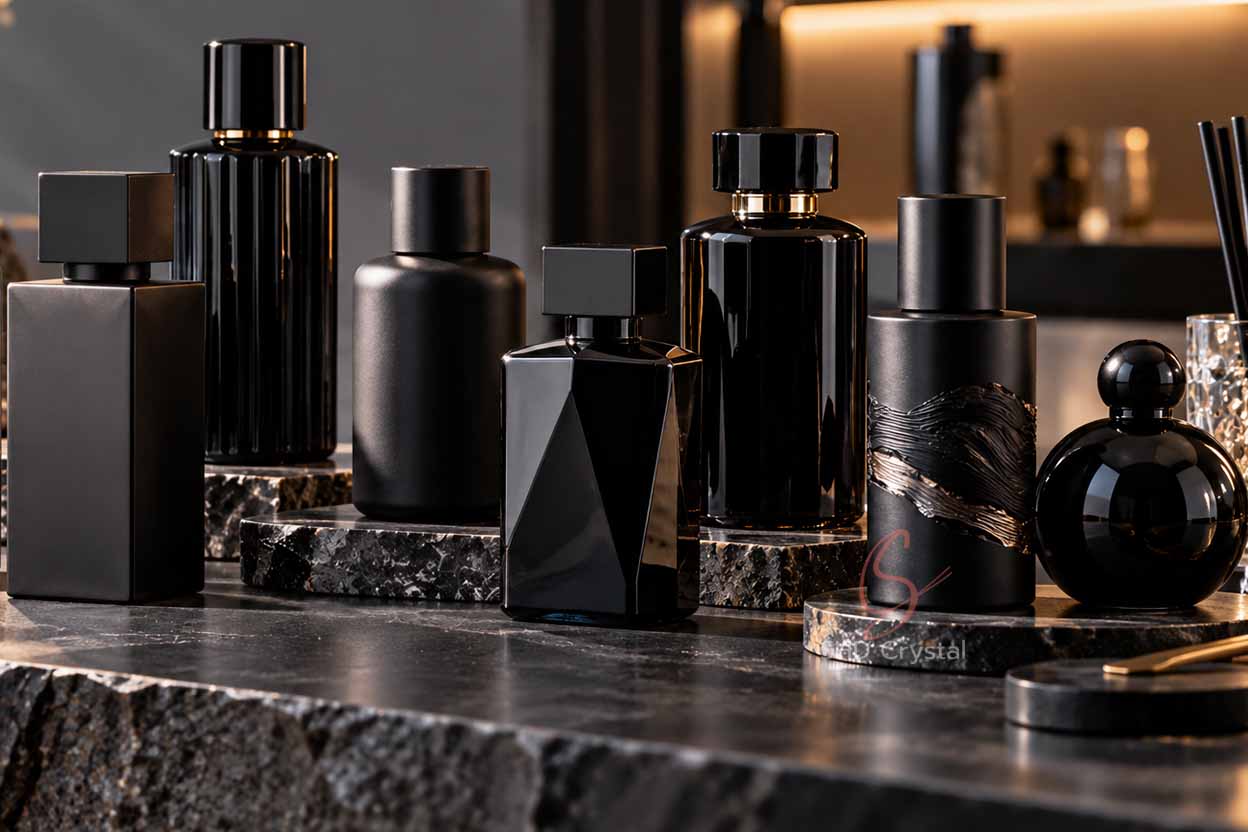
Black Glass and Black-Coated Glass Are Not the Same Product
A visually black bottle can be achieved through more than one technical route. Some black glass is produced by modifying the glass composition with suitable colorant systems during melting. Historical and modern glass formulations demonstrate that combinations involving elements such as iron, cobalt, nickel, selenium, copper, and other colorants can be used to create very dark or visually black glass. The actual composition and processing route vary according to the glass system and required performance.
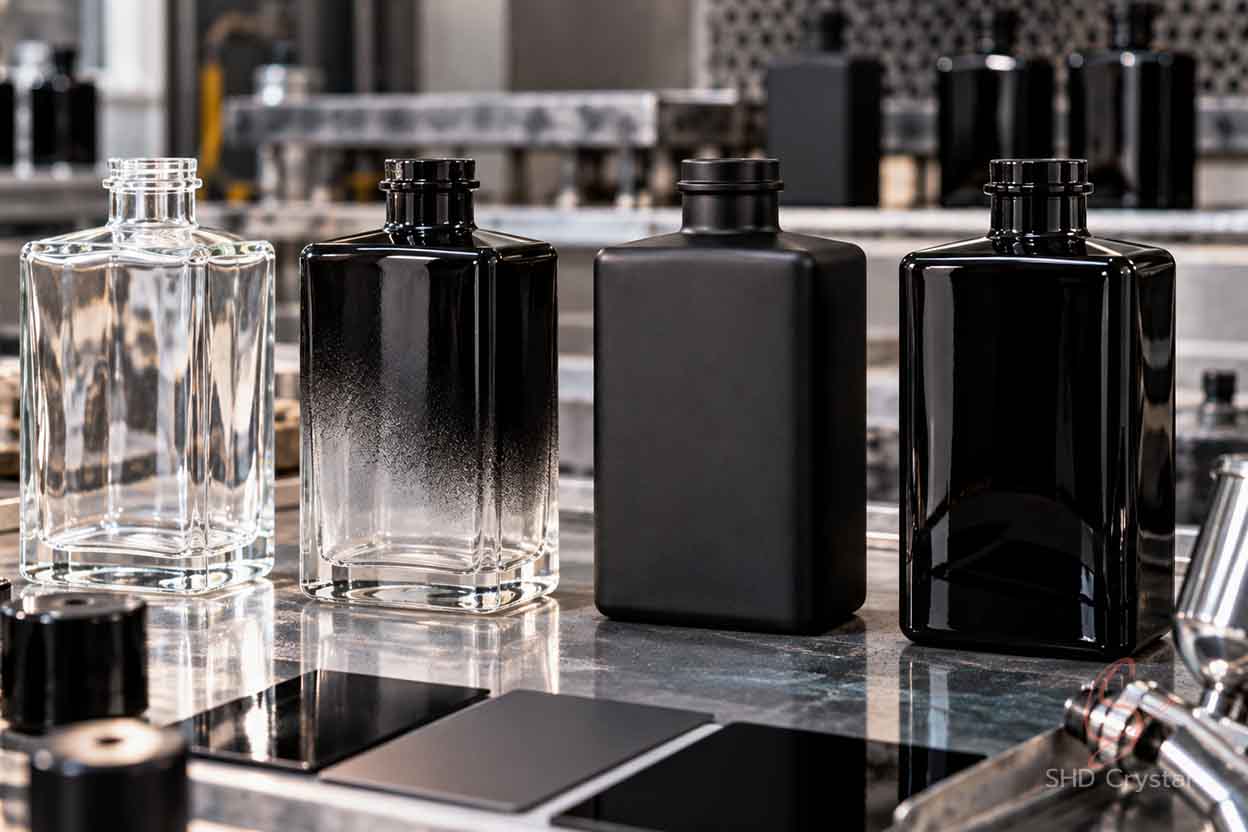
A different route is black glass bottle coating, where the bottle is formed first and then given an opaque black surface finish. Commercial glass decorators offer both matte and glossy black spray finishes, sometimes combined with screen printing, metallic decoration, or other secondary processes.
These two approaches should not be treated as interchangeable. Integral glass color affects the material itself, while a coating introduces a separate decorative layer with its own appearance, handling, adhesion, and inspection requirements.
Matte and Gloss Black Create Different Surface Demands
A matte black finish reduces strong reflection and can create a softer, more architectural appearance. Gloss black produces stronger highlights and makes the bottle surface appear deeper and more reflective. Neither option is automatically easier to produce.
A matte surface may reveal abrasion, rubbing, or uneven texture under directional light. A glossy finish may make dust, fingerprints, coating variation, and small surface defects more visible. The required appearance should therefore be defined during sampling under realistic lighting rather than approved only from a digital rendering.
Coating Uniformity Becomes More Difficult on Complex Shapes
Bottle geometry directly influences how a black coating is perceived. Broad flat panels usually provide relatively straightforward inspection areas, while curved shoulders, recessed patterns, deep embossing, narrow grooves, and geometric transitions can make coverage more difficult to assess. Opaque glass bottles are particularly unforgiving because the dark surface creates strong contrast. Thin spots, uneven gloss, edge accumulation, or inconsistent spraying may be more noticeable than on lighter decorative finishes.
A bottle with complicated geometry may still be suitable for a black coating, but the design and finishing method should be evaluated together during sampling.
Decoration Needs to Be Tested on the Actual Black Surface
Black provides a strong background for secondary decoration, but artwork that works on clear glass may behave very differently on an opaque surface. White printing can create sharp contrast. Gold or silver hot stamping can introduce metallic detail. Gloss-on-matte combinations can create subtle branding without adding another strong color.
Commercial glass decoration commonly combines spray coating with screen printing, hot stamping, masking, and other finishing techniques. However, decoration compatibility should be confirmed on physical samples. Ink opacity, adhesion, curing conditions, logo position, and the interaction between different finishing layers can all influence the final result.
Handling and Packing Are Part of Surface Quality
A finished coating still needs to survive assembly, packing, transportation, and unpacking. Bottle-to-bottle contact, carton dividers, sleeves, caps, and other packaging components can create friction against decorated surfaces. A finish that looks acceptable immediately after coating may perform differently after repeated handling.
For glass bottle surface finishing, packing trials are therefore useful when the project includes full-body coating, matte surfaces, metallic decoration, or other finishes that may show abrasion. Protective inserts should prevent unnecessary movement while avoiding excessive pressure against decorative areas.
Batch Consistency Needs Physical Reference Samples
One approved bottle is useful, but commercial production requires a repeatable standard. For opaque glass bottles, buyers should establish practical references for black tone, gloss or matte level, coverage, visible surface defects, decoration position, and overall appearance.
Multiple samples should also be reviewed together under consistent lighting. Slight differences that appear acceptable individually can become much more noticeable when bottles are arranged side by side. This becomes particularly important for repeat production, where bottles from different batches may eventually appear together in the same retail environment.
Conclusion
Black glass bottle coating is not simply a matter of spraying a clear bottle until it becomes dark. Surface preparation, bottle geometry, coating application, curing, decoration compatibility, handling, inspection, and packing all contribute to the final appearance.
A well-controlled glass bottle surface finishing process allows opaque glass bottles to achieve a consistent matte or glossy identity while maintaining practical standards for decoration and repeat production. The most appropriate route should be selected according to the intended appearance, bottle structure, application, and production requirements rather than assuming that all black bottles are produced in the same way.
Developing Black Glass Surface Finishes With SHD Crystal
SHD Crystal supports glass surface processing that includes color spraying, frosting, screen printing, hot stamping, engraving, polishing, and other decorative methods. Its published manufacturing information also emphasizes that stable formed surfaces provide the foundation for later finishing processes.
For a black glass bottle coating project, development can begin with the bottle structure, intended matte or glossy effect, decoration requirements, handling conditions, and packaging method. Physical samples can then be used to evaluate coating uniformity, visual contrast, secondary decoration, and surface protection before larger production begins.
FAQs
Q&A 01 | Is a black glass bottle always made from black-colored glass?
No. Some bottles obtain their dark appearance from colorants incorporated into the glass composition, while others are manufactured from another base glass and later receive an opaque black coating. The production route should be confirmed for the specific project.
Q&A 02 | Is matte black coating easier to maintain than glossy black?
Not necessarily. Matte and glossy surfaces reveal different types of variation. Matte finishes may show rubbing or inconsistent texture, while glossy surfaces can make fingerprints, dust, and minor coating defects more visible. Sample handling tests are useful for both.
Q&A 03 | What should buyers check before approving opaque glass bottles?
Important checks include coating coverage, black tone, gloss or matte consistency, visible scratches, decoration adhesion and alignment, bottle-to-bottle color consistency, and protection during packing and transportation.
https://shdcrystal.com/blogs/black-glass-bottle-coating/
The link to this article is managed and owned by SHD Crystal. Please cite the source if reposting. Thank you for your cooperation.