
How Crystal Glass Composition Is Built from Batch Materials
When new buyers ask us what actually decides quality, we point straight to crystal glass composition, because every property you care about downstream starts with what goes into the melting furnace. When a gift brand asks why one sample rings brighter than another, our answer begins with the batch sheet rather than the polishing wheel.
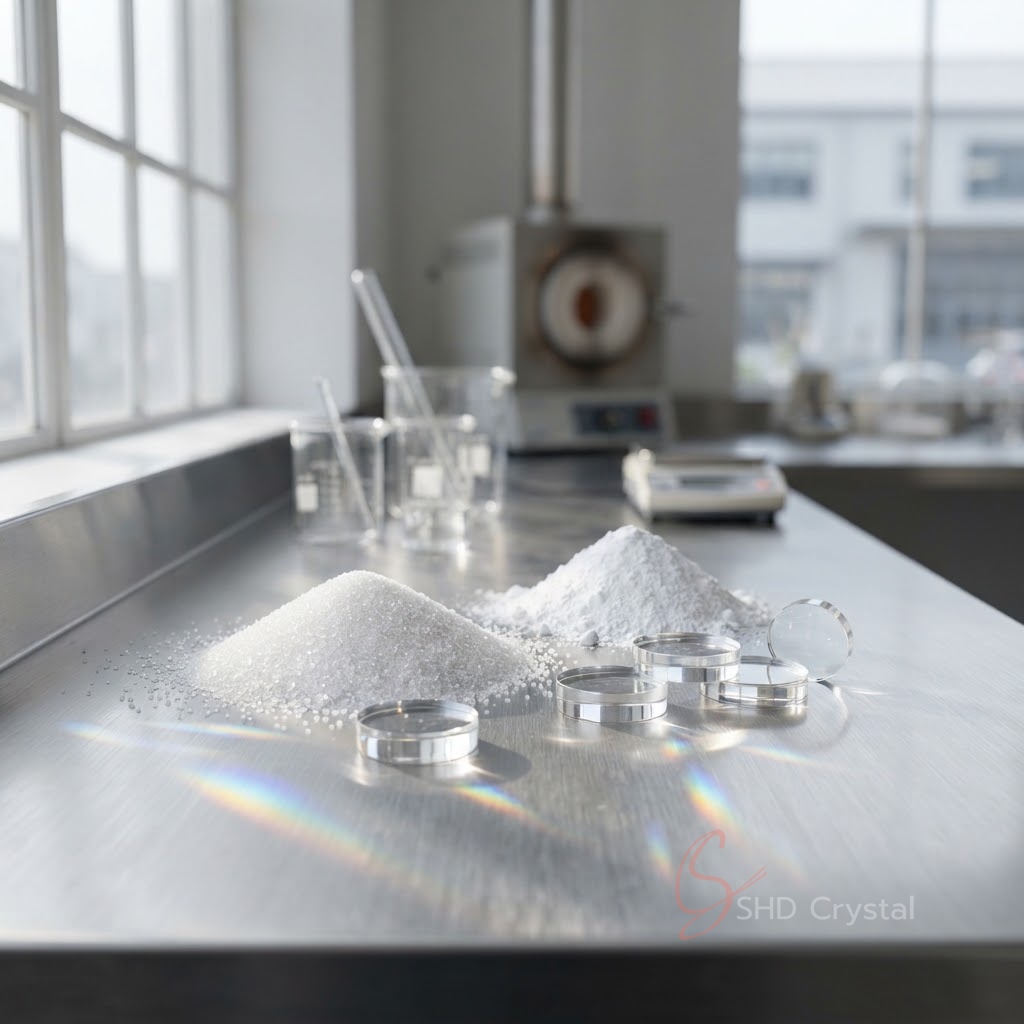
We run OEM programs for importers, drinkware labels, and corporate gift houses, and in practice the buyers who get consistent product are the ones who treat raw materials as part of their quality spec. This guide covers what we weigh out daily and how traditional lead crystal differs from modern lead-free lines.
Every melt starts with batch materials weighed against a fixed recipe: silica sand as the glass former, alkali carbonates as fluxes, calcium carbonate as a stabilizer, and the weighting oxides that separate true crystal from ordinary soda-lime glass. We also feed cullet back into the furnace, and the cullet ratio itself becomes a formulation variable.
| Component | Traditional lead crystal | Lead-free crystal |
|---|---|---|
| Glass former | High-purity quartz sand, roughly half of the melt | Similar sand base, comparable share |
| Flux | Potassium carbonate for warmth and brilliance | Sodium-potassium carbonate blend tuned for viscosity |
| Weighting agent | Lead oxide, typically around 24% by weight | Zinc, barium, or potassium oxides in combination |
| Stabilizer | Small calcium carbonate addition | Calcium carbonate plus refining agents |
Reading that table row by row shows how crystal glass composition translates into melt behavior. The flux choice matters more than buyers expect: potassium carbonate melts slower but gives the warm optical character at the heart of every potassium-calcium formulation, while sodium-heavy fluxes melt faster and cheaper at some cost to clarity under polariscope inspection.
The weighting agent row drives density, refractive index, and cutting response. When the lead oxide percentage falls from typically around 24% down to zero, density drops with it, so a finished tumbler feels noticeably lighter. That is why we ask brands early whether heft is part of their perceived-value story.
Why Lead Oxide Percentage Still Shapes the Classic Crystal Standard
From our production experience, the lead oxide percentage buyers quote most often sits at or above 24% for full lead crystal. That loading pushes density high enough that cut facets catch light sharply, while the softer melt lowers forming temperature and extends working time at the bench.
That longer working time is a real advantage for deep-cut decanters and complex stemware, because the glass stays formable through more steps before it stiffens. The trade-offs are weight, cost, and regulatory handling on the melt side, which is why many markets have moved toward lead-free alternatives without giving up sparkle entirely.
Inside Our Lead-Free Melts: Zinc, Potassium, and Barium Oxides
Lead-free crystal typically relies on zinc oxide, barium oxide, or elevated potassium oxide to recover refractive index and density. None matches lead single-handedly, so formulating becomes a balancing act where small adjustments change melt viscosity enough to affect everything from mold fill to annealing stress. In practice, we verify every new crystal glass composition against a density window each shift.
One failure case stays with us. We helped an importer whose previous supplier had quietly swapped the cullet ratio between two batches of a lead-free tumbler; small shifts in crystal glass composition show up fast in lead-free bodies, and optical clarity changed visibly under showroom lighting before a full container was disputed.
A second lesson came from our own line. When we scaled up a barium-containing formula, the higher viscosity caused short fills on a pressed bowl mold, leaving rounded rims that failed dimensional checks. We adjusted the flux package and re-tuned the forming temperature window before the tooling ran again.
Matching Potassium-Calcium Formulation to Your Product Type
Choosing between formulas is easier if you start from the product rather than the chemistry. A potassium-calcium formulation leans toward brightness and cleaner polariscope readings, which suits wine glasses and thin-walled stemware, while denser blends suit awards, heavy tumblers, and cut decorative pieces.
Picture the scenario: you are launching an engraved whiskey set for holiday gifting programs. In practice we would steer you toward a moderately weighted lead-free body that cuts cleanly yet passes food-contact expectations in your target markets, then confirm the potassium-calcium formulation against retained samples poured from the actual production furnace.
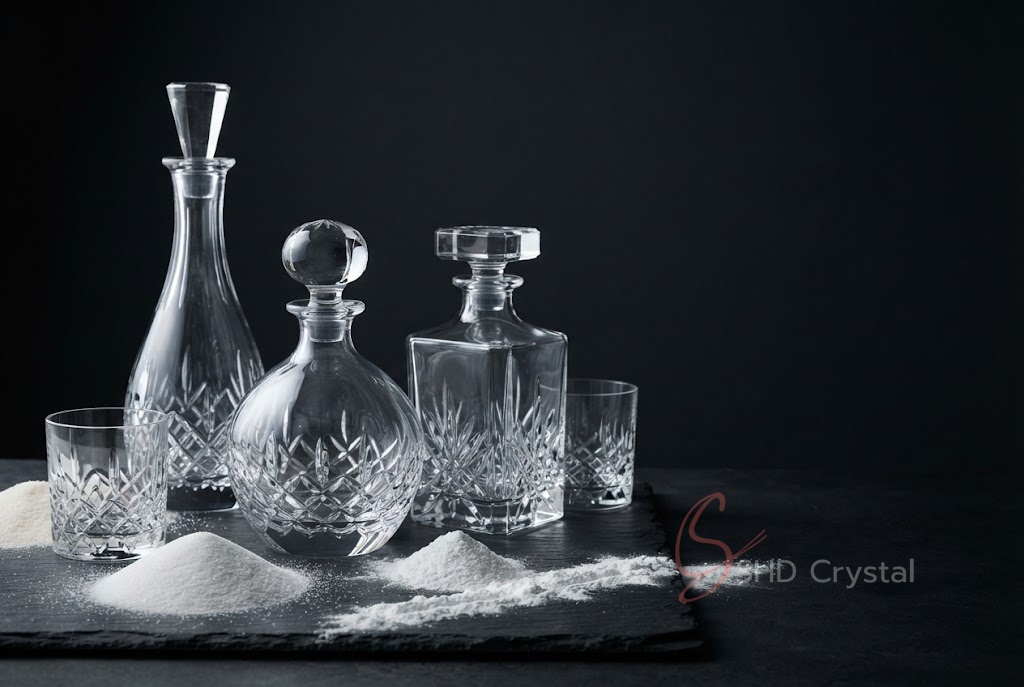
Whatever direction you take, ask any prospective supplier for full batch formulation disclosure and retained samples per lot. A factory confident in its crystal glass composition will send both without hesitation, along with density and refractive index figures measured on production glass rather than lab prototypes.
Frequently Asked Questions
Is lead-free crystal suitable for everyday drinkware?
Yes, and it is now the default for most export markets. Well-formulated lead-free bodies using zinc or potassium oxides reach a refractive index close to traditional crystal, while the lighter weight can actually help stemware balance.
What formulation details should we request from a supplier?
Ask for the full batch recipe including the lead oxide percentage or its lead-free equivalents, the cullet ratio, and retained samples from the specific furnace campaign making your order. Suppliers who resist disclosure are usually hiding batch variation.
Does a higher refractive index always mean better crystal?
Not necessarily. Refractive index contributes to sparkle, but cutting quality, polish, and wall-thickness uniformity influence perceived brilliance just as much. We have seen mediocre high-index glass lose shelf comparisons against well-cut moderate-index pieces.
Can you match a competitor’s crystal exactly?
We can match measurable targets such as density, refractive index, and wall thickness very closely. Exact chemical matching depends on competitor disclosure, so we usually work from physical benchmarks instead of guessed recipes.
Conclusion
Understanding crystal glass composition does not require a ceramics degree, but it does require asking questions before the purchase order is signed. Decide whether a potassium-calcium formulation or a denser lead-free blend fits your product, then confirm your supplier will disclose batch data.
Request Batch Data and Retained Samples From Our Line
Send us your target product and market, and our production team will walk you through the crystal glass composition options we run today, including typical lead oxide percentage ranges and lead-free alternatives. We provide batch disclosure, retained samples, and honest guidance at your volumes.
Interested in custom glassware or related products?
Contact our team to discuss your project requirements.