
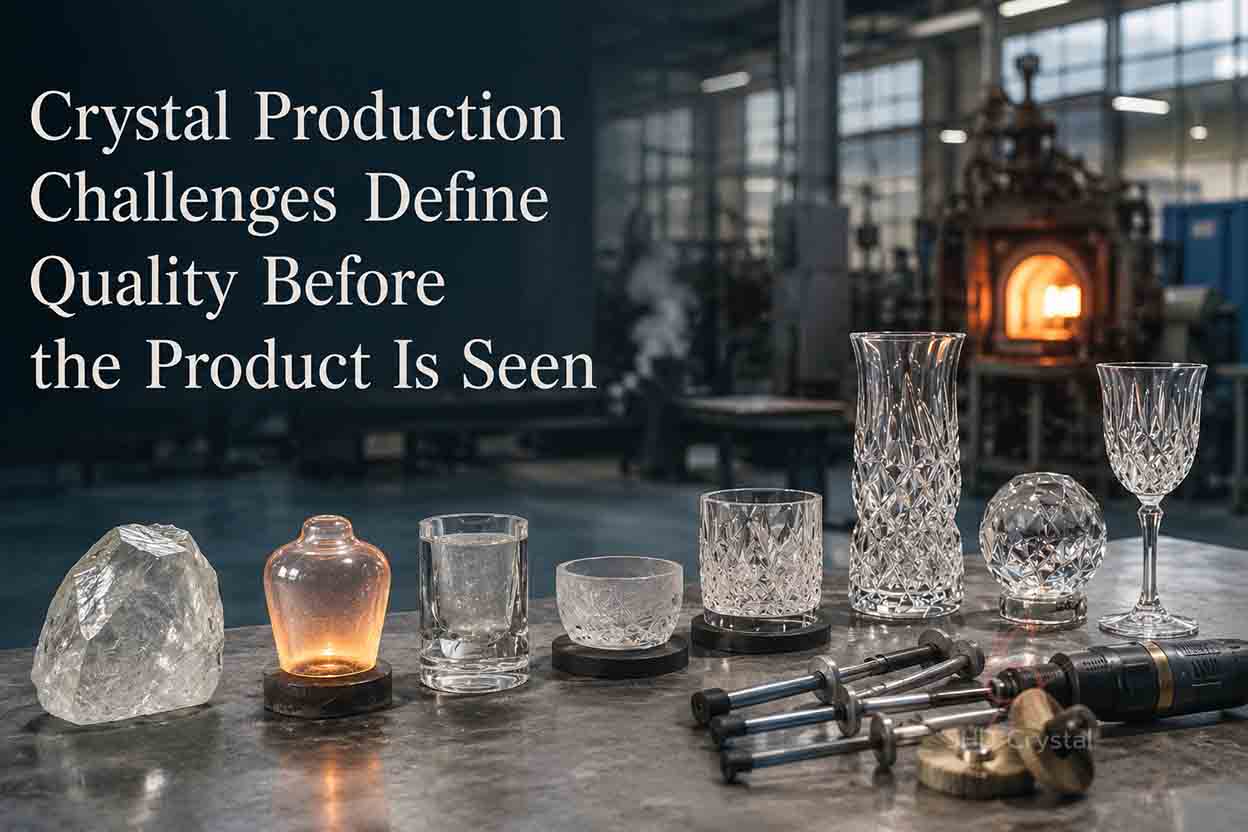
Crystal production challenges begin long before a finished bowl, vase, decanter, or decorative object reaches final inspection. In custom crystal manufacturing, the visible result is only the last step of a much larger process. What the buyer sees as brilliance, weight, clarity, and surface refinement is shaped earlier by material behavior, forming decisions, cooling discipline, finishing control, and inspection judgment. This is why crystal projects that look straightforward on a drawing can become difficult in real production. The challenge is not simply making crystal products look attractive. The challenge is making them repeatable, stable, and commercially realistic.
How Crystal Production Challenges Build Across the Production Chain
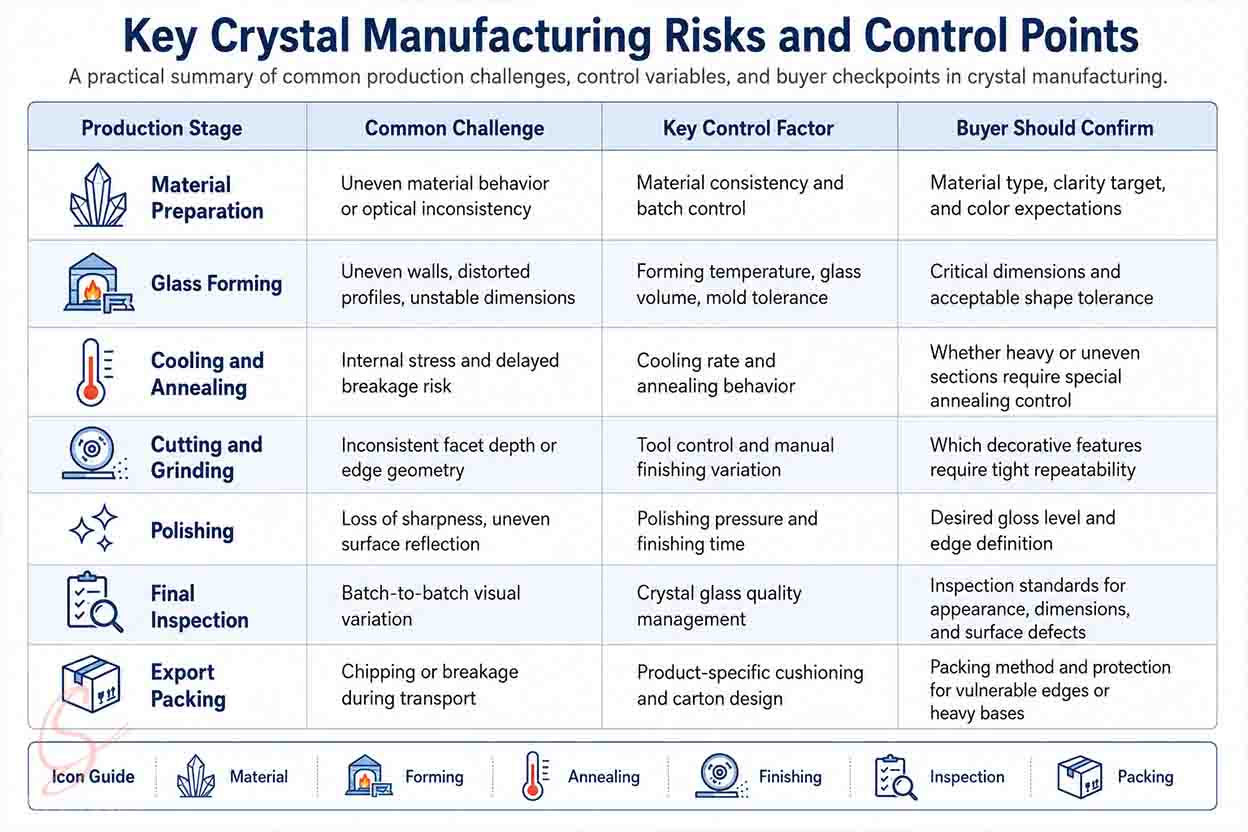
A useful way to understand crystal manufacturing is to stop looking at the finished product first and start looking at the production chain. Each step affects the next one. If the material does not flow evenly, the shape becomes unstable. If the wall thickness is unbalanced, cooling becomes harder to manage. If finishing removes too much material in one area, symmetry and fit may shift. In practice, crystal production challenges are rarely caused by one dramatic error. They are more often the result of several small process issues accumulating across forming, annealing, cutting, polishing, and final inspection.
Material Behavior Creates the First Technical Limits
Not all clear glass materials behave the same way. Even within crystal-oriented production, different formulations respond differently to heat, flow, and finishing. Some compositions prioritize clarity and brilliance. Others may be selected for broader production practicality or cost balance. For buyers, this matters because a product concept that performs well in one material may need adjustments in another.
This is where glass forming control becomes important. During hot forming, the factory must manage how the material moves into the mold, how evenly it distributes across the wall, and how the shape is maintained before cooling begins. Sharp transitions, narrow necks, thick bases, and deep decorative relief can all make forming less predictable. A product may still be possible, but it may no longer be easy to reproduce consistently without process refinement.
One common misunderstanding is that crystal defects are mainly visual defects. In reality, many visual problems start as material and thermal problems. A slight variation in temperature, a slow response during shaping, or uneven glass gathering can later appear as asymmetry, distortion, optical inconsistency, or a poor finish. That is why early process review matters more than many buyers expect.
Forming Stability Is About More Than Mold Shape
Mold design is essential, but mold shape alone does not solve production difficulty. In custom work, factories often need to evaluate mold tolerance together with forming temperature, glass volume, and release behavior. A beautiful profile on paper may need a wider shoulder, a more stable base, or a softer corner radius before it becomes suitable for production.
This stage is also where crystal production challenges become closely tied to engineering tradeoffs. A heavier base can make a product feel premium, but it can also create a more difficult wall thickness transition. Deep cutting areas may improve visual drama, yet they may require more controlled blank distribution before the finishing stage. Tight openings can strengthen a silhouette, but they may complicate forming consistency and later finishing access.
For this reason, experienced manufacturers treat glass forming control as an active decision-making system rather than a passive production step. They review where the glass enters the form, how mass is distributed, and whether the product geometry creates vulnerable zones for cooling stress. This is especially relevant in products that combine decorative ambition with functional use, such as drinkware, candle holders, cosmetic packaging, or tabletop display pieces.
Cooling and Annealing Decide Whether a Good Shape Becomes a Reliable Product
A product may leave the mold looking acceptable and still carry hidden internal stress. This is one of the most important realities behind crystal production challenges. Internal stress does not always announce itself immediately. Sometimes the piece survives initial handling but becomes more vulnerable during transport, cutting, polishing, use, or export packing.
Annealing exists to reduce that risk, but annealing is not a box to tick. It depends on the product’s actual wall distribution, thickness, mass concentration, and production rhythm. A thick-footed crystal vessel will not behave the same way as a thin decorative ornament. If cooling is too fast, internal stress may remain trapped. If the production flow is unstable, the same design may perform differently from one batch to another.
This is where crystal glass quality management needs to go beyond visual sorting. Reliable factories do not only inspect the final shine. They evaluate structural consistency, dimensional repeatability, and whether the product is behaving as expected through the production cycle. Good quality management begins by understanding what the process is capable of, not by trying to polish every issue away afterward.
Finishing Adds Value but Also Adds Variation
Many buyers associate crystal with cut patterns, polished edges, brilliant transparency, and tactile weight. All of that is valid. Yet finishing is also one of the main points where variation enters the product. Cutting depth, polishing pressure, grinding balance, and manual finishing variation can all influence the final impression.
This is another area where buyers sometimes hold a simplified view. They may assume that more handwork automatically means better quality. In reality, handwork creates both value and variability. Handmade finishing can produce desirable character, but if tolerance expectations are not defined clearly, larger quantities may show noticeable differences in angle sharpness, symmetry, or surface feel.
Effective crystal glass quality management therefore requires clear acceptance standards. What level of variation is acceptable in handmade finishing? Which dimensions are critical and which are visually flexible? Which decorative features must match closely from batch to batch? These questions are especially important in hospitality programs, branded giftware, and retail collections where multiple units are displayed together and inconsistency becomes easier to notice.
Buyers Should Evaluate Process Capability, Not Only the Sample
A polished sample can be convincing. It can also be misleading if it does not represent real production behavior. One of the more practical crystal production challenges for buyers is judging whether a supplier is showing a beautiful sample or a stable manufacturing solution. These are not always the same thing.
Before approving development, buyers should ask about forming method, likely tolerance range, wall thickness distribution, finishing route, and how batch consistency will be checked. If the design includes multiple deep facets, unusual mass concentration, or a complex rim, the discussion should include whether those features affect breakage risk, production speed, or finishing difficulty. This is where glass forming control becomes a commercial issue as well as a technical one. Better control often means fewer revisions, lower rejection risk, and more predictable delivery.
Another useful question concerns scale. A supplier may produce a small hand-finished run successfully but struggle when the order requires higher repeatability across larger quantities. This is not a reason to avoid the supplier automatically. It is a reason to clarify process boundaries early. Good development work depends on understanding what can be reproduced consistently and what remains inherently variable.
Stable Supply Depends on Structured Quality Thinking
For international buyers, consistency across time matters as much as the first sample. A project becomes more valuable when the second and third production runs still match the approved direction. This is where crystal glass quality management supports long-term cooperation. Consistent color tone, surface clarity, edge treatment, and finishing quality are all signs that the manufacturing process is being managed rather than improvised.
Structured inspection does not remove every risk, but it improves visibility. Dimensional checks, appearance inspection, bottom flatness review, edge evaluation, and packaging verification all help identify issues before shipment. In practical terms, the goal is not perfection in the abstract. The goal is stable output that aligns with the product’s application, price level, and brand expectation.
Conclusion
The most important lesson behind crystal production challenges is that quality is built step by step, not added at the end. Material response, process design, cooling discipline, finishing choices, and inspection standards all shape whether a crystal concept becomes a reliable product or a recurring source of adjustment. Buyers who understand these relationships can make better decisions, reduce avoidable revisions, and develop crystal projects with stronger production confidence.
Planning a More Dependable Crystal Project
Working with a supplier that understands crystal production challenges can make custom development far more efficient. When design review is supported by practical glass forming control and disciplined crystal glass quality management, the result is not only a more attractive product, but also a more stable path from concept to repeat production.
Read the original full version: https://shdcrystal.com/blogs/crystal-production-challenges/