
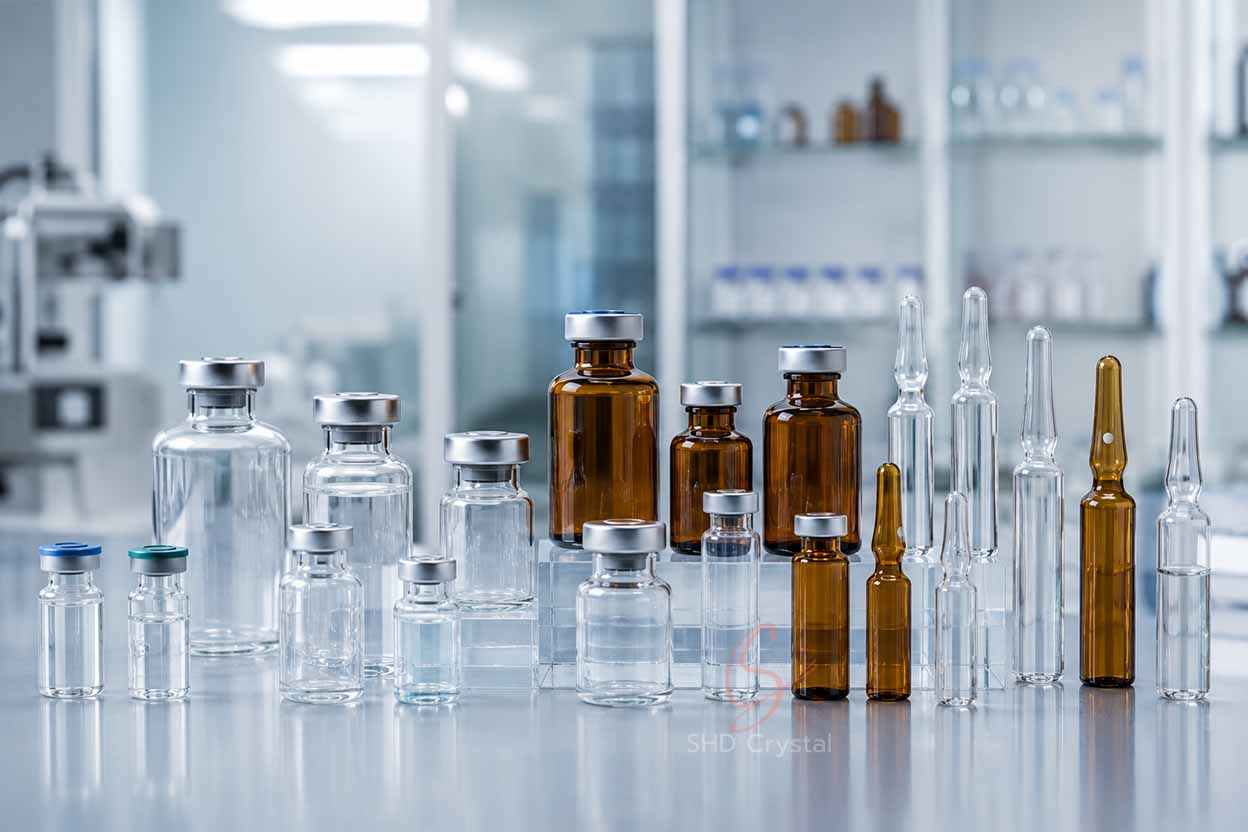
Glass medicine bottles are selected according to much more than bottle shape or visual appearance. In pharmaceutical applications, the glass may remain in direct contact with a formulation for months or years, which makes chemical resistance, hydrolytic stability, light protection, closure compatibility, and dimensional consistency important considerations. Oral liquid bottles, pharmaceutical glass vials, and glass ampoules may all belong to the broad category of medicine packaging, but their material and manufacturing requirements can be very different.
How Custom Glass Medicine Bottles Change Across Pharmaceutical Applications
The first distinction is the medicine itself. A molded bottle for cough syrup does not face exactly the same requirements as a vial containing an injectable drug. Likewise, an ampoule designed to be hermetically sealed and opened immediately before administration has different structural requirements from a screw-cap medicine bottle. For this reason, pharmaceutical glass is commonly evaluated according to its hydrolytic resistance and suitability for contact with particular drug products rather than simply being described as “medical glass.”
Type I, Type II, and Type III Glass Serve Different Purposes
USP <660> classifies traditional pharmaceutical glass containers according to material composition and hydrolytic resistance.
Type I glass is borosilicate glass. Its glass network contains significant amounts of boric oxide together with silica and other oxides, giving it high hydrolytic resistance and strong resistance to thermal shock. USP states that containers meeting Type I performance are suitable for most parenteral and nonparenteral products.
This is one reason Type I borosilicate is widely associated with pharmaceutical glass vials and glass ampoules used for injectable medicines, vaccines, biologics, and other sensitive formulations. Current pharmaceutical vial and ampoule portfolios from SCHOTT Pharma, for example, use Type I borosilicate glass for these applications.
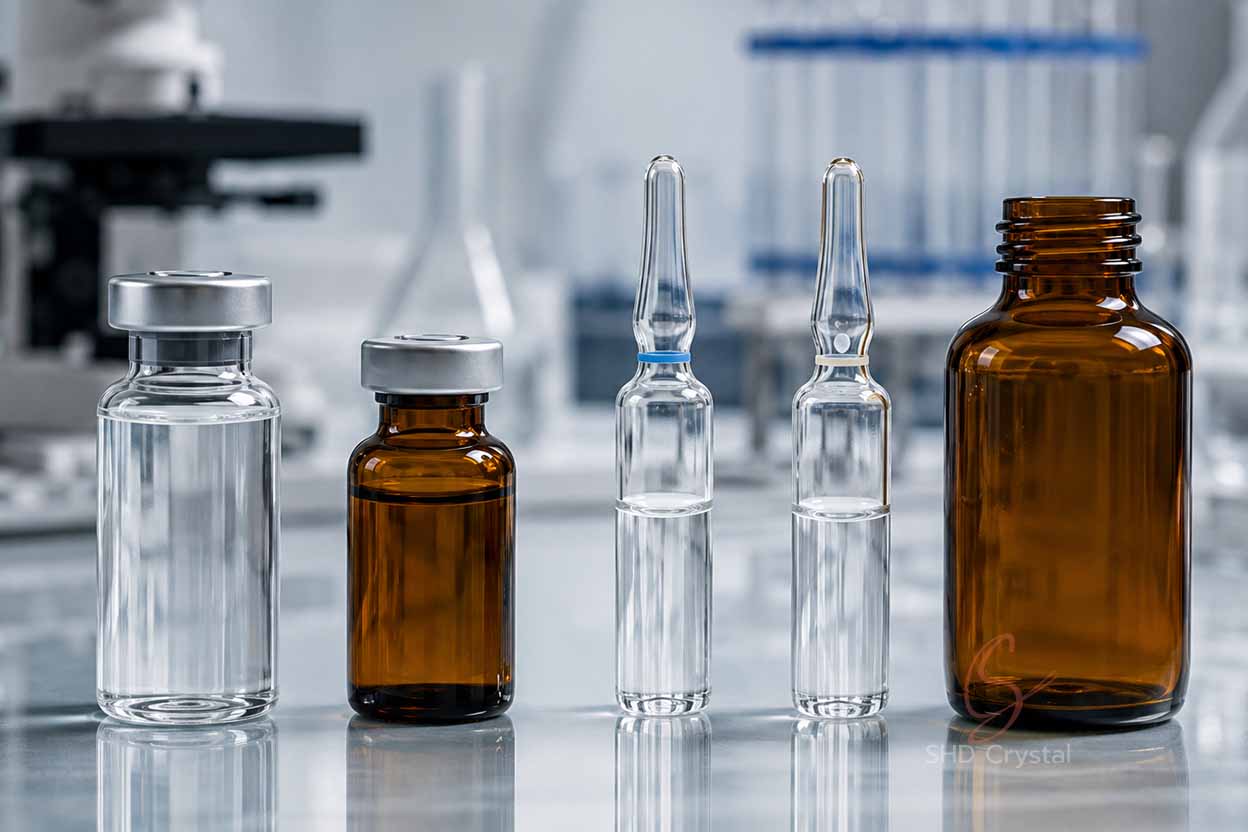
Type II glass starts with soda-lime-silica glass but receives an internal surface treatment that raises its hydrolytic resistance. According to USP guidance, containers meeting Type II performance are suitable for many acidic and neutral aqueous pharmaceutical products.
Type III glass is untreated soda-lime-silica glass with more moderate hydrolytic resistance. It can still be useful for less demanding applications, including various nonparenteral medicines and molded pharmaceutical bottles. However, USP notes that Type III containers are generally not used for parenteral products unless appropriate stability data demonstrate suitability.
This hierarchy is important for custom glass medicine bottles because it shows that “better glass” is not simply a matter of transparency or price. The material has to match the medicine and its storage conditions.
Pharmaceutical Glass Vials Require More Than a Small Bottle Shape
pharmaceutical glass vials are commonly used for injectable formulations, vaccines, biologics, lyophilized products, and other medicines that require controlled primary packaging. Many are produced from Type I borosilicate tubing. Glass tubing is converted into individual vials through controlled hot forming, with the shoulder, neck, flange, body, and bottom developed to precise dimensions. This dimensional accuracy matters during fill-and-finish operations. Stopper fit, sealing performance, vial movement through automated filling equipment, and container closure integrity can all be affected by dimensional variation. Modern pharmaceutical vial systems therefore place considerable emphasis on uniform geometry and controlled glass surfaces.
The inner surface is becoming increasingly important as pharmaceutical formulations become more complex. A container may meet a broad material classification while still requiring additional evaluation for a particular formulation, especially when highly sensitive biologics or challenging pH conditions are involved.
Glass Ampoules Follow a Different Production Logic
glass ampoules are another familiar pharmaceutical format, but they operate very differently from conventional bottles. An ampoule is generally produced from pharmaceutical glass tubing. During production, the tube is heated and shaped into the body and neck before the container is prepared for filling and final sealing. The finished ampoule creates a closed glass system that protects the formulation until the neck is opened at the point of use.
Type I borosilicate glass is widely used because its chemical resistance is well suited to sensitive medicines. Commercial pharmaceutical ampoules also require tight dimensional control to support filling, sealing, inspection, and predictable opening behavior. This makes neck geometry particularly important. An ampoule must be strong enough to survive filling, transport, and storage while still allowing controlled opening when required.
The engineering challenge is quite different from producing a decorative bottle with a screw cap.
Molded Medicine Bottles Can Use a Broader Material Range
Larger custom glass medicine bottles, including containers for syrups, oral solutions, tablets, or other healthcare preparations, are more commonly associated with molded glass production.
Molten glass is portioned and formed inside molds to create the body, shoulder, base, and neck finish. Depending on the product and applicable requirements, soda-lime-silica or other suitable pharmaceutical glass compositions may be used. Here, production variables such as gob weight, forming temperature, wall thickness distribution, mold tolerance, neck dimensions, and annealing conditions affect consistency.
The bottle also has to work with the complete packaging system. Screw caps, measuring closures, droppers, tamper-evident components, labels, and cartons all depend on stable bottle dimensions.
Amber Glass Solves a Different Problem
Glass type and glass color should not be confused. A bottle being amber does not automatically tell the buyer whether it is Type I, Type II, or Type III. Amber coloration addresses another packaging requirement: light protection.
Light-sensitive formulations can degrade when exposed to ultraviolet or short-wavelength visible light. Properly specified amber pharmaceutical glass can therefore reduce relevant light transmission while maintaining the other material properties required by the application. Current amber Type I borosilicate vial systems, for example, are designed to meet USP, European Pharmacopoeia, and Japanese Pharmacopoeia light-transmission requirements.
For custom glass medicine bottles, the decision is therefore not simply “clear or amber.” buyers may need to answer two separate questions:
- What level of chemical and hydrolytic resistance does the medicine require?
- Does the formulation also need protection from particular wavelengths of light?
A light-sensitive injectable might therefore require an amber Type I vial, while an oral medicine with different stability requirements could use another glass composition and package design.
Interested in custom glassware or related products?
Contact our team to discuss your project requirements.
Pharmaceutical Glass Requirements Are Becoming More Application-Specific
Pharmaceutical glass standards are also evolving beyond a simple Type I versus Type II versus Type III discussion. USP has proposed revisions to <660> that would add materials such as aluminosilicate and quartz glass and update methods used to evaluate pharmaceutical glass composition and performance. The direction is significant. It reflects a broader movement toward evaluating how the glass actually interacts with the intended pharmaceutical product rather than relying only on a familiar material name.
Drug formulation, pH, sterilization conditions, filling process, storage duration, surface durability, extractable elements, and container closure performance can all influence the final packaging decision.
For buyers evaluating custom glass medicine bottles, this means material selection should begin with the application, not with a preset assumption that one glass category is automatically best for every medicine.
Production Control Connects the Material to the Finished Container
Choosing the correct glass composition is only the beginning:
For molded bottles, wall thickness transition, neck accuracy, body symmetry, base stability, mold condition, and annealing influence the finished package.
For pharmaceutical glass vials, tubing quality, hot-forming consistency, flange geometry, bottom formation, and dimensional tolerances become particularly important.
For glass ampoules, the neck profile, sealing area, break system, body dimensions, and cosmetic inspection require their own controls.
This explains why pharmaceutical packaging should be reviewed as a complete container system rather than as an attractive empty bottle.

Frequently Asked Questions About Pharmaceutical Glass
Q01-Is Type I Borosilicate Required for Every Medicine Bottle?
No. Type I borosilicate provides high hydrolytic resistance and is particularly important for many injectable and sensitive pharmaceutical applications. Type II and Type III glass can remain suitable for other drug products depending on formulation, intended use, stability data, and applicable pharmaceutical requirements.
Q02-Are Amber Pharmaceutical Bottles Always Borosilicate?
No. Amber describes the optical protection provided by the colored glass, not its pharmaceutical classification. The actual glass composition and hydrolytic performance should be confirmed separately.
Q03-What Is the Main Difference Between Vials and Ampoules?
pharmaceutical glass vials normally use a separate stopper and closure system, while ampoules are sealed as glass containers and opened by breaking a designed section of the neck. Their filling, sealing, dimensional, and opening requirements are therefore different.
Conclusion
custom glass medicine bottles cover a much wider technical range than their appearance suggests. Type I borosilicate supports many demanding injectable applications, Type II treated soda-lime glass provides high surface hydrolytic resistance for suitable formulations, and Type III glass remains useful for less demanding pharmaceutical applications. At the same time, pharmaceutical glass vials and glass ampoules introduce their own forming, sealing, inspection, and dimensional requirements.
The direction of pharmaceutical packaging is increasingly clear: material selection is becoming more closely connected with the medicine, its filling process, storage conditions, and drug-container interaction. A successful package therefore begins by understanding what the formulation requires from the glass.
Custom Glass Manufacturing Support From SHD Crystal
SHD Crystal supports custom glass medicine bottles and other custom glass product development through glass material evaluation, mold development, forming, annealing, surface finishing, dimensional inspection, and packaging coordination. Its broader manufacturing experience covers glass bottles as well as drinking vessels, serving ware, decorative glassware, and other customized glass products, allowing different structures and production requirements to be evaluated according to the intended application.
For regulated pharmaceutical primary packaging such as injectable vials and ampoules, buyers should additionally confirm that the selected material, production system, testing procedures, and supplier qualifications meet the applicable pharmacopeial and destination-market requirements. SHD Crystal focuses on combining practical customization support, stable glass manufacturing, and attentive project service with the goal of delivering products that meet agreed design and quality expectations.
Link to the first article published online: https://shdcrystal.com/blogs/custom-glass-medicine-bottles/