Blogpost keywords: custom whiskey bottle OEM, spirit bottle contract manufacturing, whiskey glass packaging OEM
Custom whiskey bottle OEM projects support spirit bottle contract manufacturing and whiskey glass packaging OEM with stable mold and QC control.
Custom Whiskey Bottle OEM Production Guide
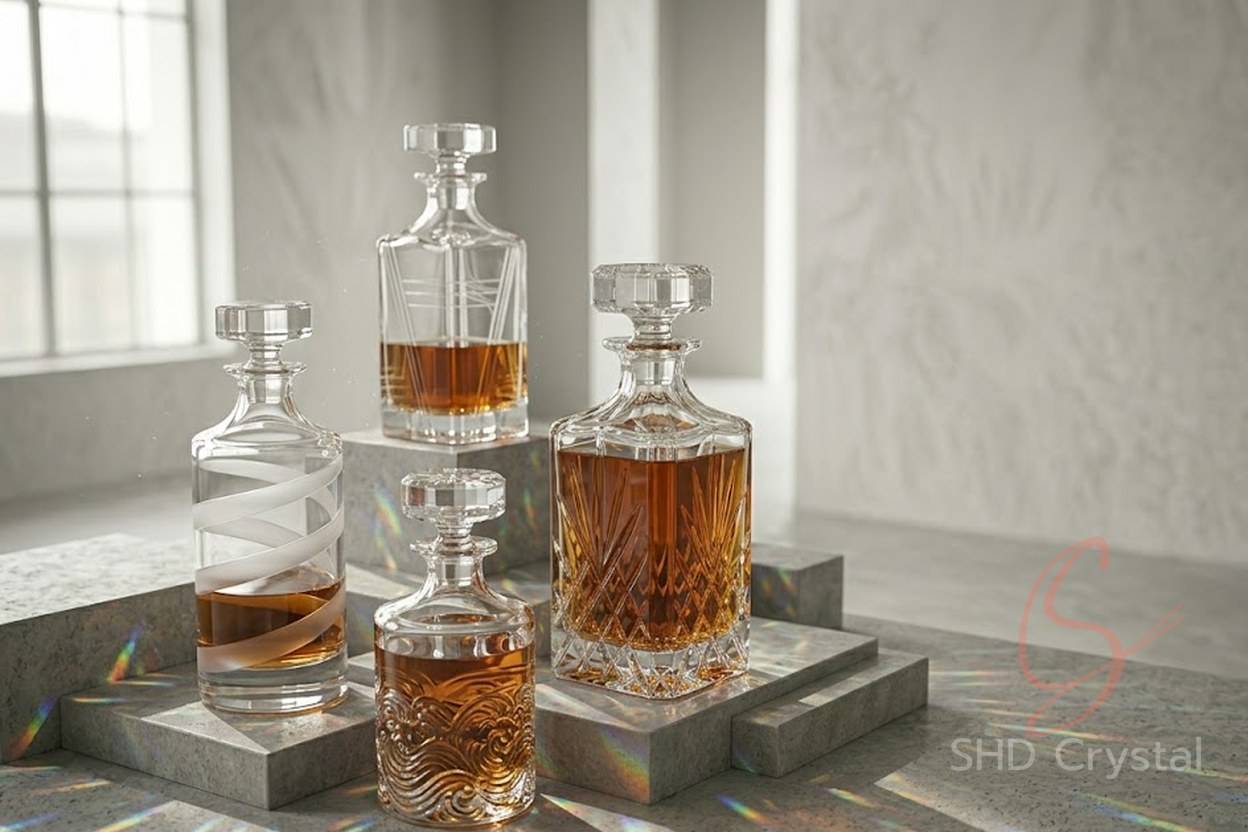
Custom whiskey bottle OEM is not just about producing a glass container. It is a coordinated manufacturing process that connects bottle design, mold engineering, glass forming, surface finishing, closure matching, labeling, and export packing into one controlled system. For spirits brands, distributors, and private label buyers, the success of a whiskey bottle project depends more on process stability than on a single sample appearance.
A bottle that looks perfect once is not enough. It must look the same every time.
That is where OEM control becomes critical.
Why Custom Whiskey Bottle OEM Needs Full Process Alignment
Custom whiskey bottle OEM begins long before production. The first stage is mold feasibility. A whiskey bottle often includes thick bases, sharp shoulders, embossed logos, or faceted bodies. Each of these elements affects how molten glass flows inside the mold and how stress is released during cooling.
In spirit bottle contract manufacturing, one of the most important hidden factors is wall thickness transition. If the base is too thick compared to the body, uneven cooling stress may appear during annealing. If the shoulder angle is too sharp, glass flow may become unstable during forming. These issues are not visible in CAD drawings, but they become obvious in mass production.
OEM buyers should understand that a visually strong design must still survive industrial reality.
Mold, Sample, and Repeat Production Stability
Whiskey glass packaging OEM projects rely heavily on mold accuracy. A small deviation in neck diameter or base alignment can affect closure fit, labeling position, and carton stability. That is why pilot samples are not just for approval—they are for testing repeatability.
A common mistake is approving a single “perfect” sample without checking batch variation. In real production, slight differences in glass weight, cooling behavior, and polishing pressure can appear. If the OEM system is not controlled, these variations can accumulate and affect brand consistency.
Spirit bottle contract manufacturing should therefore include multiple-stage sampling: pre-form, trial mold, production sample, and bulk verification.
Decoration, Closure, and Filling Line Compatibility
Custom whiskey bottle OEM projects often include embossing, frosting, spraying, metallic coating, or silk printing. Each decoration method introduces its own tolerance range. For example, deep embossing improves brand identity but increases mold complexity. Spray coating improves visual depth but requires strict color control across batches.
Closure compatibility is another key point. Cork stoppers, bar-top caps, and screw closures must match neck finish precisely. Even a small mismatch can affect sealing performance or filling line efficiency.
Whiskey glass packaging OEM should always test bottle + closure + filling line together, not separately. This avoids late-stage surprises during mass production.
Packaging and Export Control
OEM production does not end at glass manufacturing. Export packaging is part of the system. Whiskey bottles are often heavy, especially with thick bases or embossed designs. That increases the need for stable inner dividers, compression-resistant cartons, and pallet optimization.
If packaging is too loose, bottles may collide and damage embossed surfaces. If packaging is too tight, stress may transfer to the neck or shoulder during transport. A balanced structure must be tested with real filled weight, not empty bottles.
For repeat orders, packaging consistency is as important as glass consistency. Any change in insert design, carton strength, or stacking pattern may affect downstream logistics.
Conclusion
Custom whiskey bottle OEM success depends on full process coordination. Mold design, wall thickness control, sample validation, decoration stability, closure matching, and export packaging must work as one system. When these elements are aligned, the bottle is not only visually strong but also production-stable and repeatable at scale.
Building a Stable Whiskey OEM Supply System
For spirits brands and distributors working on spirit bottle contract manufacturing or whiskey glass packaging OEM, custom whiskey bottle OEM becomes reliable when suppliers manage engineering, sampling, decoration, and packaging as a unified workflow. This reduces batch variation and ensures the bottle maintains the same identity from first sample to long-term production.
Read the original article on custom crystal glass manufacturing:https://shdcrystal.com/blogs/custom-whiskey-bottle-oem/